


For years, insurance had a reputation for being slow to change—and to be fair, there were good reasons for that. Insurers deal with sensitive customer data, complex policies, strict regulations, and serious financial risk, so caution has always been part of the business.
But the market has moved on. That’s why insurance technology is moving more and more towards connected platforms. Instead of each function living in its own small “silo,” modern insurers, brokers, and partners want an environment where data flows faster, processes are automated, and the client receives a service that seems simple, personalized, and available at the right moment.
From Isolated Systems to a Connected Ecosystem
Traditional insurance software was often created gradually. The company would first introduce one system for policies, then another for claims, a third for documentation, a fourth for CRM, and additional tools for compliance, analytics, or communication with agents. On paper, each tool solves one problem. In practice, however, employees must manually transfer information, check for duplicates, and search for data across multiple systems.
The connected platform works differently. It unifies key processes or at least easily integrates with other tools via APIs. This means that a broker, underwriter, agent or customer support can see relevant information in one place. When the policy status changes, when a customer reports a claim, or when a new risk emerges, the system can automatically initiate the next step.
That is why more and more attention is paid to solutions such as insurance management software, because they are no longer just a “digital drawer” for documents. They become the operational basis for sales, customer service, partner management, and decision-making.
The Client No Longer Compares an Insurer Only With Another Insurer
One of the biggest pressures on insurers comes from rising customer expectations. People now compare insurance experiences with banking apps, online stores, delivery services, and other digital platforms they use every day.
They expect insurance to be clearer, faster, and easier to manage. While risk remains complex, the process should not feel confusing or slow.
Connected platforms help a lot by bringing together important information in one place—customer history, previous claims, data from connected devices, communication with agents, as well as external sources like weather risks or vehicle data. When an insurer has a bigger picture, it can offer protection that really suits the client’s needs, rather than a one-size-fits-all product.
Personalization Is No Longer Just a Marketing Buzzword
Allianz notes that connected platforms are making insurance far more personalized, especially in auto, health, property, and commercial coverage.
Telematics allows the price of auto insurance to be formed according to the actual behavior of the driver, and not just according to general data. On the other hand, smart sensors in homes and businesses can detect water leaks, fire risks or equipment failure in time, before more damage occurs.
This marks a major change: insurers are moving from passive claim response to active risk reduction. To do that, they need connected data, faster processing, and systems that work together.
Recent research also shows this is not just a tech trend. Insurers are modernizing core systems, moving to the cloud, automating processes, and improving data management to meet profitability, regulatory, and customer demands
Brokers and Partners Are Getting a Bigger Role
Another key reason for the move to platforms is changing distribution. Insurance is now sold through brokers, agencies, banks, digital marketplaces, embedded models, and partner networks. With so many participants, disconnected systems quickly slow everything down.
Connected platforms give brokers and partners access to accurate, up-to-date information on products, policies, commissions, and documents. This reduces manual work, errors, and delays.
At the same time, good platforms protect data with clear permissions, audit trails, and security rules. Collaboration becomes faster and more controlled, instead of relying on spreadsheets, emails, and phone checks.
Data Is Becoming the Most Important Infrastructure
In insurance, data has always been important, but today it is becoming the central infrastructure of the business. Without quality, connected data, it is difficult to develop artificial intelligence, automate underwriting, detect fraud, or personalize offers.
However, the amount of data alone is not enough. If data is scattered, out of date, or out of sync, it can even create more problems than good. That’s why connected platforms are not just a technological trend but a way to bring order to data and processes.
The Future of Insurance Will Be Connected or Too Slow
In the coming years, insurers who only offer the cheapest policy will not have the advantage, but those who can quickly assess the situation, involve the right partners and react when it is most important to the client.
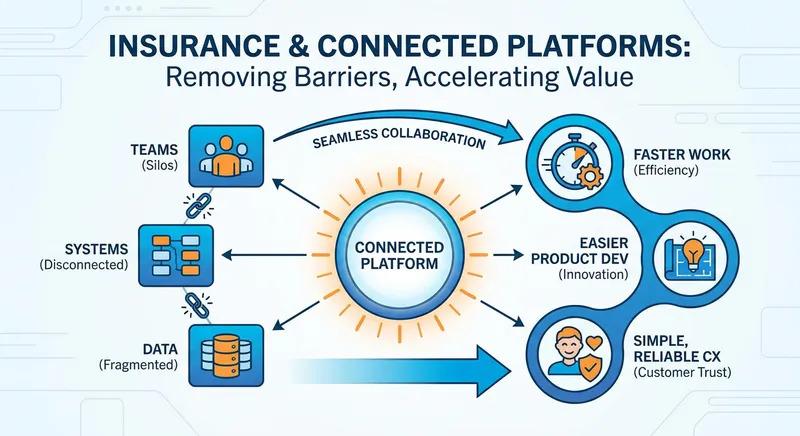
That’s why connected platforms are becoming so important. They remove barriers between teams, systems and data, so insurers can work faster, develop new products more easily and provide customers with an experience that feels simple and reliable.
Companies that stay on old, disconnected tools will feel the pressure more and more. The market is changing, risks are becoming more complex, and users are expecting more. This is why insurance must move from scattered processes to one connected way of working.