


Most developers think splitting code into folders or classes is enough. It isn’t. Modularity runs deeper than physical separation.
What actually makes a system modular comes down to two structural properties, and most explanations never get there.
Understanding those properties entirely changes how you read, write, and evaluate software design decisions.
Here you’ll find a clear breakdown of what software modularity really means, what makes it work, and where it quietly breaks down.
What Do People Get Wrong About Modularity Before They Understand It?
Modularity is not the same as splitting code into files. That distinction matters more than it sounds.
Most developers start by separating code into folders, classes, or named components. It feels like modularity. But physical separation and structural independence are two different things.
A system can have fifty neatly named units and still fall apart when you change one. If each unit reaches into the internal state of the others, they’re not independent. They’re just spread out. The separation is cosmetic.
Modularity isn’t measured by how many pieces you’ve created. It’s measured by the quality of the relationships between those pieces.
How tightly are they connected? Can one change without forcing changes in the others? Those questions tell you whether a system is actually modular, not the file count.
What is Software Modularity?

Software modularity is a design property that describes how well a system is broken into units, each with a defined interface and a hidden internal implementation.
Both conditions matter. Not just one.
The interface is what the rest of the system sees and uses. The internal implementation is everything behind it: the logic, the state, the decisions. Other modules don’t touch that part. They interact through the interface only.
That boundary is what makes change safe.
When a module’s interface stays stable, you can rewrite everything inside it. The rest of the system doesn’t notice. Nothing depended on the internals, only on the interface.
Remove either condition, and that guarantee disappears. No defined interface means the implementation leaks out. Exposed internals mean invisible dependencies form throughout the system.
Modularity is about enforcing that boundary, by design, not by convention.
This idea has a name: information hiding. David Parnas formalized it in 1972, arguing that each module should hide one design decision from the rest of the system. The principle hasn’t changed. Most modularity problems today trace back to violating it.
What Structural Properties Make a Module Actually Independent?
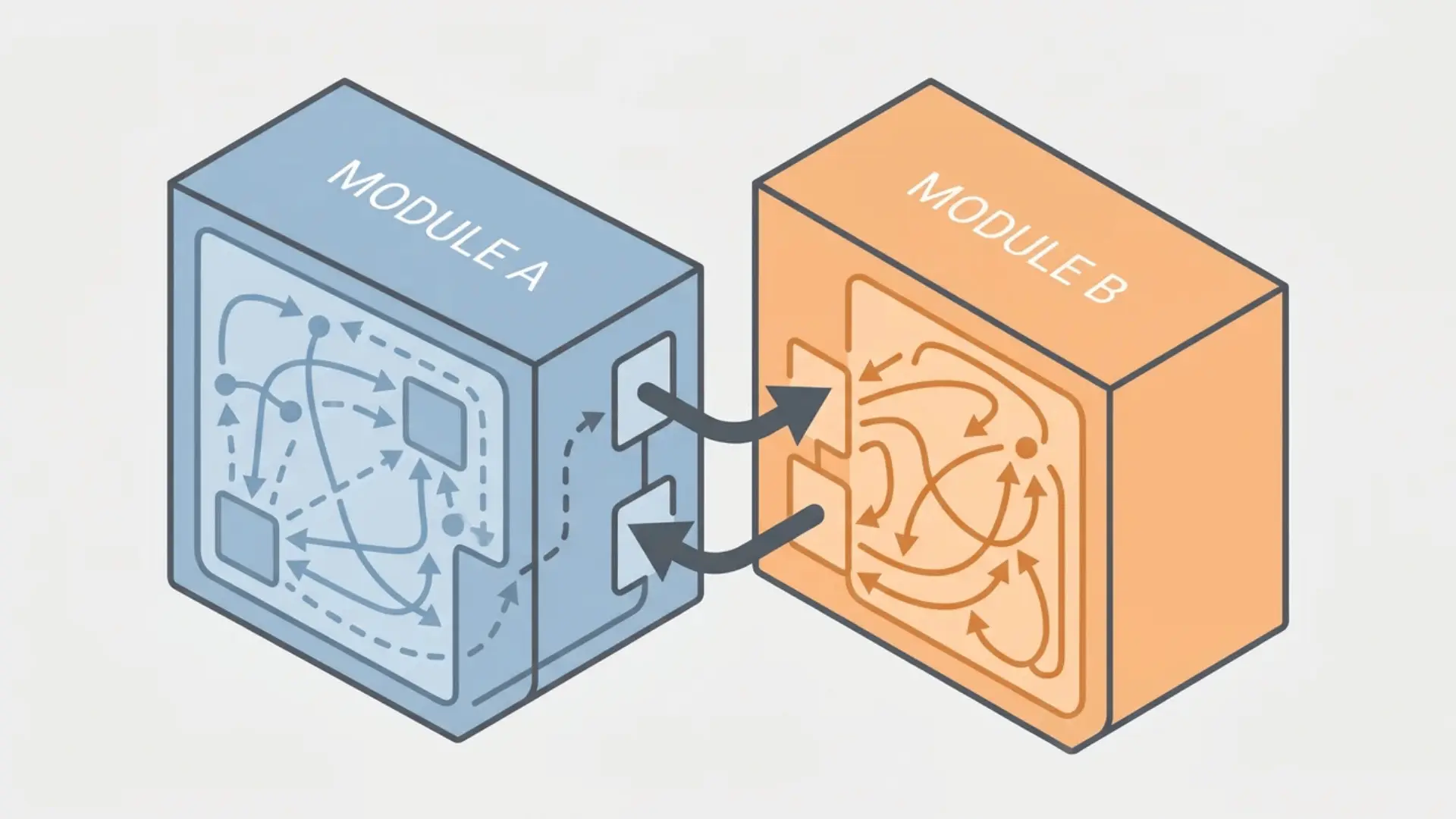
A module’s independence comes from two structural conditions: cohesion and coupling, and neither is sufficient on its own.
Most explanations treat them as separate ideas to optimize individually. They’re not. They work together, and understanding why changes how you think about module boundaries entirely.
Cohesion: What it Means for a Module to Have One Job
Cohesion describes how well a module’s internal elements belong together. A high-cohesion module has one clearly bounded purpose. Everything inside it serves that purpose and nothing else.
A quick test: try describing what a module does in one sentence. If that sentence needs the word “and,” the module is probably doing too much.
Low cohesion looks tidy on the surface. The module has a name and a boundary. But internally, it’s handling several loosely related things. That blur has direct consequences for how the module connects to everything around it.
When a module can’t stand on its own, it starts borrowing. It reaches into other modules to fill what’s missing. That’s where coupling problems start, not in the dependencies themselves, but in the blurred purpose that made them necessary.
Coupling: How Dependencies Between Modules Are Controlled
Coupling describes how much one module depends on another. Low coupling means dependencies are controlled, routed through interfaces rather than direct access to another module’s internals.
High coupling happens when that boundary breaks. The three patterns that cause it most often are:
- One module relies on another’s internal state or logic directly
- A change inside one forces changes in the other
- The interface exists on paper, but enforces nothing in practice
A common example: a
UserServicethat queries the database directly instead of going through a repository interface. Any change to the schema forces a change inUserService, even though the service has nothing to do with persistence. The interface existed, but the boundary didn’t hold.
Why the Two Properties Are Linked, Not Separate
Tight coupling is usually a symptom of low cohesion, not a separate problem. When a module’s purpose is blurred, it can’t complete its work on its own. It reaches into other modules to fill the gaps. That reaching is coupling.
This plays out in a pattern that comes up repeatedly in teams:
- Boundaries are drawn around implementation layers; all database logic sits in one shared module
- Cohesion looks clean from the outside
- But every feature depends on that shared layer, so any change breaks everything touching it
The boundary needs to follow functional responsibility, not implementation type. Get that right, and both properties tend to fall into place together.
What Changes when a System is Genuinely Modular?

The outcomes of a modular system aren’t separate advantages. They follow directly from the structural properties that make modularity real. Here’s what each one actually means in practice:
- Maintainability: The interface contract absorbs change. You fix one module without touching anything else in the system.
- Reusability: A high-cohesion module can be dropped into another project as-is. A low-cohesion one brings its dependencies with it; you can’t take the part you need without also taking the parts it shouldn’t have owned.
- Parallel development: Stable interfaces let teams build and test independently. One team’s decisions don’t silently break another’s.
- Scalability: Low coupling at the code level isn’t enough. If two modules share a data layer, they aren’t truly independent, regardless of how clean the code looks.
These outcomes don’t come from modularity as a concept. They come from whether the structural properties, interface contracts, cohesion, and coupling are actually enforced.
How Do You Apply These Properties in Practice?
Understanding cohesion and coupling is one thing. Knowing where to draw the line in your actual code is another.
Three checks will surface most modularity problems without a full architecture review.
Write a one-sentence purpose statement.
Before creating a module boundary, describe what that module does in one sentence. If the sentence needs “and,” the module is likely doing too much.
Audit your dependencies.
List everything a module imports or calls. If it’s reaching into another module’s internal logic rather than its public interface, that’s a coupling problem, not a style preference.
Check for change amplification.
Pick any recent bug fix or feature addition. Count how many files you had to touch. If changes in one area consistently ripple into unrelated areas, your boundaries are following implementation layers, not responsibility.
Run those three checks on one module in your current system. Most teams find at least one clear boundary problem on the first pass.
Wrapping Up
Software modularity isn’t a feature you switch on. It’s a structural property you either build in or you don’t.
The difference between a modular system and a divided one comes down to cohesion, coupling, and interface contracts.
Now you know what those properties actually mean and why each one depends on the others.
Start with one module. Ask whether its boundary follows responsibility or convenience. That question alone will tell you a lot.
Frequently Asked Questions
What is the difference between modularity and microservices?
Modularity is a design principle at any scale. Microservices apply it at the service level. A microservices system can still be poorly modular if boundaries are drawn incorrectly.
What makes a module different from a class or a function?
A class or function is a language construct. A module is an architectural unit with a defined boundary that explicitly hides its internal implementation from the rest of the system.
Can a system have too many modules?
Yes. Over-decomposition creates coordination overhead, more interfaces to maintain, and more points at which failures can occur. Granularity should match the size of responsibility, not a target module count.
How do you know if existing code lacks modularity?
The clearest signal is change amplification; modifying one part forces changes in unrelated others. Difficulty testing units in isolation is another reliable indicator.