


Your Apple Watch can give you a VO2 max number that looks exact, even though it never measures the oxygen moving through your lungs. That can make the score feel more confusing than useful.
If your reading jumps after similar workouts or seems lower than expected. The VO2 max Apple Watch estimate depends on heart rate, pace, movement, workout type, and personal health data.
I’ll help you understand what feeds that number, why it can change, and how much trust to place in it. You’ll also learn how to read your Cardio Fitness trend so the score becomes something practical instead of another number to worry about.
What Cardio Fitness Means on Apple Watch
Cardio Fitness is Apple’s name for its VO2 max estimate. VO2 max represents the maximum amount of oxygen your body can use during exercise and is expressed in mL/kg/min.
A laboratory test measures this directly while you exercise wearing a respiratory mask. The equipment analyzes the oxygen you inhale and the gases you exhale as workout intensity increases.
Apple Watch takes a different approach. It uses heart rate, pace, movement, and workout data to predict what your oxygen use could be at maximum effort.
That distinction matters. The Watch is not trying to replace laboratory testing. It gives you a practical estimate you can collect repeatedly during normal outdoor workouts.
How Apple Watch Calculates VO2 Max
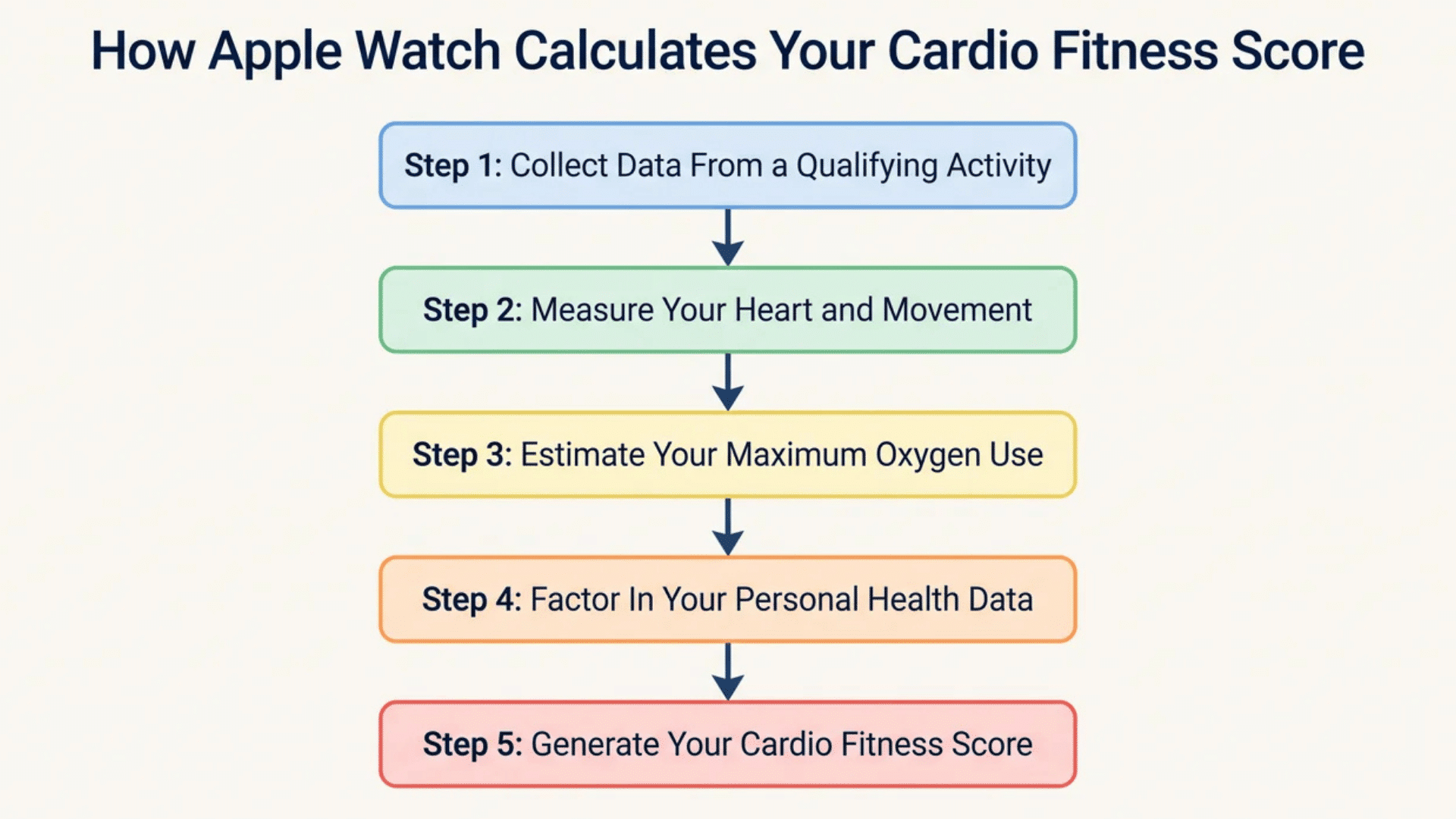
The calculation happens in several stages, not through a single sensor reading.
1. It Starts With a Qualifying Outdoor Workout
Apple Watch generates Cardio Fitness estimates primarily from:
- Outdoor Walk
- Outdoor Run
- Hiking
Indoor workouts, cycling, and strength training do not normally generate the same VO2 max estimate.
The Watch also needs usable heart-rate and movement data. Weak GPS reception, poor sensor contact, or inconsistent activity data can prevent a reading from being created.
2. It Compares Heart Rate With Movement
During the workout, Apple Watch combines data from its optical heart sensor, motion sensors, and GPS, a similar sensor mix to other wearables like fitness tracking rings, though each brand’s algorithm interprets that signal differently.
The key relationship is how hard your cardiovascular system appears to work relative to your pace and movement.
A lower heart rate at the same pace may suggest improved aerobic efficiency, while a higher heart rate can indicate greater cardiovascular effort.
3. It Predicts Maximum Oxygen Use
You do not need to exercise at your maximum heart rate for Apple Watch to estimate VO2 max.
Its algorithm uses submaximal exercise data to predict what your aerobic capacity could be at a higher effort level.
That prediction is why the number can differ from a laboratory test. The Watch is modeling oxygen use rather than measuring it directly.
4. It Adds Personal Health Information
Apple also considers data stored in the Health app, including:
- Age
- Sex
- Height
- Weight
- Heart-rate-affecting medications you have logged
These factors help the algorithm interpret the same workout differently for different people. Keeping your Health profile accurate is therefore important if you want more meaningful Cardio Fitness estimates.
5. It Creates Your Cardio Fitness Score
Once Apple has enough usable data, the Watch generates an estimated VO2 max value in mL/kg/min.
Apple Watch supports values between 14 and 65 mL/kg/min. For users age 20 and older, the Health app also compares the result with age- and sex-based Cardio Fitness classifications.
You can find Apple’s current details on its Cardio Fitness support page.
How to Find Your VO2 Max in the Health App
You can view your Cardio Fitness score on the paired iPhone rather than relying on the Watch screen.
- Open the Health app.
- Tap Browse.
- Select Heart.
- Tap Cardio Fitness.
The Health app also shows longer-term trends, which are more useful than one isolated result. Instead of checking only the latest number, compare your weekly, monthly, six-month, and yearly patterns.
How to Interpret Your Cardio Fitness Score
No single VO2 max number counts as good for everyone. Apple compares your result with people in the same age and sex category, which gives the number more context.
| What to Check | What It Tells You |
|---|---|
| VO2 max value | Your estimated aerobic capacity in mL/kg/min |
| Cardio Fitness category | How your score compares with your age and sex group |
| Current trend | Whether your estimate is rising, stable, or declining |
| Long-term average | A more useful fitness signal than one workout result |
Treat a single score as a snapshot. The trend is more useful because it smooths out day-to-day variation caused by weather, recovery, terrain, heart rate, or GPS accuracy.
Why Your Apple Watch VO2 Max May Look Low
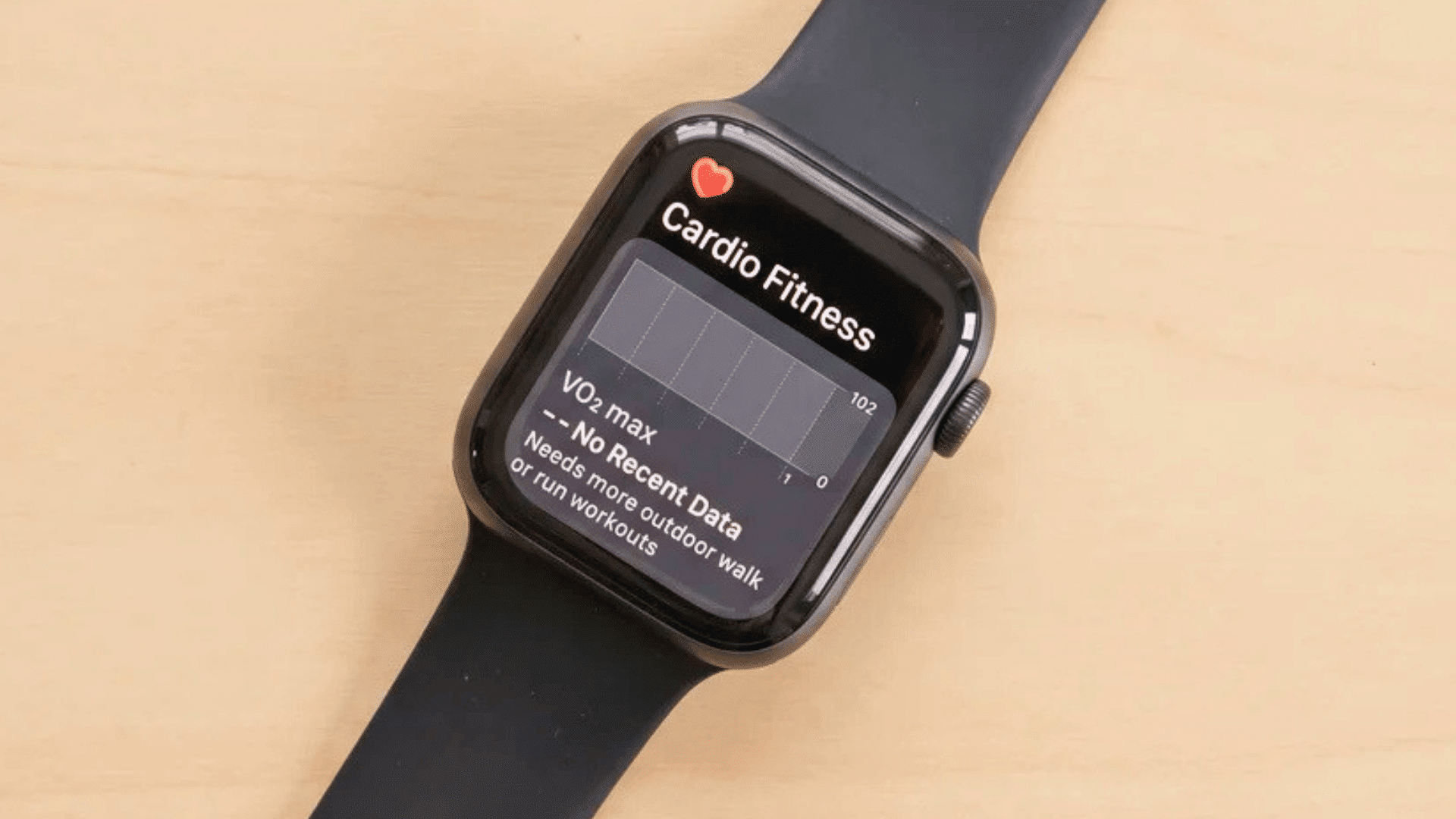
A lower-than-expected reading doesn’t always mean your cardiovascular fitness suddenly got worse.
Several factors can influence the estimate.
- Higher heart rate: Heat, fatigue, stress, dehydration, or poor recovery can push your heart rate higher at the same pace.
- Different terrain: Hills can increase effort without producing the same pace relationship Apple expects.
- Poor GPS reception: Inaccurate speed or distance data can affect the estimate.
- Incorrect Health profile: Outdated height, weight, age, or medication information can distort the calculation.
- Running or walking efficiency: People with similar true VO2 max values may move at different levels of efficiency.
The most useful response to one low reading is usually to look at the surrounding trend rather than react to the number itself.
Why Apple Watch May Not Record VO2 Max
A missing reading is often easier to explain than a low one.
The most common reason is workout type. Indoor sessions, cycling, and strength training typically don’t produce Cardio Fitness estimates.
GPS and heart-rate data also matter. A loose Watch, poor satellite reception, or incomplete movement data can interrupt the calculation.
Age is another factor. Apple provides Cardio Fitness classifications for users aged 20 and older, as explained on its support page.
If readings stop appearing, check the workout type, Watch Fit, location services, and Health profile before assuming anything has changed with your fitness.
How Accurate Is Apple Watch VO2 Max?
Apple Watch VO2 max is useful for tracking cardio fitness trends, but it should not be treated as a clinical measurement. Research shows that the Watch can underestimate VO2 max, with accuracy varying between individuals.
The 2026 study “Accuracy of VO2 Max Estimates From Apple Watch Series 10” found an average underestimation of 6.25 mL/kg/min, with a 13.2% mean absolute percentage error.
The 2025 study “Investigating the Accuracy of Apple Watch VO2 Max Measurements: A Validation Study” reported an average underestimation of 6.07 mL/kg/min and 13.31% error.
Both studies also found considerable variation between individuals. That means you cannot simply add six points to your Watch reading to estimate a laboratory result. Your personal difference may be smaller or larger.
For everyday fitness tracking, focus on consistent workout conditions and long-term trends rather than treating a single VO2 max reading as an exact measurement.
Why Apple Watch and Lab VO2 Max Can Differ
The two methods don’t measure fitness in the same way.
A laboratory VO2 max test directly analyzes respiratory gases as exercise intensity increases. Apple Watch predicts VO2 max indirectly using cardiovascular and movement data.
Running economy can also affect the result. Two people can have similar aerobic capacity but require different amounts of energy to maintain the same pace.
Heart-rate response varies as well. Temperature, hydration, medication, stress, fatigue, and genetics can all influence heart rate independently of VO2 max.
That is why a Watch estimate can be useful without perfectly matching a laboratory result.
The Best Way to Use Apple Watch, VO2 Max
Treat Cardio Fitness as a long-term tracking tool rather than a score you need to improve after every workout. A reading of 38 one day and 40 the next does not automatically mean your aerobic fitness changed.
More useful questions are:
- Has the monthly average increased?
- Is the six-month trend moving upward?
- Are similar workouts becoming easier?
- Is your pace improving at a similar heart rate?
Those patterns provide more context than chasing small fluctuations between individual readings.
Closing Thoughts
Your Apple Watch is most useful when you treat Cardio Fitness as a trend, not a fixed fitness grade.
The VO2 max Apple Watch score can shift with heart rate, GPS quality, terrain, workout type, and the personal data stored in Health.
I’d focus on patterns across several weeks instead of reacting to one unusual reading. That gives you a clearer view of whether your aerobic fitness is improving, holding steady, or moving in the wrong direction.
Keep your profile updated, use qualifying outdoor workouts, and compare similar sessions over time. If this helped you understand your score better, check your latest Cardio Fitness trend and share what you notice.
Frequently Asked Questions
How do I get my VO2 max on Apple Watch?
Record eligible Outdoor Walk, Outdoor Run, or Hiking workouts while wearing your Apple Watch. Once enough valid heart-rate, movement, and GPS data is available, the estimate appears under Cardio Fitness in the iPhone Health app.
What is a good VO2 max score on Apple Watch?
There is no universal good score. Apple compares your VO2 max estimate with reference ranges for your age and sex, so the Cardio Fitness category provides better context than the number alone.
Are Apple Watches accurate for VO2 max?
Apple Watch is useful for monitoring VO2 max trends, but it is less precise than laboratory testing because it estimates oxygen use from heart rate, pace, movement, and personal data.
Why is my VO2 max low even though I exercise?
Your score can appear low if most of your training is indoors, cycling, or strength-based. Heat, fatigue, hills, inaccurate profile data, GPS quality, and individual exercise efficiency can also influence the estimate.