

You’ve probably seen a robotic arm on an assembly line, a drone delivering packages, or a surgical robot in a news segment.
But here’s what most people don’t realize: those aren’t just different robots. They’re entirely different categories, built on different logic, for different purposes.
Not all robots move the same way, think the same way, or do the same kind of work.
The types of robots that exist today span everything from warehouse navigation to open-heart surgery, and understanding the differences tells you a lot about how this technology actually works.
Here, you’ll learn how robots are classified, what makes each type unique, and where they show up in the real world. Let’s get into it.
How Robots are Classified
There isn’t one “official” list of robot types. Different industries group robots in different ways depending on what matters most to them. If you’re just getting started, there are some robot facts worth knowing that make the classification logic a lot easier to follow.
That said, most classification systems come down to three key factors:
- Structure: the physical design of the robot
- Mobility: how it moves through space
- Function or control: how it operates and makes decisions
One robot can belong to more than one category.
A robot used in surgery, for example, might also be autonomous and mobile. Its label depends on the design and the task it’s built for.
Understanding these three factors is the key to making sense of any robot you come across, no matter how it looks or what it does.
Types of Robots Explained with Examples
Different types of robots are built for different tasks. Each type has a unique design, way of working, and use case. Let’s look at the most common robot types with examples.
Industrial Robots
Industrial robots are among the most well-known. They are classified mainly by their mechanical structure and the number of axes they move on.
More axes mean more flexibility. These robots excel at precision, speed, and repetition in controlled environments like factories. However, they struggle outside those structured settings.
1. Articulated Robots
Articulated robots have multiple joints, usually between 4 and 7 axes. This design mimics the movement of a human arm.
Each additional axis gives the robot more range of motion. A 6-axis articulated robot can move in almost any direction, which makes it one of the most versatile options in manufacturing.
- Best used for: welding, painting, and heavy assembly
- Limitation: complex to program and costly to set up
2. SCARA Robots
SCARA stands for Selective Compliance Articulated Robot Arm. These robots are rigid vertically but flexible horizontally. That combination makes them ideal for tasks where parts need to be inserted from above with speed and accuracy.
- Best used for: electronics assembly, packaging, and pick-and-place
- Limitation: limited vertical flexibility; can’t reach around or inside objects easily
3. Delta Robots
Delta robots use a parallel arm structure connected to a fixed base. Their lightweight build allows for extremely fast movement, faster than most other robot types.
- Best used for: high-speed sorting and pick-and-place in food and pharma production
- Limitation: low payload capacity; not built for heavy loads
4. Cartesian (Gantry) Robots
These robots move along three straight axes: X, Y, and Z. That linear motion gives them very high positional accuracy.
They’re typically mounted above the workspace, which saves floor space and allows them to handle a wide range of part sizes.
- Best used for: CNC machining, 3D printing, and large-scale assembly
- Limitation: bulky build; can’t reach around obstacles
5. Collaborative Robots (Cobots)
Cobots are designed to work right next to people. Most industrial robots need a caged-off area to operate safely. Cobots don’t.
They use built-in force sensors and cameras to detect nearby humans and slow down or stop before any contact. That makes them practical wherever a human and a robot need to share the same workspace without a physical barrier.
- Best used for: assembly lines, quality inspection, and light material handling alongside workers
- Limitation: slower speeds and lower payload capacity than traditional industrial robots
Mobile Robots
Mobile robots are classified by how they navigate. They use sensors, software, and sometimes AI to move through their environment.
The key difference from industrial robots is adaptability. Mobile robots are designed to operate in dynamic, real-world spaces. That said, navigation errors in unpredictable conditions remain a challenge.
6. Autonomous Mobile Robots (AMRs)
AMRs use sensors and artificial intelligence to navigate on their own. They don’t need fixed paths — they build a map of their environment and update it in real time.
If something blocks their route, they find a new one. That makes them far more flexible than older guided systems.
- Best used for: warehouses, hospitals, and logistics
- Limitation: can struggle in highly cluttered or unpredictable environments
7. Automated Guided Vehicles (AGVs)
AGVs follow fixed paths, usually magnetic lines or embedded tracks on the floor. They are reliable and consistent because their routes never change.
- Best used for: manufacturing plants, warehouses, and distribution centers
- Limitation: can’t adapt when something blocks their path; require infrastructure setup
8. Legged Robots
These robots walk using mechanical legs. That design lets them handle uneven terrain, stairs, and rough ground that wheels can’t manage.
- Best used for: search and rescue, military operations, and rough terrain exploration
- Limitation: consume significantly more energy than wheeled alternatives
9. Aerial Robots (Drones)
Drones fly using propellers and onboard navigation systems. Their ability to operate from the air makes them ideal for wide-area tasks without ground access.
- Best used for: surveillance, infrastructure inspection, and delivery
- Limitation: short battery life and sensitivity to weather conditions
Functional Robot Types
Some robots are classified by what they’re designed to do, not just how they’re built or how they move.
Task-specific design means these robots are highly efficient within their domain. But that specialization also limits how well they perform outside it.
10. Service Robots
Service robots perform everyday tasks for people, such as cleaning bots, food delivery robots, or concierge robots in hotels. They reduce manual effort and operate in human environments without barriers.
- Best used for: homes, hotels, restaurants, and public spaces
- Limitation: struggle with complex tasks that need human judgment
11. Medical Robots
Medical robots assist with surgeries, rehabilitation, or diagnostics. A well-known example is the da Vinci Surgical System, which allows surgeons to perform minimally invasive procedures with precision a human hand alone can’t match.
- Best used for: hospitals, surgical centers, and rehabilitation clinics
- Limitation: very high cost, and they still require human oversight throughout
12. Humanoid Robots
Humanoid robots are designed to look and move like humans. This makes them useful in environments built for human interaction; spaces where a human-shaped body actually matters for the task.
- Best used for: customer service, research labs, and assistive care settings
- Limitation: expensive to build and maintain, with limited practical use outside research and service roles
13. Educational Robots
Educational robots are built to teach coding and robotics concepts. They make hands-on learning accessible and engaging for students at different skill levels.
- Best used for: classrooms, coding camps, and STEM education programs
- Limitation: limited to structured learning environments and foundational skill levels
Robot Control Types
Beyond structure and function, robots also differ in how they’re controlled and how independently they operate.
The level of autonomy shapes how flexible and reliable a robot is. Higher autonomy brings more independence, but also more complexity to build and maintain.
14. Pre-Programmed Robots
These robots follow a fixed set of instructions. They do the same task the same way, every time. There’s no decision-making, just execution.
- Best for: repetitive manufacturing tasks that don’t change
- Limitation: zero adaptability if conditions shift
15. Autonomous Robots
Autonomous robots sense their environment and make decisions without human input. They use cameras, LIDAR, and onboard AI to determine what to do next, whether that’s navigating a space, identifying an object, or responding to something unexpected.
The key difference from pre-programmed robots: the robot chooses its own next action based on what it detects. It isn’t following a fixed script.
- Best for: dynamic environments where conditions change and constant human control isn’t practical
- Limitation: harder to predict and more expensive to develop than rule-based systems
16. Teleoperated Robots
Teleoperated robots are controlled in real time by a human operator from a distance. This makes them ideal for environments too dangerous for people to enter directly.
- Best used for: space exploration, underwater tasks, and bomb disposal
- Limitation: signal delay (latency) and full dependence on the operator’s skill and judgment
Why No Single “List of Robot Types” Exists
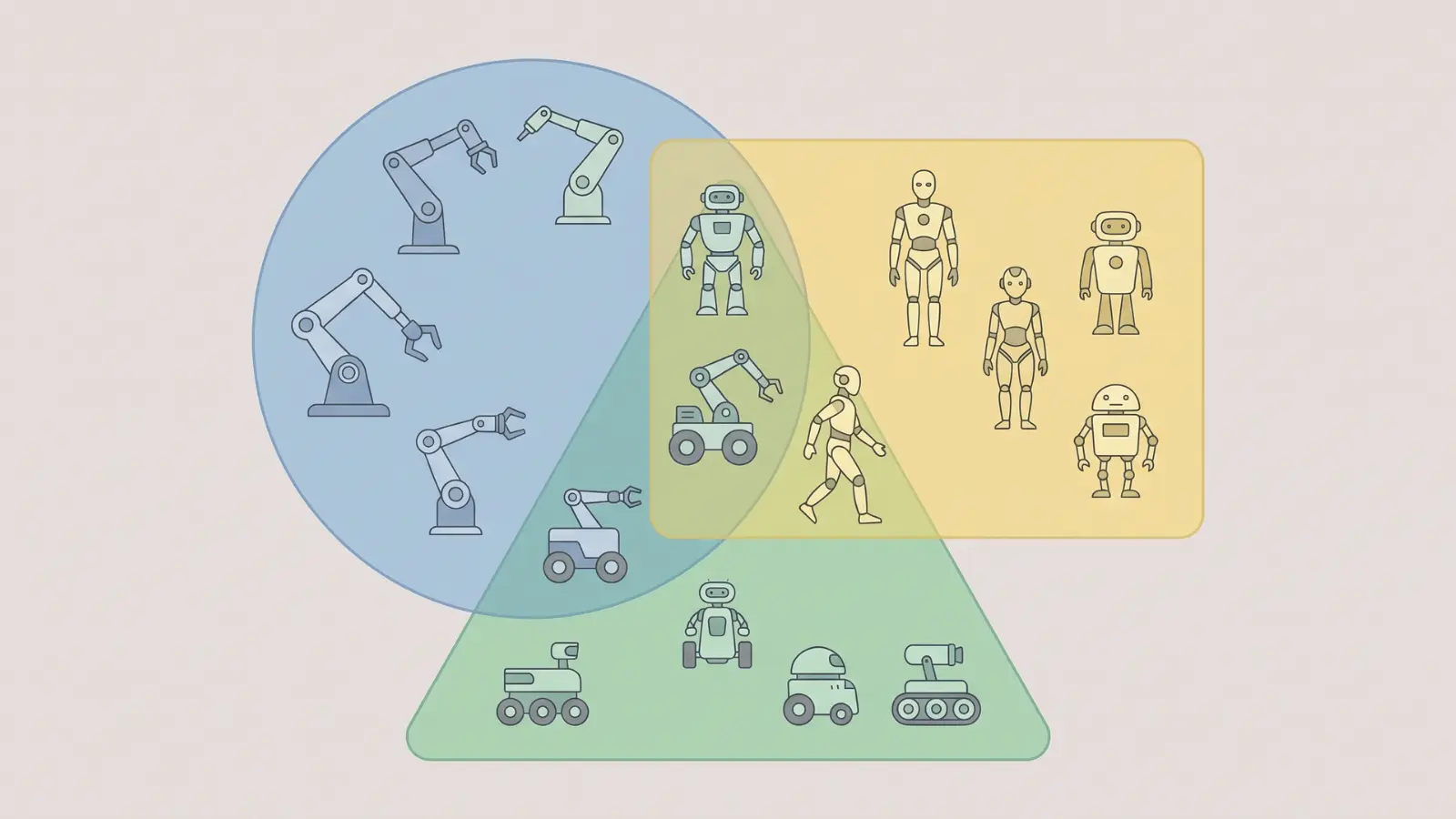
You’ll find countless “Top 5” or “Top 10” robot-type lists online. Most of them conflict with one another because there’s no universal standard.
The same robot can fit into multiple categories. A humanoid robot might also be autonomous. A medical robot might also be mobile.
Different industries classify robots based on what matters most to them: structure, task, or control. That’s why the most useful approach isn’t to memorize a list.
It’s to understand the logic: design, movement, function, and control. With that, any robot can be understood clearly.
Quick Summary of Robot Types
Here’s a fast recap of how robots are grouped:
| Classification Basis | Robot Types |
|---|---|
| Structure (industrial) | Articulated, SCARA, Delta, Cartesian |
| Movement (mobile) | AMR, AGV, Legged, Aerial |
| Application (functional) | Service, Medical, Humanoid, Educational |
| Control (behavior) | Pre-programmed, Autonomous, Teleoperated |
Every robot falls into at least one of these groups. Many fall into more than one.
Conclusion
Now you know that the types of robots aren’t just a random list; they follow a clear logic based on how they’re built, how they move, what they do, and how they think. Use this approach the next time you come across a new robot in the news or at work.
It’ll help you understand it instantly. One thing to remember: a robot’s category tells you its strength and its limits.
That’s the real value here. If you found this helpful, there’s a lot more to explore. Check out other posts on robotics, automation, and emerging tech to keep learning.
Frequently Asked Questions
What are robots made of?
Most robots are built using metal, plastic, and electronic components. They include sensors, motors, controllers, and software that help them sense, move, and perform tasks.
How do robots work step by step?
Robots follow a cycle: sensors collect data, the controller processes it, and actuators perform actions. This loop allows robots to respond to their environment continuously.
What is the difference between AI and robots?
Robots are physical machines, while AI is software that enables decision-making. A robot can work without AI, but AI helps robots act more intelligently and adapt.
Where are robots used in daily life?
Robots are used in homes, hospitals, factories, and public spaces. Common examples include vacuum robots, delivery bots, and automated machines in manufacturing.