


Many still see smart building technology as just a buzzword for high-tech gadgets, but it’s not about fancy devices; it’s about integrating systems to work together seamlessly.
Smart tech connects everything from HVAC to lighting and security, turning a building into an intelligent, responsive environment. In practice, this means that systems adjust in real-time, based on live data, to optimize energy use and occupant comfort.
However, the real challenge lies in getting these systems to communicate effectively; poor integration can lead to more problems than solutions.
Understanding how smart technology works together is key to making it truly efficient.
What Smart Building Technology Actually Means?
Smart building technology refers to a building that uses connected systems, real-time data, and automation to manage core operations such as HVAC, lighting, security, and energy usage.
These systems work together to adjust building performance automatically based on changing environmental and occupancy conditions.
In a traditional building, systems run independently using manual controls or fixed schedules. In a smart building, systems are integrated through a central platform that enables coordinated, data-driven decisions.
Smart building technology works through a continuous loop of sensing, analyzing, and responding.
Sensors gather data, software processes it, and systems adjust automatically in real time. This integration allows the building to function as a unified system rather than a collection of separate technologies.
The result is a structure that can monitor conditions continuously and optimize performance without constant human intervention.
How Smart Building Technology Works (Step-By-Step Flow)
Smart building technology follows a continuous flow that turns environmental changes into automated actions. Each step links data collection, analysis, and system response in real time.
Step 1: Data Collection Through Sensors
Sensors detect changes in temperature, occupancy, air quality, light, and motion. They convert these physical conditions into digital data for the control system.
If sensors are poorly placed or miscalibrated, the system receives inaccurate data. This can lead to wrong actions, such as cooling empty rooms.
Step 2: Data Transmission Through Networks
Sensor data moves through wired or wireless networks to central control platforms. These networks enable real-time communication between devices and systems.
Strong connectivity is essential for accurate automation. Delays or weak signals can slow or distort system responses.
Step 3: Processing Through BMS/BAS
The Building Management System (BMS) integrates major building subsystems into one platform. The Building Automation System (BAS) applies rules or AI to control operations.
These systems coordinate HVAC, lighting, and security functions. They ensure actions are synchronized across the building.
Step 4: Decision Making (Rules or AI)
The system decides actions using preset rules or AI models. Rule-based logic follows fixed conditions, while AI predicts patterns from past data.
This works because pattern recognition improves efficiency over time. Poor setup or bad data can produce incorrect decisions.
Step 5: Automated Action Execution
Once a decision is made, commands are sent to HVAC, lighting, ventilation, or security systems. These systems adjust instantly without manual input.
For example, when occupancy increases, cooling automatically increases. The cycle continues as conditions change.
Core Components that Make a Building “Smart”
Smart building technology is powered by several interconnected components, each playing a specific role in data collection, information processing, and automated responses.
IoT Sensors and Devices
These devices capture real-world data such as temperature, occupancy, light levels, and air quality, converting physical environmental conditions into digital signals.
The accuracy of these sensors directly influences system performance, and poor placement or calibration can lead to inaccurate automation.
Building Management System (BMS)
The BMS serves as the central hub for control and coordination, integrating systems like HVAC, lighting, security, and other subsystems.
It provides a unified interface for monitoring and management. Without the BMS, systems remain isolated and lack coordination.
Building Automation System (BAS)
The BAS executes automation logic across building systems, triggering actions based on data inputs or predefined rules. It directly controls equipment operations and is more execution-focused compared to the BMS, which coordinates activities.
Artificial Intelligence and Analytics
AI and analytics optimize system performance by detecting patterns in usage and operational behavior. They enable predictive maintenance by forecasting potential equipment failures. To provide accurate outcomes, these systems require large, clean datasets.
Network Infrastructure
This component connects sensors, controllers, and management platforms, facilitating real-time data communication across systems. It supports continuous automation cycles, and poor design could lead to a single point of failure.
User Interface / Dashboard
The dashboard provides a way to monitor and control the building’s systems, visualizing real-time data and performance metrics.
While it allows for manual overrides when necessary, it functions as a control layer rather than a decision-making engine for the system.
Key Systems Controlled by Smart Building Technology
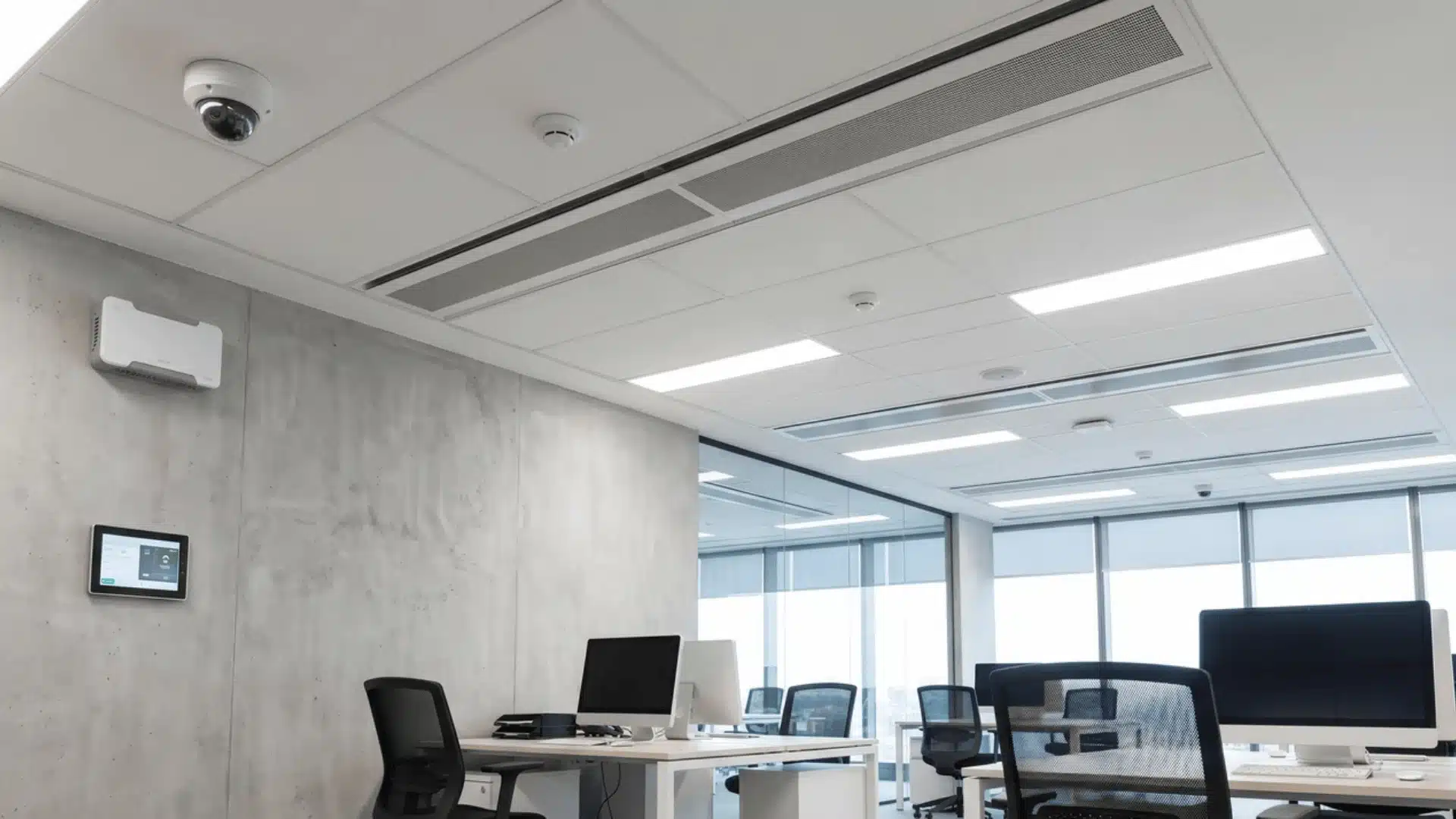
Smart building technology automates key operational systems across a facility. Each system uses data inputs and control logic to respond automatically to changing conditions.
| System | How It Works | Outcome | Limitations / Risks |
|---|---|---|---|
| HVAC Systems | Reads occupancy data. Checks outdoor weather. Adjusts temperature and airflow automatically. | Reduces wasted heating and cooling while maintaining comfort | Incorrect occupancy data can cause discomfort or inefficient operation |
| Lighting Systems | Detects motion. Measures daylight levels. Turns lights on, off, or dims automatically. | Lights adjust in real time to reduce energy waste | May misfire in low-motion areas or spaces with irregular movement |
| Security and Access Control | Verifies credentials. Monitors sensors and cameras. Flags unusual activity. | Enables automated access control and anomaly detection | Vulnerable to cybersecurity threats if not properly secured |
| Energy Management Systems | Tracks energy usage. Compares patterns over time. Adjusts load based on demand. | Reduces overall energy waste and improves efficiency | Optimization depends heavily on accurate and consistent data |
| Maintenance Systems (Predictive) | Monitors equipment performance. Detects abnormal patterns. Triggers maintenance alerts. | Identifies issues early to prevent system failures | Can generate false alerts or miss anomalies if data quality is poor |
Benefits of Smart Building Technology
Smart building technology delivers measurable improvements across three areas that matter most to building owners and facility teams.
Energy Savings
Automated HVAC and lighting systems reduce energy use by responding to real conditions rather than fixed schedules. Buildings stop cooling empty rooms and lighting unoccupied spaces, which directly cuts utility costs over time.
Occupant Comfort
Systems adjust temperature, air quality, and lighting in real time based on occupancy. Occupants experience more consistent conditions without needing to submit manual requests or wait for facility staff to respond.
Lower Operational Costs
Predictive maintenance catches equipment issues early, reducing emergency repair costs and unplanned downtime. Facility teams spend less time on reactive fixes and more time on higher-value work.
These benefits compound over time. The longer systems operate on real data, the more accurately they can optimize for efficiency and comfort.
Smart Building Architecture (How Everything Connects)
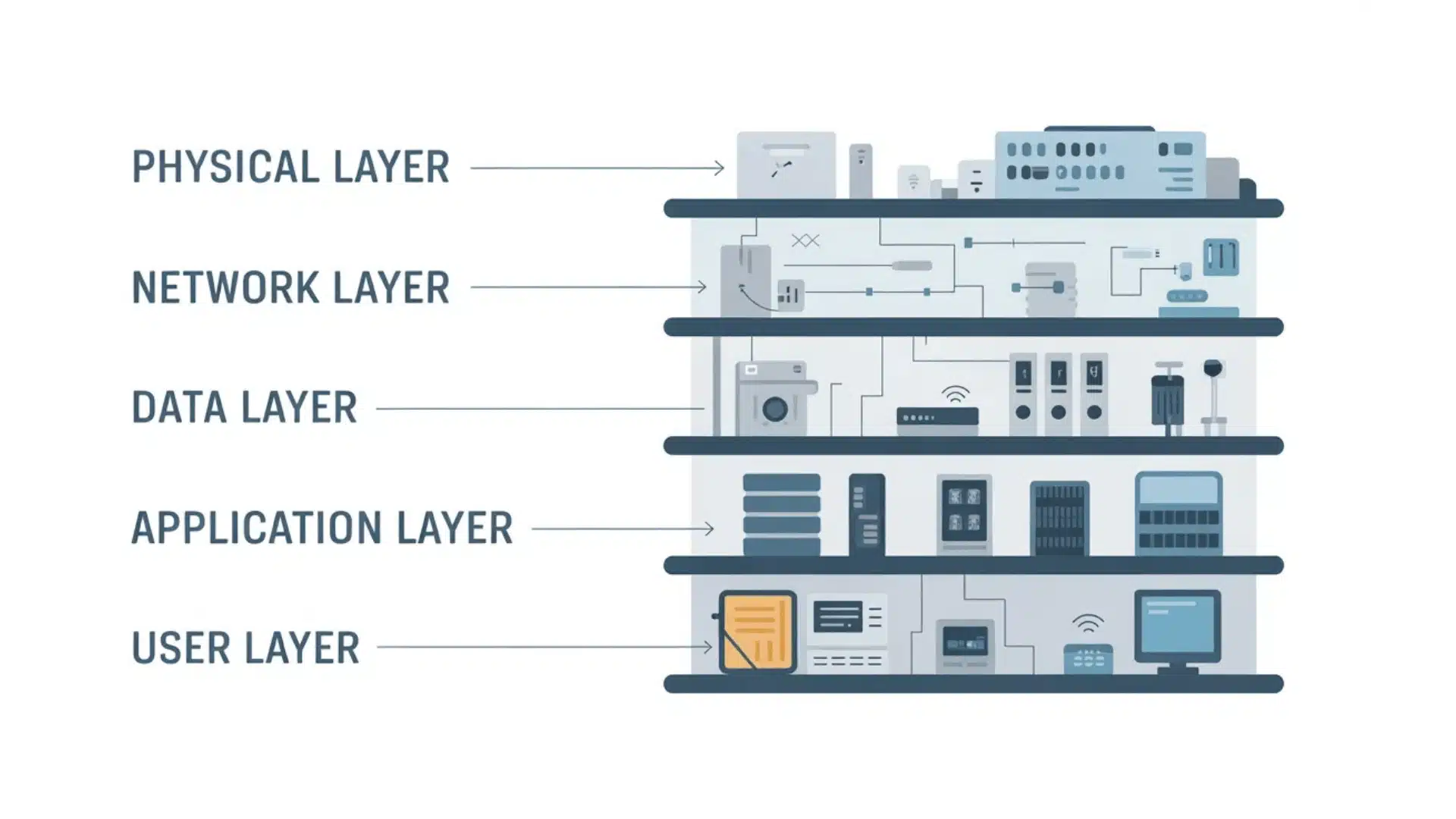
Smart building architecture follows a layered structure that organizes how devices, data, software, and users interact.
- Physical Layer: Includes HVAC equipment, lighting systems, sensors, and hardware where real-world environmental interaction occurs.
- Network Layer: Provides the wired or wireless connectivity that enables communication between all building devices and systems.
- Data Layer: Manages data collection, storage, and processing using cloud platforms or edge computing for analysis and response.
- Application Layer: Contains software logic such as BMS platforms, analytics tools, and automation rules where decisions are generated.
- User Layer: Includes dashboards and control interfaces that allow human monitoring, management, and manual overrides.
This layered structure works because it separates responsibilities while maintaining integration, improving scalability, flexibility, and overall system control.
What Makes a Building Truly “smart” (Critical Conditions)
A building is truly smart when its systems are fully integrated and communicate with each other. This integration allows HVAC, lighting, security, and energy systems to operate as a coordinated ecosystem rather than isolated units.
Automation is another core requirement, meaning systems respond automatically to changing conditions without constant human input.
Real-time data processing is essential to maintaining accurate, responsive automation. Systems must analyze incoming data immediately to adjust operations as conditions change.
A continuous feedback loop allows the building to sense conditions, analyze data, and respond repeatedly over time. This loop enables ongoing optimization rather than one-time adjustments.
Note: A building fails to be truly smart when systems lack integration, data quality is poor, networks are weak, or operations depend heavily on manual control.
Cost of Smart Building Technology
Smart building technology costs vary depending on building size, system complexity, and integration depth. The table below provides general price references for planning purposes.
| Cost Category | Small Buildings | Mid-Size Commercial | Large Enterprise / Campus | Ongoing Costs |
|---|---|---|---|---|
| Initial Infrastructure | $5,000–$20,000 | $50,000–$200,000 | $500,000+ | — |
| Software & Platform Fees | Subscription-based | $2–$10 per device/month | $10,000–$100,000+ annually for advanced analytics | Recurring annual or monthly fees |
| Maintenance & Support | 10–20% of system cost annually | 10–20% of system cost annually | 10–20% of system cost annually | Includes updates and technical support |
| Network & Cybersecurity | $5,000+ annually | $10,000–$50,000 annually | $50,000+ annually | Scales with system size and risk level |
These figures are general industry references and vary by vendor, region, and project scope. Long-term savings from energy efficiency and predictive maintenance often help offset the investment.
Common Misunderstandings about Smart Building Technology
A lot of people have the wrong idea about what smart building technology actually involves. These are the most common ones worth clearing up.
It’s not just IoT. IoT sensors are one part of the system. Without a BMS, network infrastructure, and automation logic, those sensors don’t do much on their own.
AI isn’t always required. Many smart buildings run entirely on rule-based automation and perform well. AI adds value at scale, but it’s not a requirement for a building to qualify as smart.
Energy savings aren’t automatic. Efficiency only happens when systems are properly configured and fed accurate data. A poorly set up smart building can waste just as much energy as a traditional one.
More devices don’t mean more intelligence. A building with hundreds of sensors and no integration is still a dumb building. Coordination between systems matters far more than device count.
Getting these wrong leads to bad purchasing decisions and unrealistic expectations. Understanding what actually drives performance helps you evaluate smart building solutions on the right terms.
Conclusion
Smart building technology works because every layer of sensors, networks, software, and systems is designed to communicate and act together. Automation takes over where manual control falls short: making continuous, real-time adjustments based on live data.
This means data flows seamlessly through each layer, with decisions being made and systems responding automatically, no human input required. This is what sets a truly smart building apart from a connected one.
Start by auditing your current systems for integration gaps. That’s where the path to smarter performance begins.
Frequently Asked Questions
How long does it take to see ROI from smart building technology?
Return on investment typically occurs within 3 to 5 years, depending on energy savings, maintenance reductions, operational efficiency gains, and the scale of implementation.
Who manages a smart building system after installation?
Facility managers, IT teams, or third-party service providers typically oversee operations, monitor dashboards, handle updates, and maintain cybersecurity and system performance standards.
Does smart building technology increase data privacy risks?
Connected systems collect operational data, which creates privacy risks, but encryption, access controls, and cybersecurity strategies significantly reduce exposure when properly implemented.