


Staying updated with LLM research news can feel confusing right now. Every day, there’s a new “breakthrough,” a new model, or a bold claim about better accuracy. But most updates don’t really explain what changed. And even when they try, it’s hard to tell what actually matters.
I’ve seen the same pattern again and again. Headlines talk about speed, accuracy, or performance, but they skip the deeper layer. Why does it work? When does it fail? And does it even affect real-world use?
Today, I’ll walk you through what’s actually happening in LLM research. Not just the updates, but what they really mean once you look under the surface.
Latest LLM Research News (March 2026)
A quick snapshot of what’s happening in LLM research right now. These are the updates shaping how models are being built, tested, and used today.
Key Updates You Should Know Right Now
Here are some of the most recent developments shaping LLM research:
- New methods to speed up training using unused computing time (MIT research)
- Studies showing AI systems still struggle with structured outputs across formats and tasks (StructEval benchmark)
- Research on detecting when models are overconfident but wrong (MIT Thermometer project)
- Open-source systems competing with large models in literature review and research tasks (OpenScholar paper)
These updates may look very different on the surface. But they all point in a similar direction. The focus is shifting from building bigger models to making them more reliable and efficient.
Quick Takeaways from Recent LLM Research
If you zoom out, a few patterns become clear:
- Speed is improving, but reliability is still uneven
- Models are getting better at tasks, but not consistent across formats
- Research is moving toward understanding behavior, not just outputs
A single update can sound like a big leap. In practice, though, it’s usually one small improvement inside a much larger system.
Where These Updates Fit in The Bigger AI Landscape
LLMs are no longer evolving on their own.
These updates now influence how multi-step AI systems operate, especially in systems covered in agentic AI updates. As models become slightly more reliable or efficient, it changes how different steps in a system can depend on each other without breaking.
They also affect how accuracy is judged in real use. Instead of looking at one answer in isolation, performance is now evaluated across sequences, workflows, and repeated interactions.
At the same time, these changes shape how different AI components connect together. Models are no longer standalone tools. They are part of larger systems where outputs feed into other processes.
So even small research changes can shape how larger AI systems behave over time.
What These Recent LLM Updates Actually Mean

These updates sound impressive on the surface, but their real impact is not always obvious. Here’s what actually changes beneath the headline claims and where the limits still remain:
Why “Faster Training” Doesn’t Always Mean Better Results
When you hear “training is faster,” it sounds like clear progress. But speed and capability are not the same thing.
Training means adjusting billions of parameters using data. Faster training simply means reaching those adjustments more quickly. The data itself does not change, and neither do the patterns the model learns from it.
So the mechanism is straightforward. The model learns the same relationships, just in less time or with fewer resources. That means the outcome is limited. The same strengths appear faster, but the same weaknesses remain.
Now this is where it starts to break down. If the training data contains:
- incomplete patterns
- repeated biases
- missing edge cases
Then, faster training can actually lock those issues in earlier. So in real use, a faster model may feel smoother, but it won’t be more accurate where it matters.
That’s the key contrast. Efficiency improves process, not understanding (as also reflected in recent MIT work on training optimization).
What Reliability Improvements Actually Change
Reliability sounds broad, but it usually targets very specific failure points.
The mechanism behind it is fairly direct. Models are tested across different formats and tasks, failure patterns are identified, and adjustments are made to reduce those exact errors.
This leads to improvements like better formatting in structured outputs and more consistent responses across similar prompts.
But reliability is not uniform. It shifts depending on the situation.
It varies based on:
- task type (simple vs. multi-step)
- format (text vs. structured output)
- input clarity
Here’s the important contrast. A model may be reliable in simple prompts but still fail in layered or chained reasoning tasks.
Reliability can even change within the same interaction. For example:
First answer is correct → Follow-up answer drifts slightly → Third answer breaks the structure
So reliability is not fixed; it’s conditional. Something recent structured-output benchmarks have made much clearer (StructEval).
This ties directly into the broader question of real-world performance, which is explored in the post on how accurate AI is.
Key Trends Behind Recent LLM Research

These updates are not random. They reflect a few clear shifts in how LLM research is evolving. Let’s look at these trends to make sense of where things are actually heading.
1. Shift Toward Training Efficiency and Resource Use
Training large models is expensive. That’s the core pressure behind this shift.
The mechanism involves improving how computation is used. This includes using idle compute cycles, reducing repeated calculations, and optimizing how data flows through the model.
The outcome is clear. Costs go down and iteration becomes faster. But the limitation stays the same. Efficiency does not change knowledge quality.
So this trend improves scalability, not understanding.
2. Growing Focus on Reliability and Error Reduction
This shift comes from real-world use. When models are deployed, small errors show up quickly, and repeated failures reduce trust. That’s what pushed research toward reliability.
The focus now is on:
- identifying where models fail
- reducing those specific failure patterns
But error reduction is not absolute. It depends on:
- how predictable the task is
- how close it is to training data
That’s why improvements feel strong in controlled settings but weaker in open scenarios.
3. Evolution of Evaluation and Benchmarking Methods
Evaluation is changing because older benchmarks were too narrow.
The mechanism now involves testing models across multiple task types, measuring consistency rather than just correctness, and checking structured outputs instead of only free-form text.
This reveals something important. A model can score high overall but still fail in specific conditions.
So, evaluation is shifting from “How accurate is it?” to “Where does it break?” A shift clearly visible in recent benchmark research like StructEval.
4. How These Trends Connect to Agentic AI and Real-World Systems
Today, LLMs are no longer used in isolation.
In real systems, unreliable outputs can disrupt multi-step processes, and even small formatting errors can break entire workflows.
So improvements in LLMs directly affect:
- decision chains
- system stability
- real-world automation
That’s where the impact shows up most clearly, especially when comparing how different systems operate, which becomes clearer in agentic AI vs. generative AI.
Where LLMs Still Fail Despite Recent Improvements
Even with recent improvements, LLMs still break in predictable ways. Understanding where they fail gives a clearer picture of their real limits.
Why Structured Tasks Still Break LLMs
Structured tasks require precision. LLMs are not built for strict precision.
The core mechanism is simple. LLMs generate outputs based on probability, not strict rules or guaranteed structure. This is why structured-output research highlights schema deviation as a key limitation (SLOT paper).
So when a task requires exact formatting, strict ordering, or rule-following, the model can drift.
Here’s how that happens:
It starts with correct structure → A small probability shift changes one token → That shift cascades into format errors
This is why failures often look minor but break everything.
Now look at the contrast.
- In open text → small errors don’t matter
- In structured tasks → small errors cause full failure
That’s why coding and data formatting expose these weaknesses so clearly.
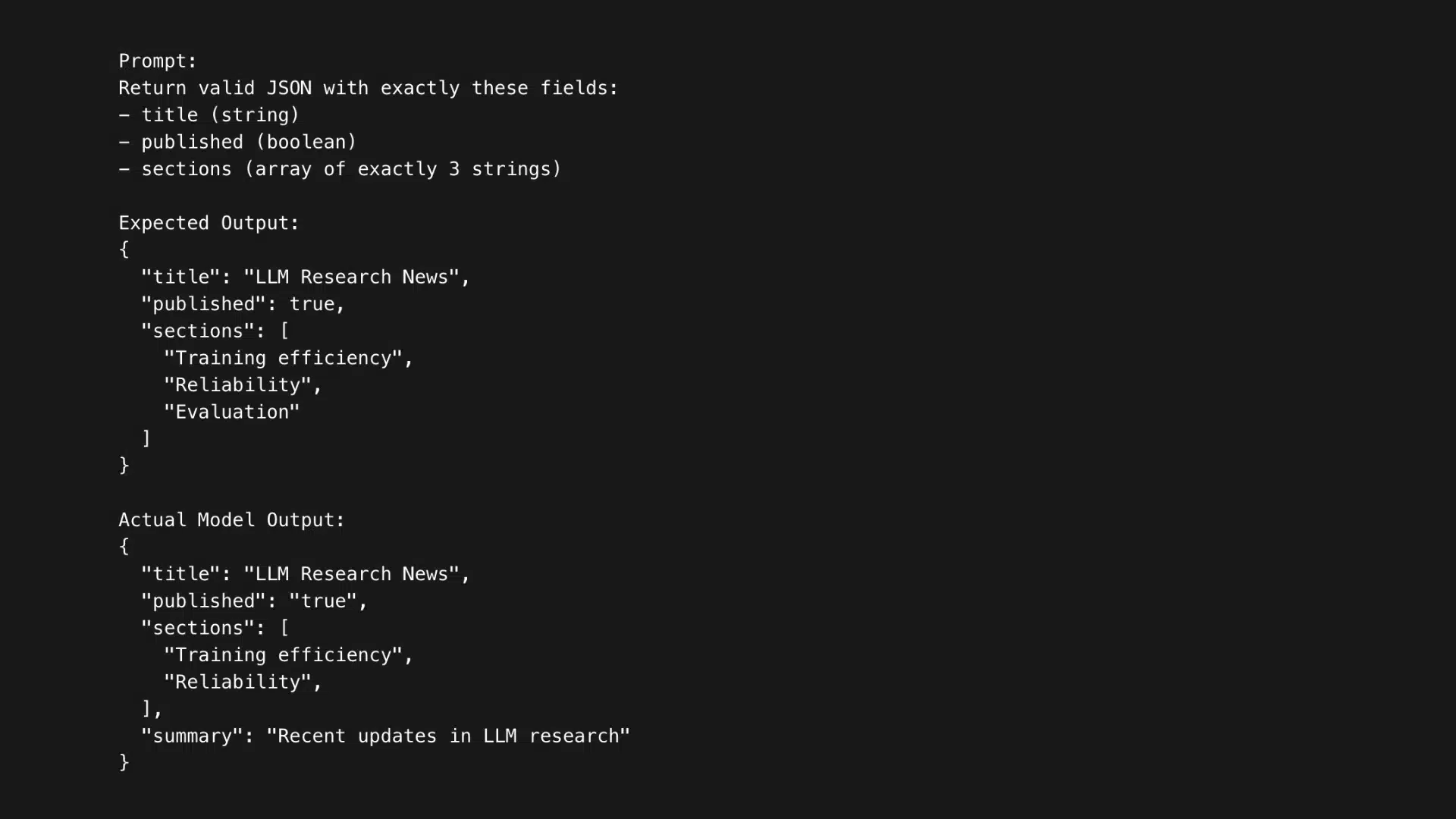
I ran a simple structured output test to see how the model handles strict formatting requirements. The task was to return a fixed JSON structure with specific fields and data types.
The expected output was a valid JSON object with correct types, complete fields, and no extra fields. The model’s response looked correct at a glance, but small structural errors made it unusable.
When Accuracy Gains Stop Improving Real Performance
The issue comes from how accuracy is measured. It is averaged across tasks, not weighted by real-world impact.
So a model can improve from 90% to 95% accuracy, but that remaining 5% may still include critical edge cases and failure points in workflows.
Here’s the real-world contrast.
- In casual use → 95% feels strong
- In production systems → 5% failure becomes a serious problem
So beyond a certain point, accuracy gains stop improving real outcomes.
Why LLMs Can Sound Confident Even When Wrong
LLMs often sound certain, even when they’re wrong. This comes from how they generate responses, not from actual understanding or verification.
How Token Prediction Creates False Confidence
LLMs generate text one token at a time.
The mechanism works step by step. For each position, the model calculates probabilities for possible next tokens, selects the highest probability option, and repeats this process across the entire response.
The key point is this. The generation process is driven by probability, not built-in truth verification; a core limitation discussed in hallucination research (LLM hallucination survey).
So when probability is strong, the output becomes smooth and the language sounds confident. That fluency creates the illusion of certainty, even when the content is wrong.
Why Training Data Reinforces Incorrect Patterns
Models learn from repeated patterns in data.
The mechanism is straightforward. Frequently seen patterns gain stronger weights, while rare or conflicting patterns receive weaker representation.
So if incorrect information appears often, it can become a dominant pattern.
This leads to:
- consistent but wrong answers
- confident repetition of flawed outputs
And because these patterns are reinforced during training, the model doesn’t “realize” the mistake. It simply follows what it has seen most often.
Situations Where Overconfidence Increases
Overconfidence is not random. It shows up under specific conditions:
- when prompts look familiar but hide complexity
- when the model is slightly outside its training range
- when multiple valid paths exist but one dominates probability
Research on calibration has shown that models can be systematically overconfident in incorrect outputs (MIT Thermometer).
Here’s the contrast.
- In unfamiliar tasks → the model may hedge
- In familiar-looking tasks → the model becomes overconfident
So the more something “looks normal,” the more confident the model may sound, even when it’s wrong.
How to Interpret LLM Research News without Misreading It
Most LLM research updates sound bigger than they actually are, so reading them the right way makes a big difference.
Lab Results vs. Real-World Impact
Lab conditions are controlled, while real-world use introduces variability that changes how models behave.
| Aspect | Lab Conditions | Real-World Use |
|---|---|---|
| Inputs | Clean and structured | Messy and inconsistent |
| Variation | Limited | High |
| Task Type | Predictable | Shifting and dynamic |
| Context | Fixed | Constantly changing |
So results often degrade outside the lab. That’s not failure, just a difference in conditions.
What Metrics and Benchmarks Actually Show
Metrics measure specific things. They show performance under defined conditions and results on selected tasks.
But they don’t capture everything.
They do not show:
- behavior across all scenarios
- failure impact in real systems
So metrics are partial indicators, not full performance measures.
How to Spot Overhyped Research Claims
You can filter most claims quickly if you know what to look for.
Watch for:
- single metric improvements without context
- no mention of limitations
- broad claims based on narrow tests
These usually mean the improvement is real, but much more limited than it sounds.
Wrapping Up
Following LLM research news becomes much easier once you understand how these systems actually work.
Most updates are not complete breakthroughs. They are improvements in specific layers like speed, reliability, or evaluation. And those improvements behave differently depending on the task and conditions.
The biggest shift right now is not just better models. It’s a deeper understanding of where models fail and why.
If you keep that in mind, the noise starts to clear. You stop chasing headlines and begin to see patterns, which is what actually helps you stay grounded as this space keeps moving fast.
Frequently Asked Questions
What is the latest research on large language models?
Recent work focuses on training efficiency, reliability, and better evaluation methods. The goal is to improve consistency and understand where models fail in real-world scenarios.
Why are LLMs sometimes wrong but confident?
They generate responses based on probability, not truth. When patterns are strong, they produce fluent and confident outputs even if the information is incorrect.
How are LLMs tested for accuracy?
They are tested using benchmarks across tasks and formats. These tests measure performance under controlled conditions, which may not fully reflect real-world behavior.
Do new models reduce hallucinations?
Some improvements reduce errors in specific cases, but hallucinations still occur. The issue depends on task complexity, input clarity, and model limitations.
What is the difference between LLMs and agentic AI?
LLMs generate responses, while agentic AI systems take actions across multiple steps. Improvements in LLMs directly affect how these systems perform and make decisions.