

Healthcare is no longer just delivered in clinics; it lives on smartphones. 87.4 million Americans now actively use health apps, and healthcare providers have accelerated their digital transformation timelines by 5 to 10 years.
Whether you’re a startup building your first product or a hospital modernizing patient care, understanding hospital app development from market opportunity to compliance to cost is no longer optional.
This guide covers types, regulations, the full development process, cost breakdowns, and the most common mistakes that derail otherwise solid products.
Everything you need to make informed decisions and build something that actually works.
Healthcare App Development Market Overview
The healthcare app development industry is one of the fastest-growing sectors in tech. The global healthcare mobile application market was valued at $114.17 billion in 2024 and is projected to reach $1,070.58 billion by 2030, growing at a CAGR of 45.2%.
This growth isn’t accidental. Rising smartphone penetration, an aging global population, and a post-pandemic shift toward remote care have permanently changed how patients access healthcare.
The mHealth apps market alone was valued at $37.5 billion in 2024 and is expected to reach $86.37 billion by 2030. North America currently dominates with a 36.5% revenue share, but emerging markets are closing the gap fast.
The mobile healthcare app development market is projected to reach $159.4 billion by 2033, growing at a CAGR of 20.9%.
For startups and hospitals alike, this isn’t just a trend it’s a structural shift in how healthcare gets delivered. The question is no longer whether to build a healthcare app, but how to build one that stands out.
Types of Healthcare Mobile Apps
Not all healthcare apps are built the same. The category you choose shapes everything: your compliance path, your tech stack, your monetization model, and your go-to-market strategy. Here’s a breakdown of the main types and what makes each one distinct.
1. Telemedicine & Virtual Consultation Apps

The demand for virtual care didn’t recede after the pandemic; it became the new baseline. These apps connect patients with licensed physicians via video, chat, or async messaging- no waiting rooms, no commutes.
The global telehealth market was valued at $123.26 billion in 2024 and is projected to reach $455.27 billion by 2030. Think Teladoc, Practo, or Doctor On Demand.
If you’re building in this space, HIPAA-compliant video infrastructure and EHR integration aren’t optional they’re day-one requirements.
2. Remote Patient Monitoring (RPM) Apps
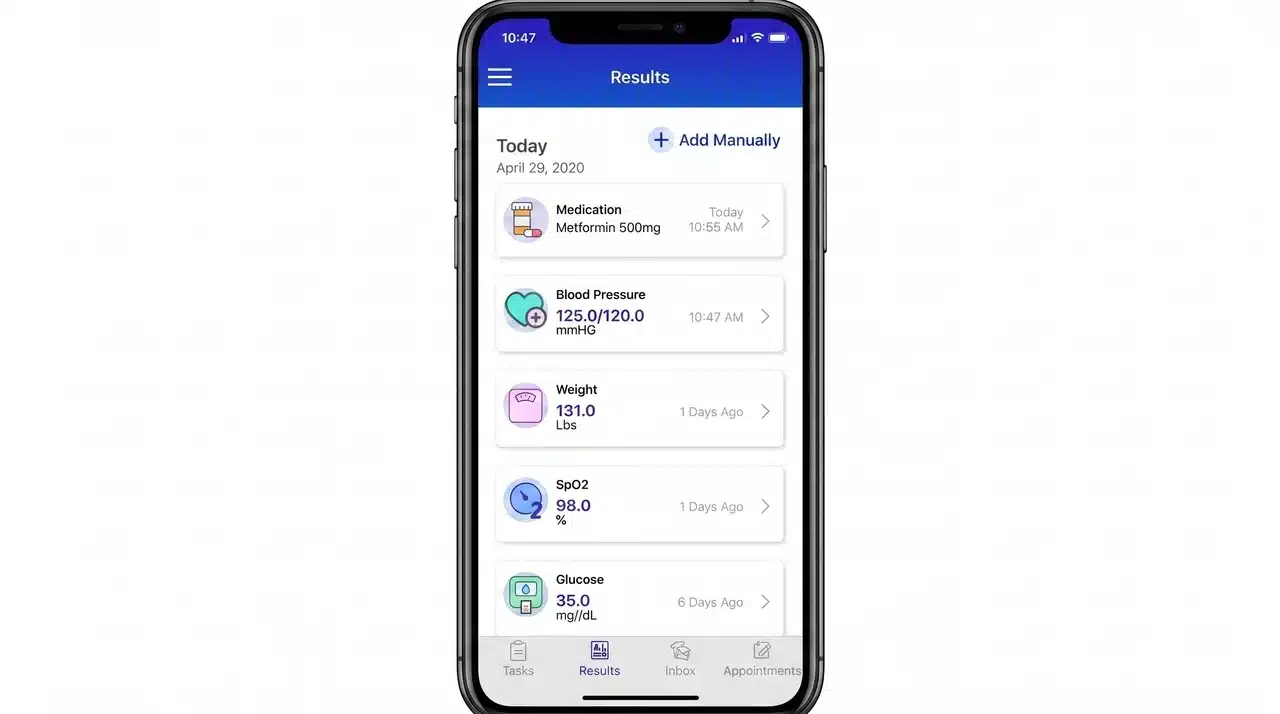
RPM apps connect with wearables and IoT devices to track vitals like blood glucose, heart rate, and blood pressure in real time. They’re especially valuable for managing chronic conditions.
The remote patient monitoring market is expected to grow from $7.2 billion in 2024 to $88 billion by 2035, at a CAGR of 25%, largely because nearly 129 million Americans are currently living with at least one chronic disease. That’s a massive addressable patient base.
3. Mental Health & Wellness Apps:

The demand for accessible mental health support didn’t recede after the pandemic it accelerated. From therapy platforms like BetterHelp to mindfulness tools like Headspace, this is now one of the fastest-growing verticals in digital health.
The global mental health apps market was valued at $11.93 billion in 2024 and is projected to reach $45.72 billion by 2033.
What sets successful apps apart here isn’t just features it’s clinical credibility. Users are increasingly skeptical of apps without evidence-based frameworks or licensed professional oversight.
4. EHR & Practice Management Apps

These are built for providers, not patients. They digitize clinical workflows: appointment scheduling, billing, e-prescriptions, lab results, and patient records. Complex to build, but sticky as a product. Hospitals and clinics rarely switch once embedded.
5. Fitness & Preventive Health Apps

Chronic disease management held the largest usage share at 34% of the mHealth market in 2024, but fitness and preventive apps are the gateway product that gets users into the healthcare app ecosystem in the first place.
Lower regulatory burden, faster to market, and also the most competitive shelf.
6. Medical Reference & Clinical Decision Support Apps

Designed for doctors, nurses, and pharmacists, these apps surface drug interaction checkers, diagnostic tools, and treatment guidelines at the point of care. Less glamorous than consumer apps, but high retention and trusted by institutions.
Healthcare Compliance & Regulations (US)
The average cost of a US healthcare data breach hit $10.22 million in 2025, the highest of any industry. Here are the core regulations every healthcare app operating in the US must navigate:
- HIPAA (Health Insurance Portability and Accountability Act) is the non-negotiable baseline for any app that touches Protected Health Information (PHI). Governs how patient data is collected, stored, and shared. Violations carry fines up to $1.5 million per year per violation category.
- HITECH Act strengthens HIPAA’s enforcement and extends direct liability to third-party vendors and business associates. That means your cloud provider, analytics tool, and payment processor all fall under its scope.
- FDA – Software as a Medical Device (SaMD) Apps that make diagnostic claims, provide treatment recommendations, or analyze physiological data for clinical decisions require FDA 510(k) clearance or De Novo pathway approval. General wellness apps are exempt.
- 21st Century Cures Act Mandates data interoperability via standardized FHIR APIs, preventing information blocking between healthcare systems. Critical for any app integrating with hospital EHR platforms.
- CCPA (California Consumer Privacy Act) applies to health apps with California users. Grants patients’ rights over their personal data collection, sale, and deletion even when HIPAA doesn’t technically apply.
- SOC 2 Type II Not a law, but a de facto requirement for healthcare software targeting hospital and enterprise buyers. Without it, procurement teams won’t sign contracts.
Step-by-Step Healthcare App Development Process
Most healthcare apps don’t fail because of bad code. They fail because teams skip steps early on. Here’s the process that actually works, in the right order.
Step 1: Discovery & Market Research
Before writing a single line of code, you need to understand who you’re building for and why. This phase typically takes 4 to 6 weeks. It involves interviewing healthcare providers, patients, and administrators to document real pain points, not assumed ones.
You’re also identifying competitors, spotting gaps, and validating that your idea solves a problem people will actually pay to fix.
Step 2: Compliance Planning
This is where most first-time healthcare founders go wrong. Retrofitting HIPAA compliance into an existing product after launch typically adds 40 to 80% of the original development cost, on top of any penalty exposure.
Decide early whether your app qualifies as a medical device under FDA rules. That single decision shapes your entire architecture.
Step 3: UX & Product Design
Healthcare users are not typical app users. A patient managing a chronic condition and a cardiologist reviewing labs need completely different flows. Good UX here means fewer errors, better adoption, and less training time for clinical staff.
A patient managing a chronic condition needs a simplified dashboard for their medication schedule, next appointment, and latest vitals in three taps or fewer.
A cardiologist reviewing telemetry needs density labs, waveforms, alerts, and trend lines visible without drilling through menus. Both are possible, but they require clearly separated user roles from the first wireframe, not as a retrofit.
Step 4: Development & Integrations
This is where your team builds the core product: authentication, data encryption, EHR integrations via FHIR/HL7, and any third-party APIs for payments or wearables. A focused MVP typically takes 8 to 12 weeks to develop once the design is locked.
Step 5: Quality Assurance & Security Testing
Healthcare apps carry a higher testing burden than most software. Beyond functional QA, you need penetration testing, data privacy audits, and validation that your app behaves correctly under clinical conditions.
Step 6: Launch & Ongoing Maintenance
Launching is not finished. A realistic maintenance budget for a HIPAA-compliant healthcare app typically runs 15–20% of the initial development cost annually.
That covers OS update cycles, dependency patches, third-party API changes, and incident response.
Teams that don’t budget for this before launch routinely discover the first major iOS update breaks their wearable integration or their video SDK requires a paid migration.
Smart & Advanced Healthcare App Features
The features you build directly determine whether clinicians adopt your app or abandon it. Here are the ones that separate good healthcare apps from great ones:
- AI-Powered Symptom Checker: Uses machine learning to assess user-reported symptoms and suggest next steps, reducing unnecessary ER visits and helping patients self-triage accurately before seeing a doctor.
- Real-Time Wearable Integration: Smartwatches, continuous glucose monitors, and connected BP cuffs stream live vitals directly to clinician dashboards, enabling proactive care rather than reactive treatment.
- EHR Integration via FHIR/HL7: Without this, patient data lives in silos. Direct two-way integration with hospital record systems such as Epic or Cerner eliminates manual-entry errors and ensures clinicians always have a current picture of the patient.
- In-App Video Consultations: HIPAA-compliant video calling built natively into the app, not routed through a consumer tool, keeps patient interactions secure, logged, and legally defensible.
- Smart Medication Reminders: Push notifications with dosage tracking improve adherence rates, particularly for patients with chronic diseases managing multiple prescriptions and complex schedules.
- Multi-Factor Authentication (MFA): A baseline security requirement for any app storing protected health information. Without it, a single compromised credential can expose an entire patient database.
Technologies Used in Hospital Application Development
The right tech stack depends on your app type and compliance requirements. These are the tools that appear most consistently in production-grade healthcare builds:
- AI/ML Frameworks (TensorFlow, PyTorch) for diagnostics and predictive analytics
- HL7 FHIR APIs for EHR interoperability across hospital systems
- React Native / Flutter for cross-platform mobile builds that reduce development costs
- AWS / Google Cloud HIPAA-eligible environments for compliant data storage
- WebRTC for encrypted peer-to-peer video consultations
- FDA-cleared AI tools, including ambient documentation tools like Abridge and Nuance DAX, and imaging analysis platforms like Viz.ai, with total AI device clearances rising from 650 in 2023 to 950 in 2024
The stack above covers the majority of use cases. What changes between projects is primarily which EHR system you’re integrating with and whether your app triggers FDA SaMD requirements.
Cost & Timeline of Healthcare App Development
Budget and timeline are the two questions every founder asks first.
Healthcare app development typically ranges from $30,000–$80,000 for a basic MVP to $150,000–$500,000 for enterprise-grade solutions. Hidden costs like server hosting and compliance audits can add another 15–20% on top of the base budget.
| App Type | Complexity | Estimated Cost |
|---|---|---|
| Fitness & Wellness App | Basic | $30,000 – $60,000 |
| Mental Health App | Basic to Mid | $50,000 – $100,000 |
| Telemedicine MVP | Mid | $80,000 – $150,000 |
| EHR / Practice Management | Mid to High | $100,000 – $250,000 |
| Remote Patient Monitoring | High | $150,000 – $300,000 |
| Full Enterprise Platform | Enterprise | $300,000 – $500,000+ |
Note: Outsourcing to offshore healthcare development teams can cut costs by 30–40% without compromising compliance, as long as your vendor has proven HIPAA experience.
Development Timeline
- Discovery & compliance planning takes 4 to 6 weeks, the phase most teams rush and regret rushing later.
- UX design and prototyping add 2 to 4 weeks, depending on the number of user roles your app needs to support.
- Core development for a focused MVP typically runs 3 to 5 months for a basic HIPAA-compliant build, and 5 to 9 months once EHR integrations or ePrescribing are in scope.
- QA, security audits, and compliance review add 2 to 4 weeks; never cut this to save time. This is where most post-launch failures originate.
- App store submission and launch take 1 to 2 weeks for iOS review; Android is typically faster.
- A full enterprise platform with deep integrations, AI features, and multi-state regulatory compliance realistically takes 14 to 22 months from kickoff to full launch.
Common Mistakes in Healthcare App Development
1. Treating compliance as an afterthought. Retrofitting HIPAA architecture after launch adds 40–80% of the original development cost. Build it in from day one, not sprint twenty.
2. Designing for developers, not patients. Navigation structures built around backend data models create logical flows for engineers and confusing dead ends for patients. Every screen should map to a user task, not a database schema.
3. Skipping real user research. Many apps are created without thorough research into the problem they aim to solve, offering solutions that are either too complex or impractical. Clinician interviews before wireframes save months of rework.
4. Overbuilding the MVP. Trying to build everything at once is a common trap. Ship the core value first, validate it with real users, then layer complexity.
5. Ignoring post-launch maintenance. Healthcare apps run on live patient data. Without a dedicated maintenance budget for OS updates, security patches, and incident response, a single vulnerability can permanently shut down your product.
6. Underestimating integration complexity. EHR connections via FHIR/HL7 are notoriously time-consuming. Teams that treat them as a two-week task routinely discover they’re a three-month one.
How to Choose a Healthcare App Development Partner
Most healthcare app projects don’t fail because of bad ideas. They fail because the team building the product didn’t understand healthcare well enough to navigate the differences from standard software development.
| What to Check | What to Ask | Red Flag |
|---|---|---|
| Healthcare Portfolio Depth | Ask for at least three completed projects, live apps you can download and test. If you need RPM, confirm they’ve shipped RPM. If you need EHR integration, confirm they’ve done it against Epic or Cerner. | Screenshots only, no live apps |
| Compliance Experience | Ask directly: How do you implement encryption at rest and in transit? Who are your HIPAA-eligible cloud providers? Have you supported an FDA SaMD submission? | Generic answers that mirror a checklist |
| BAA Readiness | Any vendor handling PHI on your behalf must sign a Business Associate Agreement before work begins. | Hesitation or unfamiliarity with the term |
| Post-Launch Commitment | Confirm they have a documented process for OS updates, security patches, and incident response, not just a development contract. | No maintenance plan beyond launch |
| Audit-Tested References | Standard client references matter. References whose products have passed a HIPAA audit or a hospital security review carry more weight. | References with no compliance history |
The right partner isn’t just technically capable. They understand the regulatory environment well enough to tell you when your plan needs to change before you’ve spent the budget finding out the hard way.
Conclusion
The opportunity in healthcare app development is real, growing, and still wide open for the right products.
The builders who succeed treat compliance as a feature, invest in real user research before writing code, and ship focused MVPs before scaling complexity.
Remote monitoring apps alone reduce hospital readmissions by nearly 38% and improve medication adherence by over 30%, proof that well-built healthcare apps generate outcomes, not just downloads.
If you’re ready to move from concept to product, the next step is a discovery session with a team that understands both the technology and the regulatory landscape.
Frequently Asked Questions
How much does it cost to develop a healthcare app?
Healthcare app development typically ranges from $30,000 for a basic MVP to $500,000 for enterprise-grade solutions, depending on features, compliance requirements, and team location.
How long does it take to build a healthcare app?
A basic HIPAA-compliant MVP takes 3 to 5 months, while a full-featured enterprise platform with EHR integrations and AI capabilities can take 14 to 22 months.
Do all healthcare apps need to be HIPAA-compliant?
Any app that collects, stores, or transmits protected health information (PHI), including appointment data, diagnoses, or prescriptions, must be fully HIPAA-compliant. General wellness and fitness apps that don’t touch PHI are typically exempt.