


Generative AI news moves at a relentless pace, shaped by product launches, funding waves, research breakthroughs, and policy shifts. The signal often gets buried under noise, hype, and fragmented reporting.
This blog breaks down how generative AI news is structured, who publishes it, and why certain sources dominate search results. It clarifies what counts as real news and what does not.
You will also learn how different audiences consume AI updates and how to evaluate credibility before trusting bold claims. The goal is sharper filtering, not more information overload.
What “Gen AI News” Actually Includes?
Generative AI news covers current events tied to AI systems that create text, images, video, audio, or code. It reports on developments, not basic explanations.
Most coverage fits into clear categories. Knowing them prevents confusion about what counts as news.
- Breaking news includes funding, acquisitions, and major launches. Competition drives announcements, media amplify them, and markets react.
- Product updates focus on new model versions and features. Rapid iteration leads to release notes, demos, and shifts in capability.
- Research announcements report new papers and benchmarks. Labs publish findings, outlets summarize claims, and readers track technical progress.
- Enterprise adoption stories show how companies deploy AI tools. Businesses announce deals, media assess impact, and leaders gauge maturity.
- Policy and regulation developments cover laws and compliance moves. Governments respond to growth, rules emerge, and firms adjust strategy.
AI Model Frameworks
Generative AI news often includes discussions on the frameworks that underpin the models driving innovations.
Understanding frameworks such as GPT (Generative Pretrained Transformer) or diffusion models is key to evaluating claims and progress.
These frameworks are the underlying technologies that dictate how AI models function, making it crucial to report not only on the outcomes but also on the architecture and model specifications.
Articles that highlight these technical foundations ensure readers are informed about the real progress being made.
Rapid innovation causes constant update cycles. That speed makes coverage frequent and time-sensitive.
Outlets split reporting across business, tech, and policy desks. This structure improves output but fragments context.
Without structured sources, readers see scattered updates. The outcome is overload instead of clarity.
Note: AI news focuses on recent events and measurable developments. Tutorials, definitions, and beginner guides fall under educational content, not news reporting.
Mainstream Tech Outlets’ Dominance in Generative AI Coverage

Mainstream tech outlets lead the charge in covering generative AI, largely because of their ability to publish quickly and frequently in formats that search engines prioritize.
For example, TechCrunch’s AI category consistently publishes updates on new model releases, startup funding, and corporate moves in generative AI.
One strategy that helps these outlets maintain high visibility is the use of dedicated AI category pages. These centralized hubs gather all AI-related stories in one place, improving internal linking and strengthening the site’s authority on the subject.
Tags like “generative AI” help group related articles, making it easier for both readers and search engines to navigate and find relevant updates. Wired has a similar AI category that groups their relevant stories for easy access.
Content often appears in a chronological feed format, with newer stories pushing older ones down, signaling freshness and ongoing relevance, which search algorithms favor. This format is well-exemplified by The Verge, which provides up-to-date AI coverage.
Despite this speed, many articles, while concise and headline-driven, sometimes lack clear citations to primary sources such as official funding announcements or research publications. To improve credibility, reporters should cite original sources like funding reports, press releases, and industry analysis.
For example, structured reports on funding trends, such as those collected in the MIT Technology Review’s coverage of AI funding, demonstrate how comprehensive industry coverage can include verifiable financial data.
Mainstream outlets typically focus on stories about companies and market events, spotlighting funding rounds, new product launches, partnerships, and business strategy shifts. This keeps readers informed on market movements but can underrepresent deep technical or research-focused perspectives.
Reuters provides detailed coverage on AI funding rounds and startup growth, often with linked primary sources.
The reason behind their visibility is simple: fast editorial cycles and frequent updates strengthen search rankings. Timeliness is a key advantage, allowing readers to track developments, from funding surges to emerging model capabilities, in near real time. Reuters is an excellent example of timely reporting on the AI sector.
However, this speed often comes at the expense of technical depth. Articles may summarize announcements but rarely offer a detailed analysis of model architecture, benchmark performance, or implementation methods.
Readers seeking these deeper insights will often need to consult specialized research outlets. MIT Technology Review goes beyond the headlines and provides in-depth analysis on AI model mechanics, architecture, and performance.
Coverage also tends to skew toward well-known companies. Startups and lesser-known labs may not get as much attention unless they break significant funding or innovation news. The Verge also tracks funding trends, with a focus on up-and-coming AI startups, offering deeper insights.
For thorough technical breakdowns, including research, benchmarks, and methodological context, look beyond mainstream tech outlets to research journals or technical analysis publications that focus on in‑depth AI progress rather than just headline news.
MIT Technology Review remains a go-to source for comprehensive, technical AI articles that analyze the state of AI technologies with accuracy.
Research and Institutional AI News Hubs
Research and institutional AI news hubs follow a different publishing logic than mainstream tech media.
- Academic and enterprise institutions publish GenAI news through structured sections like “News,” “Research Updates,” and “Consortium Announcements.”
- Content is organized around research milestones rather than market events.
- Breakthrough → press release → institutional distribution drives publication flow.
- Coverage follows validation and publication cycles, not rapid commentary cycles.
- The tone is formal and less sensational than that of mainstream tech media.
- Publishing cadence is slower due to peer review and internal approval processes.
- Articles include more methodological detail, such as datasets, evaluation methods, and stated limitations.
Strength: higher technical reliability due to research oversight and review structures.
Limitation: slower updates and potential emphasis on internal initiatives over broader industry context.
These hubs prioritize accuracy and methodological clarity over speed, making them better suited for readers who value technical depth over immediacy.
Industry-Specific AI News Platforms
Industry-specific AI news platforms focus solely on artificial intelligence, distinguishing them from general tech media that cover a wide range of technology topics. These outlets are dedicated exclusively to AI, with their entire editorial structure centered around developments in the field.
Content is organized into distinct verticals, with common sections such as foundation models, agentic AI, infrastructure, and enterprise adoption.
This targeted approach allows for deeper and more specialized commentary, catering to an audience that includes developers, enterprise leaders, investors, and AI researchers.
Since coverage stays within the AI domain, reporting tends to be more nuanced, assuming that readers already have a solid understanding of core concepts and industry terminology.
This focus reduces the distractions of general tech trends, keeping articles centered on AI advancements rather than broader consumer technology topics.
However, there are some potential downsides.
Sponsor relationships or industry partnerships can influence the framing of stories, sometimes skewing coverage toward commercial progress at the expense of independent research or open-source developments.
This can shape the perception of the AI landscape, emphasizing business-driven narratives over technical breakthroughs.
How Generative AI News is Structured Across SERPs?
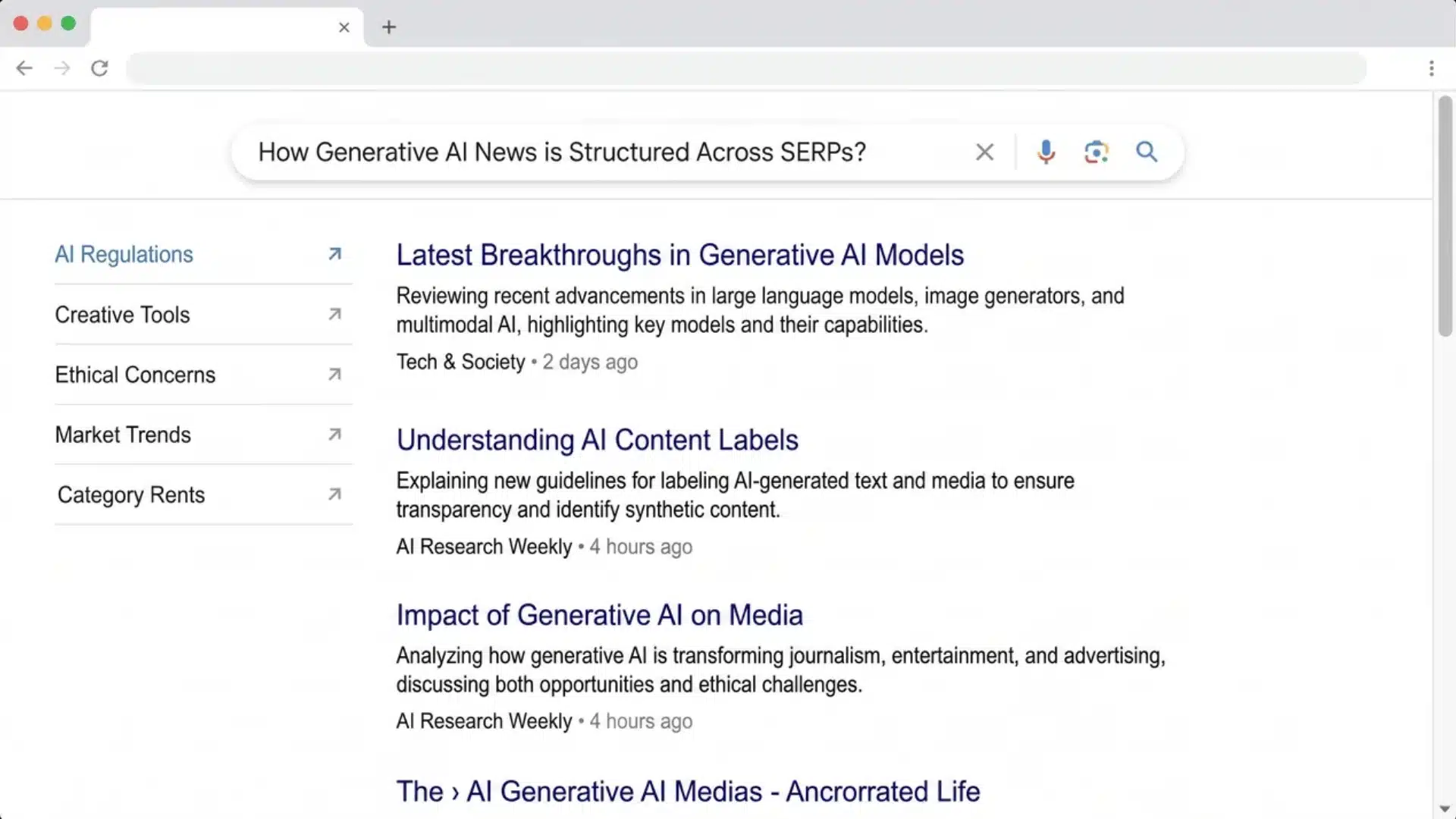
Top-ranking generative AI news pages follow consistent structural patterns that are optimized for both visibility and scalability. These formats are designed not only for readers but also to enhance search engine performance.
1. Category Landing Pages
Most leading AI news pages use category landing pages that gather all AI-related content into a single hub. This strategy boosts topical authority and helps concentrate ranking signals, making it easier for search engines to categorize and rank the content.
2. Chronological Listings
A common feature of these pages is the use of chronological listings, where the newest articles are displayed first. This structure highlights freshness, signaling to search algorithms that the content is constantly updated and remains relevant to readers.
3. Clear Tagging System
These pages also rely heavily on a clear tagging system. Tags like generative AI, agentic AI, and foundation models group related stories, strengthening internal linking and improving semantic clustering. This makes it easier for both readers and search engines to navigate through related topics.
4. Audience Retention and Engagement
Many AI news sites feature newsletter sign-ups prominently throughout their pages. While these are intended for audience retention, they also help reinforce the site’s authority through recurring engagement signals, which can improve overall search visibility.
5. Ranking Logic and Freshness Signals
The ranking logic behind top-performing AI news pages is straightforward. Frequent updates trigger Google’s freshness signals, giving newer content a higher chance of ranking for evolving topics in generative AI. This ensures that AI developments are always represented in real-time.
6. Internal Linking and Domain Authority
Strong internal linking is a key strategy for distributing authority across related articles. This process helps to build domain-level credibility and improves crawl efficiency, allowing search engines to index content more effectively.
7. Topical Clustering
Many AI news sites organize their content into specific AI-related categories. This topical clustering deepens the subject matter and contributes to sustained ranking dominance for generative AI queries. By grouping content into focused areas, these sites help strengthen their overall authority on the subject.
8. Lack of Cross-Source Synthesis
However, one downside is the lack of cross-source synthesis. Many of these pages present isolated updates rather than connecting them to broader industry patterns. This limits the depth and context of the coverage, making it harder for readers to get a comprehensive understanding of the topic.
9. Limited Technical Analysis
Another limitation is the lack of deep technical breakdowns. While the articles often summarize announcements and developments, they rarely dive into the architecture, benchmarks, or implementation details of AI models. For readers seeking a more technical understanding, specialized sources are often required.
10. Mixed Formats in SERPs
Finally, SERPs for generative AI queries display a variety of formats. Because the query is broad, results often include news sites, definition pages, tag hubs, and trend reports. Each format addresses a slightly different interpretation of the user’s intent, which can make it harder to find highly relevant content in a single result set.
How to Evaluate Credibility in GenAI News?
Generative AI headlines move fast, but not all coverage meets the same credibility standards.
| Evaluation Criterion | What to Look For |
|---|---|
| Named Authors | Articles should clearly identify the writer, ensuring accountability and transparency. |
| Cited Sources | Reliable coverage references primary materials like research papers, official filings, or press releases. |
| Transparent Corrections | Credible outlets publicly correct mistakes rather than silently revising content. |
| Links to Original Research | Articles should link directly to studies or benchmarks for independent verification. |
| Hype Cycle Awareness | Be cautious of articles designed to attract attention with sensational or exaggerated claims. |
| Sensational Framing Risk | Watch for headlines that overstate AI’s capabilities to increase engagement. |
| Unverified Model Claims | Check for independent validation of performance numbers or testing methods. |
| Benchmark Cherry-Picking | Ensure reports don’t selectively highlight strong results while ignoring weaker performance. |
| “AGI” Claims Without Evidence | Skeptical of claims about Artificial General Intelligence (AGI) without measurable proof. |
| Primary Source Check | Ensure the article links directly to official releases or research papers for factual accuracy. |
| Assess Performance Context | Verify that performance results are compared against relevant baselines and fair testing methods. |
| Limitations Discussion | Look for articles that mention the risks, constraints, and failure cases of AI technologies. |
Applying these checks reduces exposure to hype-driven narratives and helps separate documented progress from exaggerated claims.
Types of Gen AI News Readers and What They Should Follow?
Different roles consume different layers of generative AI news based on their objectives and decision context.
| Reader Type | What They Should Follow | Why It Matters |
|---|---|---|
| Developers | Model updates, API changes, open-source releases | These directly affect implementation, compatibility, and system performance. |
| Executives | Enterprise adoption stories, infrastructure partnerships, and cost discussions | These shape strategic planning, risk assessment, and ROI evaluation. |
| Researchers | Research papers, benchmark results, architecture shifts | These determine technical progress, reproducibility, and future research direction. |
| Investors | Funding rounds, strategic alliances, and market positioning moves | These signal capital flow, competitive strength, and long-term industry momentum. |
Because each role prioritizes different outcomes, no single news source can effectively serve all audiences at the same depth.
Conclusion
Generative AI news is not just about headlines; it is about understanding structure, source credibility, and intent. Without that lens, updates blur into hype cycles and repeated narratives.
By identifying coverage types, evaluating reliability signals, and aligning sources with your role, you gain control over how you consume information. That clarity reduces noise and improves decision quality.
If you want to stay informed without being misled, apply these filters consistently when reading generative AI news. Start curating smarter sources today and track progress with purpose.
Frequently Asked Questions
How can I track generative AI news without checking multiple websites daily?
You can use RSS aggregators, curated newsletters, and alert tools to consolidate updates from selected AI categories and trusted publications into one streamlined feed.
Why do some AI announcements disappear quickly from headlines?
Many stories are announcement-driven and lack long-term impact, so media attention fades once newer releases or funding rounds replace them in fast-moving cycles.
How do embargoed AI releases affect news timing?
Journalists often receive advance access under embargo, leading multiple outlets to publish similar stories simultaneously when the embargo lifts.
Is social media a reliable source for generative AI news?
Social platforms surface updates quickly, but posts often lack verification, context, or primary sourcing, increasing the risk of misinformation spreading rapidly.