


Data analytics has always required time, precision, and technical skill, but that balance is starting to shift.
Generative AI in data analytics introduces a different way of working where asking the right question can matter as much as writing the right query.
It adds a layer that translates intent into outputs, which sounds simple but changes how analysis actually happens. This shift brings both speed and new kinds of errors that are easy to miss.
In this blog, I break down how this system operates, where it fits in real workflows, and what you should watch for when using it in practice.
Let’s first understand what generative AI in data analytics actually does.
Generative AI in Data Analytics: What It Does and Why It Matters
Generative AI in data analytics works less like a traditional analysis engine and more like a layer that translates your intent into usable outputs.
When you ask a question, it converts your input into structured queries, code, or summaries, which then interact with actual data systems. This creates two connected layers: one that generates instructions and another that processes real data.
That’s why it feels fast and intuitive but still depends heavily on data quality and structure. In clean environments, it can speed up exploration and reporting.
In messy setups, it may misinterpret context or produce incorrect results. The real value comes from reducing manual effort while keeping humans in control of interpretation and validation.
Core Use Cases of Generative AI in Data Analytics
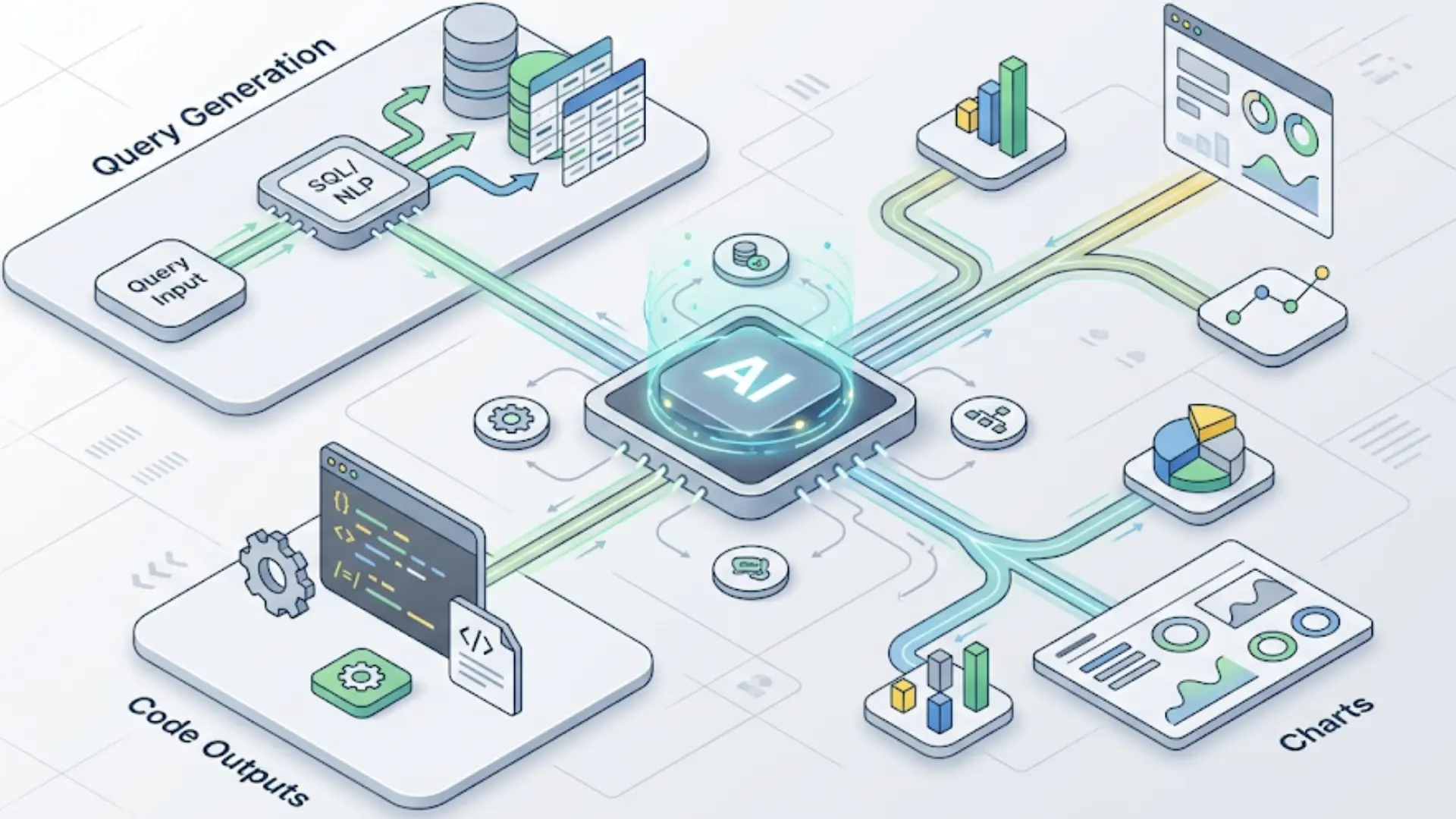
Generative AI supports data analytics through multiple practical use cases, from query generation to reporting. It helps speed up workflows while still depending on data quality and human validation.
1. Natural Language to SQL and Query Generation
This is one of the most widely used applications. You ask questions in plain language, and the system converts them into structured queries.
It breaks your request into components, maps them to database fields, and builds SQL automatically. When the database schema is clean and relationships are well defined, results tend to be accurate and fast.
However, if naming is inconsistent or relationships are unclear, the system can generate incorrect joins or filters. This creates outputs that look correct but contain hidden errors, especially in complex datasets.
2. Automated Data Cleaning and Structuring
Generative AI helps clean and organize messy datasets by identifying patterns like missing values, duplicates, or inconsistent formats.
It suggests fixes based on patterns learned from past data rather than a true understanding of your rules. This works well for repetitive, predictable cleaning tasks, but it struggles with exceptions that require business context.
For example, it may standardize formats across most rows but incorrectly modify edge cases.
So while it reduces manual effort, it still needs human validation to ensure important details are not lost.
3. Synthetic Data Creation and Augmentation
AI can generate new data that mimics the structure and patterns of real datasets. This is useful when data is limited, sensitive, or incomplete.
It learns relationships from existing data and creates similar samples that can be used for testing or modeling. This works best when patterns are stable and consistent.
However, it becomes less reliable when rare events or edge conditions matter. Generated data may look realistic on the surface but still miss critical variations that affect outcomes in real scenarios.
4. Automated Visualization and Reporting
Generative AI can quickly convert raw data into charts, dashboards, and written summaries. It selects chart types, highlights trends, and explains patterns in simple language. This speeds up reporting and makes insights easier to communicate.
However, the system focuses on visible patterns rather than deeper statistical meaning. It may emphasize trends that are not actually significant.
So while it improves presentation speed, interpretation still requires careful human review to avoid misleading conclusions.
5. Predictive Insights and Scenario Simulation
Generative AI can simulate possible outcomes by identifying patterns in data and projecting them forward.
It may suggest how metrics like sales or demand could change under different conditions. This is helpful for exploring ideas and testing assumptions quickly.
However, it does not replace formal predictive models. Its outputs are based on learned patterns rather than precise statistical forecasting. This makes it useful for exploration, but less reliable when decisions depend on accurate predictions.
6. Code Generation for Analysis
Generative AI can produce SQL, Python, or R code based on natural language instructions. This reduces the time needed to write repetitive or standard scripts. It is especially helpful for quick analysis or prototyping.
However, the generated code is not always optimal. It may include inefficient logic, miss edge cases, or assume incorrect data structures.
Because of this, the output should always be reviewed and tested before use. It speeds up development, but does not remove the need for technical oversight.
Where Generative AI Fits in the Data Analytics Lifecycle
Generative AI supports different stages of the analytics lifecycle, but its role changes depending on where it is applied. It does not replace the workflow. It sits on top of it and speeds up specific steps while still depending on data quality and human validation.
- Data preparation and cleaning: identifies patterns like missing values and suggests fixes
- Data exploration and querying: allows natural language questions instead of manual queries
- Analysis and insight generation: summarizes patterns and generates explanations
- Reporting and communication: converts outputs into readable summaries and dashboards
Generative AI fits across the entire lifecycle, but its effectiveness depends on how structured the data is and how clearly each step is defined.
How Generative AI Actually Works in Data Analysis

Generative AI processes user input, maps it to structured logic, interacts with data systems, and generates outputs based on learned patterns and data context.
1. From Prompt to Query: How Text Becomes SQL or Code
When you type a question, the system first interprets your language and breaks it into key components. It identifies entities like “sales” or “customers,” detects time ranges, and understands actions such as “compare” or “show.”
These elements are then mapped to database fields and relationships. Finally, the system builds a structured query or code. If this mapping aligns correctly with the schema, the results are accurate. If not, even small mismatches can produce misleading outputs.
2. Pattern Learning vs. Real Data Understanding
Generative AI learns from patterns in training data rather than directly understanding your dataset. Even when connected to your data, it relies on pattern recognition to interpret queries. This creates a gap between appearing intelligent and actually understanding context.
It can generate answers that sound correct but are based on assumptions. This is why outputs can be convincing while still being wrong, especially when the data structure or query intent is unclear.
3. Interaction with Databases and Data Schemas
The system’s performance depends heavily on how your data is structured. When schemas are clean, consistent, and well-labeled, mapping from language to data becomes easier and more accurate.
In contrast, unclear naming, weak relationships, or poorly defined tables increase the chances of errors. For example, clear table names improve results, while unclear relationships lead to incorrect joins. This means data organization directly affects how reliable AI-generated outputs will be.
4. Why AI Outputs Can Be Wrong or Misleading
Errors usually come from incorrect mapping between language and schema, missing context, or assumptions based on patterns.
When the system lacks clarity, it may fill gaps with generated guesses, often referred to as hallucinations.
These issues are not random. They appear more often when questions are vague, data is messy, or relationships between tables are complex. This is why validation is always necessary, even when outputs seem confident and well-structured.
Key Benefits of Generative AI in Data Analytics
Generative AI improves data workflows by reducing manual effort, making data easier to access, and speeding up repetitive tasks. However, these benefits depend on data quality, clarity of input, and proper validation.
- Speed in Data Workflows: Generative AI reduces manual steps by turning plain language into queries, reports, or code. This speeds up early exploration, but frequent errors can reduce that advantage.
- Access for Non-Technical Users: It allows users without coding skills to work with data using simple questions. This works best for basic queries, while complex requests still need careful phrasing and interpretation.
- Productivity Gains in Routine Tasks: Most efficiency comes from automating repetitive work like code generation and report formatting. However, deeper analysis still depends on human thinking and decision-making.
- Situations Where Benefits Drop: If data is messy, questions are unclear, or outputs are not checked, generative AI can create confusion and slow down the overall workflow instead of improving it.
These benefits are real, but they work best when AI is used carefully with clear data, structured workflows, and consistent human validation.
Limitations and Risks of Generative AI in Data Analytics
Generative AI improves speed and accessibility, but it also introduces risks that are easy to overlook. These risks often come from how AI generates outputs rather than how data is actually analyzed.
| Limitation / Risk | What It Means |
|---|---|
| Accuracy and hallucination | AI may generate answers that look correct but are based on assumptions, not real data logic |
| Data dependency | Output quality depends heavily on how clean and structured the data is |
| Lack of context | AI cannot fully understand the business meaning or the decision impact |
| Over-reliance | Users may trust outputs without proper validation |
These risks are manageable when you understand where they come from. The key is to treat AI outputs as a starting point, not a final answer, and always validate results before making decisions.
How Generative AI Changes the Role of Data Analysts
Generative AI shifts the role of data analysts from doing manual work to focusing more on interpretation and oversight.
Instead of spending most of their time writing queries or building reports, analysts now review outputs, validate results, and guide decisions. This shift also brings new skill requirements.
Analysts need to ask clear questions, understand how data is structured, and check whether AI-generated outputs make sense. Technical skills still matter, but judgment becomes more important.
AI can assist with speed and automation, but it cannot understand context or business logic on its own. Because of that, human involvement remains critical at every stage, especially when decisions depend on accuracy and a deeper understanding.
Wrapping Up
Generative AI for data analytics is powerful, but it works best when you understand what it actually does. It doesn’t replace analysis. Instead, it speeds up parts of it and makes data easier to work with.
The key is to treat it as a tool, not a decision-maker.
It can generate queries, summaries, and ideas, but it still depends on your data and your judgment. If you approach it with that mindset, you get the benefits without falling into the common traps.
Start small, test outputs carefully, and focus on how it behaves in your own data environment before scaling further.