

Most people picture a humanoid machine when they hear the word robot. But the reality is far more interesting and far more useful.
What is a robot, really? It’s a programmable system built to sense its environment, make decisions, and take action, often without any human input at all.
Robots have quietly shaped industries, surgeries, and even space exploration for decades.
Today, I’ll walk you through how they work, the different types you’ll encounter, and why they’re used in the first place. Let’s start with the basics.
What is a Robot and How Does It Work?
A robot is a programmable machine built to sense, decide, and act. It’s not just a mechanical arm or a toy that moves. It’s a system that takes in information, processes it, and responds, automatically or with minimal human input.
The Three Core Components Every Robot Has
Every robot, regardless of size or purpose, is built around the same three parts.
- The control system is the brain. It receives information and decides what the robot should do next.
- The sensors are how the robot perceives its environment, detecting temperature, distance, light, pressure, or movement.
- The actuators are what create physical action, whether that’s a motor spinning, a gripper closing, or wheels turning.
Take away any one of these three, and you no longer have a robot.
What Separates a Robot from A Simple Machine
The key difference is programmability. A conveyor belt moves things, but it can’t adjust when something changes. A robot can. That ability to respond to new information is what puts robots in a category of their own.
It’s also worth clearing up a common assumption. Robots don’t have to look human. Most don’t. A robotic arm on a factory floor looks nothing like a person, but it is still a robot. What defines a robot is its function, not its form.
The Four-Step Loop Robots Follow Every Time They Act
Robots work through the same logical cycle on every task.
First, sensors collect data from the environment. Then the control system interprets that data and decides what to do. Next, the actuators carry out the action. Finally, the robot checks whether the action worked and adjusts if needed.
This loop is what gives robots their accuracy and repeatability. They don’t fatigue, lose focus, or drift from one repetition to the next.
Where Robots Still Fall Short
Robots aren’t perfect. Sensor errors can feed bad data into the system. Incomplete programming leads to wrong decisions. And traditional robots struggle to handle anything outside of what they were built for.
That last point matters. A conventional robot is reliable but rigid. It follows fixed instructions and fails when the situation changes. AI-powered robots handle this differently, learning from data and adapting over time, but that’s a separate category entirely.
Key Facts About Robots You Should Know
Robots have a longer history than most people realize, and a bigger role in modern life than most people expect. Here are the facts that actually matter.
1. The Word “Robot” Came From a Play About Forced Labor
Czech writer Karel Čapek introduced the term in his 1920 play R.U.R. (Rossum’s Universal Robots). It came from the Czech word robota, meaning drudgery or forced labor.
The robots in the play weren’t machines. They were artificial people, created to work so humans wouldn’t have to. That origin explains a lot about how we’ve thought about robots ever since.
2. People Have Imagined Mechanical Beings for Thousands of Years
Greek mythology described Talos, a giant bronze automaton built to protect the island of Crete.
Homer wrote about self-moving tripod machines in The Iliad around 800 BC. Leonardo da Vinci sketched a mechanical knight in 1495 that could sit, wave, and move its jaw.
Robots weren’t born in Silicon Valley. They were born in the human imagination centuries ago.
3. The First Industrial Robot Did a Job Too Dangerous for People
Unimate, invented by George Devol and commercialized by Joseph Engelberger, was installed on a General Motors assembly line in 1961.
Its job was to extract hot die-cast metal parts from molds, work that risked serious burns for human workers. That’s the real origin of modern robotics: not convenience, but safety.
4. There are Now Over 3 Million Industrial Robots Operating Worldwide
According to the International Federation of Robotics (IFR), more than 3 million industrial robots are currently deployed in factories across the globe.
That number has more than doubled in less than a decade, driven by demand in automotive, electronics, and logistics.
5. South Korea Has the Highest Robot Density on Earth
South Korea operates around 932 industrial robots per 10,000 manufacturing workers, the highest ratio of any country in the world. Singapore ranks second at 831, followed by Japan at around 390. The global average is 162. In South Korea, robots aren’t just common. They’re the norm.
6. Isaac Asimov’s Three Laws Were Fiction, but They Sparked Real Policy Debates
In his 1942 short story Runaround, Asimov wrote three rules: a robot cannot harm a human or let one come to harm; it must obey human orders unless they conflict with rule one; and it must protect itself unless that conflicts with the first two.
These were invented for a story, not an engineering lab. But they remain the most widely referenced framework in discussions about robot safety and AI ethics today.
7. Most Robots Don’t Look Anything Like Humans
The humanoid robot is a sci-fi staple, but it’s a tiny category in the real world. The majority of robots are arms, wheels, drones, or systems with no human shape at all.
What makes something a robot isn’t its appearance. It’s its ability to sense, process, and act.
8. Every Robot Follows the Same Four-Step Loop
Sensors collect data from the environment. A processor interprets that data and decides what to do. Actuators, whether motors, grippers, or wheels, carry out the action. Then the robot checks whether it worked and adjusts.
This sense, process, act, and feedback cycle is what separates a robot from a simple machine, and it’s what gives robots their accuracy and repeatability.
9. Surgical Robots Let Surgeons Operate With Sub-Millimeter Precision
The da Vinci Surgical System allows surgeons to perform minimally invasive procedures through tiny incisions, with movements scaled down and steadied beyond what the human hand can do alone.
The robot doesn’t operate independently. A surgeon controls every move. But it extends human capability into spaces and tolerances no unassisted hand could reach.
10. NASA’s Mars Rovers Operate Millions of Miles Away, Largely on Their Own
Curiosity and Perseverance explore the Martian surface with minimal real-time input from Earth.
The communication delay between Earth and Mars can reach 24 minutes each way, which means the rovers can’t wait for instructions before taking each step.
They navigate, collect samples, and make basic decisions autonomously, pushing the boundary of what robots can do.
11. AI-Powered Robots Can Learn. Traditional Robots Cannot.
A conventional robot follows fixed instructions. Change the environment, and it fails. An AI-powered robot learns from data, recognizes patterns, and improves its own performance over time.
A warehouse robot using AI can figure out the most efficient picking routes on its own, without a programmer updating its code every time the layout changes.
12. Robots Don’t Get Tired, Distracted, or Inconsistent
A robotic arm on an assembly line can perform the same weld thousands of times with the same pressure, angle, and timing. No fatigue. No loss of focus at the end of a shift.
For tasks that require high volume and zero variation, that consistency is something human workers genuinely cannot match, not because of skill, but because of biology.
Types of Robots and What They Actually Do
Robots come in several distinct categories, each built for a specific environment and purpose.
From industrial arms on factory floors to AI-powered systems that learn on the job, the range is wider than most people expect.
If you want the full breakdown, here’s a closer look at the types of robots and what each one actually does.
Why Robots are Used Instead of Humans
The answer isn’t “to replace jobs.” It’s more specific than that. Robots are chosen over humans in situations where human biology becomes the limiting factor.
Robots are chosen over humans in three main scenarios:
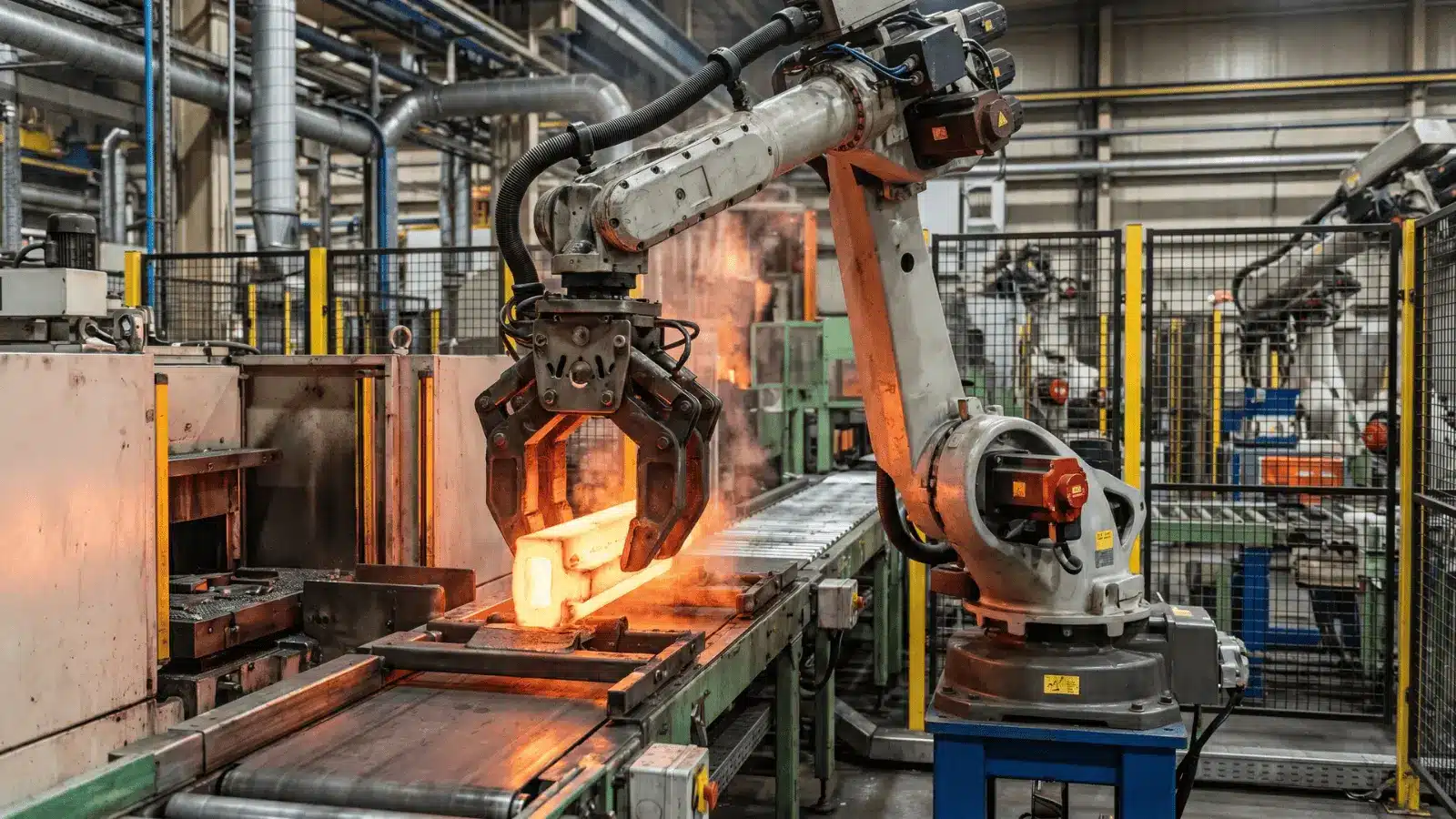
- Dangerous environments: Some jobs put workers at serious risk just by showing up. Handling toxic chemicals, working in extreme heat, or defusing explosives are tasks where a mistake can cost a life. Robots remove that risk entirely. The machine takes the damage so the person doesn’t have to.
- Repetitive tasks at scale: Humans lose focus, tire, and drift after thousands of repetitions. Robots don’t. They perform the ten-thousandth weld the same way they performed the first. For high-volume, low-variation work, that consistency is the whole point.
- Need for extreme precision: Microchip manufacturing and surgical procedures share one thing in common: a tiny mistake has outsized consequences. Robots can hold tolerances and movement precision that human hands simply cannot sustain, especially over long periods.
The outcome is clear: improved worker safety, faster output, and lower error rates. But robots have real limits too.
They have no creativity and no ability to reason outside their programming. Put a conventional robot in a situation it wasn’t built for and it fails, sometimes badly.
And they’re entirely dependent on how well they’re built and coded. A well-designed robot is a force multiplier. A poorly programmed one is a liability.
Common Misconceptions About Robots
A lot of what people believe about robots is wrong. Here’s a quick correction on the most common ones.
| Misconception | The Truth |
|---|---|
| All robots look like humans | False. Most robots have no human form at all. Humanoid robots exist, but they’re a small and specialized category. The majority are arms, wheels, or systems built purely for function. |
| Robots think like humans | No. Robots follow programmed logic. Even AI-powered robots don’t think. They recognize patterns and predict outcomes based on data. There’s no understanding behind the output. |
| Robots are replacing all human jobs | Not accurate. Robots take over specific tasks, not entire roles. A robot might handle the welding on a production line, but humans still manage the process, quality control, and decision-making. |
| All robots work on their own | Many robots require active human control. Remote-controlled surgical systems and bomb disposal units are operated by trained professionals in real time. Autonomy is a setting, not a given. |
Simple Summary of Robot Facts
Here’s a quick recap of everything covered:
- The word “robot” is over 100 years old, and the concept goes back thousands of years further than that
- A robot is defined by its ability to sense, process, and act, not by what it looks like
- Every robot runs on the same four-step loop: sense, process, act, and adjust
- There are five main types: industrial, service, medical, exploration, and AI-powered
- Robots are used where danger, repetition, or precision makes human work risky or unreliable
- Over 3 million industrial robots are already operating worldwide, and that number keeps climbing
- AI-powered robots can learn and adapt. Traditional robots follow fixed instructions and cannot
- Most robots assist humans. They don’t replace them entirely
Conclusion
Robots are more than machines that move. They’re precision tools built to handle what humans can’t, whether that’s a dangerous environment, a microscopic surgical cut, or a warehouse running at full speed overnight.
The biggest takeaway? Robots don’t replace humans; they extend what humans can do. From the factory floor to the surface of Mars, the right robot in the right role changes everything.
If you’re curious about how robotics might apply to your industry or everyday life, start exploring now. The technology is more accessible and more relevant than most people realize.
Frequently Asked Questions
How many robots are in the world today?
More than 3 million industrial robots are currently operating in factories worldwide, according to the International Federation of Robotics (IFR). That number grows every year as manufacturing, logistics, and healthcare continue to automate.
Which country uses the most robots?
South Korea has the highest robot density in the world, with around 932 industrial robots per 10,000 manufacturing workers. Singapore ranks second at 831, followed by Japan at roughly 390. All three sit far above the global average of 162 per 10,000 workers.
What was the first robot ever built?
The first programmable industrial robot was Unimate, invented by George Devol in 1954 and installed on a General Motors assembly line in 1961. The first humanoid robot was Elektro, built by Westinghouse in 1937–38. It stood seven feet tall and could speak around 700 words.
Can robots feel or have emotions?
No. Robots don’t feel anything. Some are programmed to mimic emotional responses, adjusting tone of voice or facial expressions, but that’s pattern recognition, not feeling. There’s no internal experience behind it.