

A tester with no script and no plan is doing ad hoc testing. A tester with no script and a clear method is doing something far more powerful.
That difference gets blurred a lot. Teams either treat exploratory testing as a fallback when there’s no time to write test cases, or they run unstructured sessions and call it exploratory. Both miss the point, and both produce weaker coverage than they should.
Exploratory testing is a real methodology. It has structure, it has technique, and it finds bugs that scripted tests structurally cannot reach.
What is Exploratory Testing?
Exploratory testing is the simultaneous act of learning a system, designing tests, and executing them, and it is not the same as clicking around without a plan.
A lot of teams either dismiss exploratory testing as too loose to be useful, or they practice something far closer to ad hoc testing and call it exploratory; neither works.
Here’s what actually separates the two.
- In ad hoc testing, there’s no guiding logic; a tester pokes at the application without a clear goal or any record of what they covered.
- In exploratory testing, each thing you observe changes what you test next. You’re running a real-time feedback loop: what the application does shapes your next move.
That loop is the method. It’s not written down in advance like a scripted test, but it’s not random either. The tester’s knowledge of how software tends to break and their feel for this particular application are what steer the session.
Scripted testing follows a predetermined path. Exploratory testing builds the path as it goes, using evidence.
How Exploratory Testing Actually Works
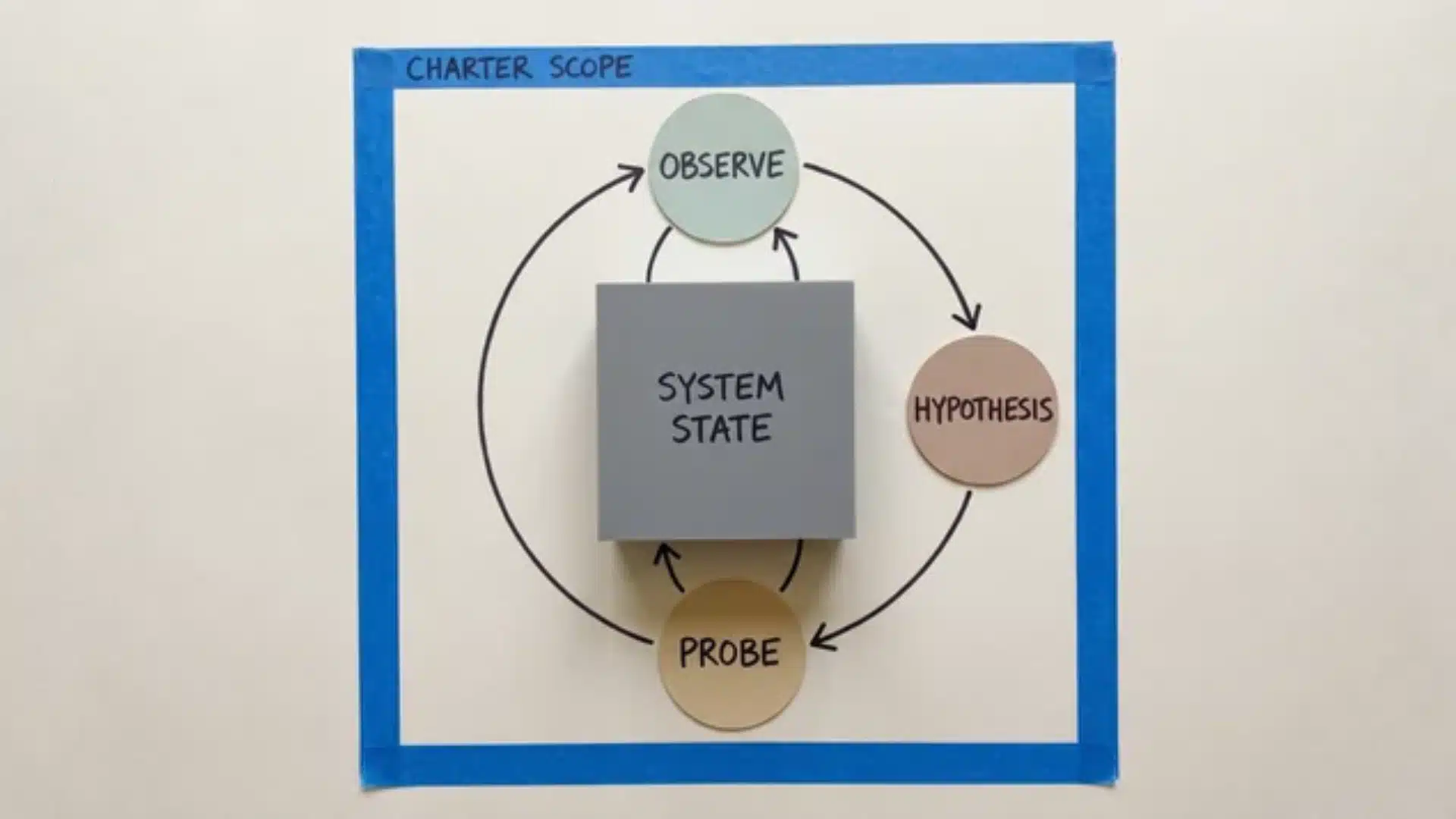
Exploratory testing starts before you touch the application. You need a charter, a short statement that defines what you’re investigating and why.
It’s not a script. It doesn’t tell you what to click. It gives the session a boundary so your investigation stays focused rather than drifting. That boundary is what keeps exploratory testing honest.
The Charter: What Scopes Exploration without Scripting It
A charter might be as simple as: “Investigate how the checkout flow handles invalid payment states.” That’s enough. It tells you where to start and what kind of findings matter. It doesn’t tell you how to get there.
Without one, you’re doing ad hoc testing even if you’re experienced and methodical by instinct. The charter is what makes the session auditable afterward.
The Observe-Hypothesize-Probe Cycle
Once you’re in the application, the session runs on a tight loop. You observe something, a response, a state change, an error. You form a hypothesis about what that means. Then you probe to test it.
That probe produces a new observation, and the loop starts again.
This is why exploratory testing finds bugs that scripted tests miss. A scripted test verifies that the application meets the specification. The exploratory loop follows unexpected behavior wherever it leads. A scripted test can’t do that; it has no mechanism to deviate from its path.
The loop breaks down in a specific way. If the tester doesn’t know the domain well enough to form useful hypotheses, observation produces nothing actionable.
That’s when exploratory sessions drift into ad hoc territory, not because the method failed, but because the method requires genuine expertise to run.
Techniques that Keep Exploration Structured
| Technique | The problem it fixes | How it works |
|---|---|---|
| Session-Based Testing | Hard to prove what you tested | Run timed sessions with a clear goal. Debrief at the end. |
| Heuristics and error guessing | Exploration feels random | Use known failure patterns to predict where things are likely to break. |
| Pair testing | One person misses things | One tester drives. One watches and spots what the driver normalizes. |
| Mind mapping | Coverage gaps you don’t notice | Map features and edge cases before the session starts. |
When Exploratory Testing Fits and when It Doesn’t
Exploratory testing works best at the edges, in new features, with unclear specs, and for behaviors no test script would think to check.
Automated tests own the stable paths. They confirm known behavior stays known. Exploratory testing finds what the specification missed.
Tester skill changes everything. Without domain knowledge and pattern recognition, sessions drift into ad hoc territory. The method needs an experienced hand to run well.
The two approaches aren’t competitors; they cover different ground. Use both, just not for the same things.
Conclusion
Exploratory testing isn’t a loose alternative to scripted testing. It’s a disciplined method with its own structure, techniques, and evidence trail, one that finds what scripts can’t.
You now know what separates it from ad hoc testing, how the observe-hypothesize-probe loop works, and which techniques make sessions auditable.
The best way to make it click is to run one. Pick a feature you’re currently working on, write a charter, and run a 45-minute session. See what the application shows you.
Frequently Asked Questions
What do you mean by exploratory testing?
Exploratory testing is when a tester learns the system, designs tests, and runs them all at the same time. Each result shapes the next move. The tester structures its knowledge rather than using a prewritten script.
What is an example of exploratory testing?
A tester receives a charter: investigate how the app handles invalid payment states. They probe the checkout flow, follow unexpected responses, and log what they find. No steps were written in advance; the application’s behavior guided the session.
What is the difference between exploratory and ad hoc testing?
Ad hoc testing has no goal, no charter, and no record of what was covered. Exploratory testing has all three. The tester’s judgment drives both, but only exploratory testing yields something auditable.
What is the difference between functional testing and exploratory testing?
Functional testing checks whether the application matches its specification. Exploratory testing investigates how the application actually behaves. One confirms expectations. The other finds what the specification didn’t anticipate.