

Turnitin and ChatGPT are often discussed together, but the way detection actually works is widely misunderstood.
Many assume it can directly identify AI use, when in reality, it relies on patterns in writing rather than proof of behavior. This creates a gap between what people expect and what the system actually does.
Today, I’ll break down how detection works at a deeper level, where it tends to be reliable, and where it starts to fail. You’ll also see why scores are often misinterpreted and what they really mean in practice.
To understand that properly, we first need to look at what Turnitin is actually detecting.
Can Turnitin Detect ChatGPT?
Yes, but with an important catch. Turnitin can flag text that shows patterns common in AI-generated writing, including text from ChatGPT.
But it doesn’t know for certain that you used ChatGPT. It can’t check your browser history. It has no access to your ChatGPT account.
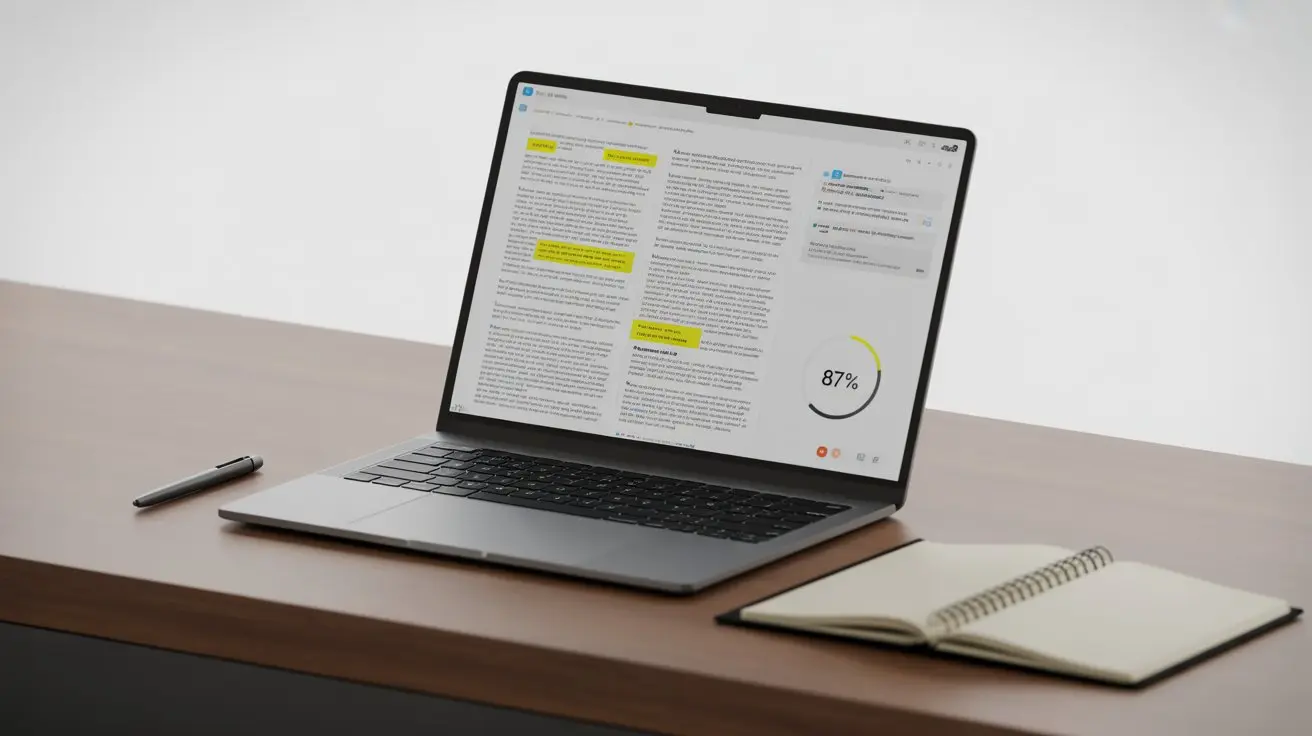
What it does is analyze your writing and produce a score showing how likely it is that the text was AI-generated.
Here’s what that means in practice:
- Turnitin gives an “AI writing likelihood” percentage
- It highlights sections that look AI-generated
- It never says “this student used ChatGPT.”
- The score is a signal, not proof
A lot of people assume Turnitin “knows” they used AI, but that’s not how it works. It reads your text and looks for patterns, nothing more.
How Turnitin Detects AI Writing

Turnitin’s AI detection isn’t the same as its plagiarism checker. There’s no database of ChatGPT outputs it’s comparing your work to. Instead, it looks at how the writing itself behaves.
1. Pattern Predictability (Perplexity)
When ChatGPT writes, it picks the most statistically likely next word at each step. This makes the output smooth, but also very predictable.
Linguists call this “low perplexity.” It means the text rarely surprises. Human writing, by contrast, takes unexpected turns. Turnitin’s system is trained to spot that predictability and flag it as AI-like.
2. Sentence Variation (Burstiness)
Humans write unevenly. One sentence might be short and punchy. The next might stretch across two lines with a dependent clause or two. That variation is called “burstiness.”
AI tends to produce sentences with a much more uniform length and structure. When burstiness is low, it’s a signal that the writing may be machine-generated.
3. Training-Based Classification
Turnitin has trained its detection model on large amounts of both human and AI-written text. It’s learned to recognize the “fingerprint” of each.
This isn’t about matching copied content; it’s about comparing linguistic patterns and producing a probability score.
Turnitin’s model doesn’t follow fixed rules. It learns patterns from large datasets of human and AI writing. These include word choice, sentence flow, predictability, and structure.
Over time, the system builds a statistical profile of what “human-like” and “AI-like” writing look like. When it scans your text, it compares those patterns and assigns a probability score based on similarity.
4. Document-Level Analysis
Turnitin doesn’t just scan sentence by sentence. It looks at how sections of a document behave together.
The result is a percentage, for example, “40% of this document appears AI-generated”, with specific sections highlighted in the instructor’s report.
Instead of scoring the entire document at once, Turnitin breaks it into smaller chunks. Each section is analyzed separately and then combined into an overall percentage.
This is why longer documents tend to produce more stable results.
With more text, the system has more pattern data to work with, which improves consistency. Short documents don’t give enough signal, so the score becomes less reliable.
What Turnitin Actually Reports
To understand how Turnitin is used in practice, think about what instructors actually look for.
Turnitin does not provide a definitive answer. Instead, it presents a set of signals based on writing patterns.
These include:
- An overall percentage indicating how much of the document appears AI-generated
- Highlighted sections where AI-like patterns are detected
- No identification of a specific tool, such as ChatGPT
- No claim of certainty, only a likelihood score
Turnitin does not make decisions; it supports them. The final judgment always comes from the instructor, who reviews the context, the writing, and the student’s work as a whole.
A high AI score is not a verdict. It’s a starting point for closer review, not automatic proof of misconduct.
How Accurate is Turnitin’s AI Detection?
Turnitin has claimed accuracy rates around 98% in controlled testing. But real-world accuracy is a different story.
In lab conditions, the model is tested on fully AI-generated, unedited text. That’s where it performs best. In real submissions, writing is almost never that clean.
Accuracy drops when:
- The text has been heavily edited after generation
- A student mixed their own writing with AI output
- The writing style is unusual, structured, or highly formal
High confidence in controlled settings doesn’t mean the same confidence in every submission. A score of 98% accuracy sounds reassuring, until you realize that’s for a very specific type of text that rarely shows up in the wild.
For example: Fully AI-generated text with no edits often gets flagged at very high confidence. But once a student edits, rewrites, or mixes in their own writing, the score can drop sharply.
This gap between clean test data and real-world writing is why accuracy claims don’t always match what instructors see in practice.
When Turnitin Detection Works vs. When It Becomes Unreliable
| Scenario | When Detection Works Well | When Detection Becomes Unreliable |
|---|---|---|
| Content Type | Fully AI-generated with no edits | Mixed human + AI writing |
| Writing Style | Formal, structured, repetitive | Creative, irregular, or unconventional |
| Pattern Consistency | Same tone and sentence patterns throughout | Patterns disrupted by rewriting or paraphrasing |
| Editing Level | Raw output with no manual changes | Heavily edited or reworked text |
| Document Length | Longer documents with consistent signals | Short documents with limited data |
Detection works best when patterns are clear and consistent. As soon as those patterns are disrupted by editing, mixing, or creative variation, the system loses reliability.
Why False Positives Happen
This is one of the most overlooked issues with AI detection, and it matters a lot. Turnitin sometimes flags human writing as AI-generated, and it’s not a rare edge case.
It happens because:
- Highly structured academic writing naturally mimics AI patterns
- Non-native English speakers often write in more predictable, formulaic ways
- Repetitive or template-style writing lowers burstiness scores
- Some writing styles just happen to be smooth and uniform
When a student writes carefully structured, grammatically correct prose, Turnitin may read that as “too clean to be human.” That’s a false positive, and it can have real consequences if instructors treat the score as proof rather than a signal.
A high AI score is not evidence of cheating, but a starting point for conversation.
Common Myths About Turnitin and ChatGPT Detection
There’s a lot of misinformation about what Turnitin can and can’t do. Here are the most common ones, set straight.
These myths come up constantly, and most of them misrepresent how the tool actually works:
- Turnitin can see your ChatGPT history: False. Turnitin only reads the text you submit. It has no connection to ChatGPT or any AI platform.
- Paraphrasing always beats detection: Not always. Light rewording often doesn’t break the AI pattern enough. Deeper rewriting may reduce the score, but results vary.
- AI detection and plagiarism detection are the same thing: They’re completely different. Plagiarism detection matches text against a database. AI detection classifies writing behavior. Neither replaces the other.
- Turnitin is always accurate: It isn’t. Accuracy depends heavily on the type of text, how it was written, and how much editing happened after generation.
What “Detection” Really Means
Here’s the bottom line.
When Turnitin “detects” ChatGPT, it means one thing: the writing shows patterns that are statistically more common in AI-generated text than in human writing. That’s it.
It doesn’t mean:
- The student definitely used ChatGPT
- The submission is dishonest
- The score is final or definitive
Turnitin analyzes writing style, not behavior. It produces a probability, not a verdict. The final judgment always comes from a human, usually the instructor, who looks at the full context.
Understanding this distinction matters. Whether you’re a student, educator, or just trying to understand how these tools work, it’s important to know that AI detection is a lens, not a gavel.
Wrapping Up
Turnitin can detect writing that looks like ChatGPT, but it can’t read minds, check browser history, or prove authorship. It works on probabilities, not certainties.
The score it produces is a signal, not a verdict. False positives happen, and context always matters.
Understanding how this tool actually works puts you in a much better position, whether you’re a student, an educator, or just curious about AI.
Want to stay ahead of how AI is changing writing and detection? Read more blogs on this topic and keep yourself informed.
Frequently Asked Questions
Does Turnitin detect all AI tools, not just ChatGPT?
Yes. Turnitin detects AI writing patterns, not specific tools, so content from ChatGPT, Gemini, Claude, or other AI systems can also be flagged.
Can Turnitin detect ChatGPT if you copy and paste without editing?
Yes. Detection is most reliable with raw, unedited AI text because it contains strong and consistent AI-generated patterns.
What happens if legitimate work gets flagged by Turnitin?
A high AI score is not proof of misconduct. It is a signal, and instructors review the work and context before making any decision.
Does Turnitin flag Grammarly or AI-assisted editing as AI writing?
Light grammar corrections usually do not trigger detection. However, heavy AI-assisted rewriting can create patterns that may be flagged.



One Response