


Every CIO eventually hits the same wall: legacy processes that technology alone can’t fix. That’s where business process services (BPS) providers come in, pairing automation, AI, and domain know-how to modernize operations without a rip-and-replace overhaul. Here’s who’s actually delivering.
The Automation Projects That Never Leave the Pilot Stage
Most enterprises don’t lack automation tools; they have RPA licenses sitting half-used and an AI proof-of-concept that impressed the board months ago without moving an inch since. Internal IT teams are usually staffed to keep systems running, not to redesign the messy, exception-heavy workflows automation actually depends on, and 30% to 50% of initial RPA implementations fail to deliver the value they promised.
The reasons tend to repeat across industries:
- The bot works on clean test data but chokes the moment it hits a scanned invoice, a mismatched PO number, or a handwritten note
- Nobody assigned ownership of exceptions, so unusual cases quietly pile back onto the human team anyway
- The pilot succeeds in one department and never gets rebuilt for another, because it was never designed to be reusable
- McKinsey identifies integration with legacy systems and organizational resistance to workflow changes as the largest barriers to scaling enterprise automation.
This is the exact terrain BPS providers have spent years mapping. They’ve already handled the invoice with the coffee stain and the claim with three conflicting codes, and that accumulated pattern-recognition is what separates a partner who accelerates transformation from one who just adds another dashboard.
The Companies Worth Evaluating
Below are five providers that show up consistently in enterprise shortlists, each with a distinct angle on how they combine people, process, and AI.
DXC Technology
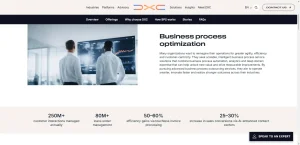
DXC runs one of the broadest business process services portfolios in the industry, built on decades of experience serving regulated sectors like insurance, banking, healthcare, and government. Its business process services support more than 185 clients in over 100 countries, handling high-volume credit, debit, and payroll transactions while cutting call volumes, and the firm’s insurance practice alone touches roughly a fifth of global property and casualty transactions.
What sets DXC apart is how it packages BPS offerings around outcome-based pricing rather than pure headcount arbitrage – clients can choose platform-enabled BPaaS models, fully managed outsourcing with SLAs, or hybrid co-managed setups depending on how much control they want to retain. DXC is also a licensed third-party administrator in multiple countries, which matters a lot to compliance-conscious buyers in insurance and financial services.
Pros:
- Deep regulatory and compliance infrastructure, particularly for insurance and public sector work
- Flexible engagement models (BPaaS, managed services, hybrid) rather than one-size-fits-all contracts
- Massive global delivery footprint across onshore, nearshore, and offshore centers
Cons:
- Turnaround narrative still in progress following years of restructuring and leadership changes
- Some reviewers note delivery still leans more on process discipline than bleeding-edge automation compared to smaller, more agile rivals
Genpact

Genpact’s roots trace back to General Electric’s internal process organization, and that operational DNA still shows up in how the company approaches transformation work. Its Digital Smart Enterprise Processes methodology blends Lean Six Sigma with domain-trained AI models, and finance leaders frequently report meaningful productivity gains within the first quarter of deployment.
The company reported $1.3 billion in revenue for the first quarter of 2026, up nearly 7% year over year, with its Advanced Technology Solutions segment growing the fastest. Genpact leans hard into its Cora AI platform to embed automation directly into finance, supply chain, and risk operations rather than bolting it on afterward.
Pros:
- Strong process-engineering pedigree that predates the AI hype cycle by decades
- Cora platform ties automation, analytics, and workflow redesign together in one stack
- Consistent double-digit earnings growth signals financial stability for long-term contracts
Cons:
- Revenue growth still trails some smaller, faster-moving competitors
- Regional client concentration remains a noted risk factor for the business
EXL Service
EXL built its reputation on data and analytics before “AI-driven operations” became a marketing category, and that shows in how it structures engagements. With roughly three-quarters of its revenue tied to insurance and banking, EXL focuses tightly on payment integrity, claims automation, and revenue-cycle work where labeled data quality directly affects model accuracy.
The company posted $570.4 million in quarterly revenue, up nearly 14% year over year, and has set a medium-term growth target of around 12% annually. EXL tends to work well for mid-market organizations that want a hands-on partner rather than a sprawling global consultancy relationship.
Pros:
- A data-first approach, really, with thousands of analytics and AI pros in-house
- Deep expertise in claims processing and payment integrity
- Better suited for mid-market clients who don’t need (or want) a large multinational engagement
Cons:
- The breadth is lower for companies outside of insurance, banking and healthcare, with a more narrow industry focus.
- DXC or Capgemini are on a smaller scale and are limited in capacity for largest global rollouts
Capgemini

Capgemini’s profile changed dramatically when it bought BPO firm WNS Holdings for about $3.3 billion in late 2025, marrying Capgemini’s strategy-and-technology consulting pedigree with WNS’s vertical BPO depth in banking, travel, and healthcare. Everest Group named Capgemini a Leader in its Agentic Process Automation Solutions assessment for 2026, citing its DGEM, RAISE, and Resonance AI frameworks alongside the WNS deal as key differentiators.
One early result: a €600 million multi-function contract running on an agentic AI platform that coordinates customer service, finance, and supply-chain workflows simultaneously. For enterprises wanting consulting-grade strategy work bundled with real execution muscle, this combination is hard to match right now.
Pros:
- Consulting-led approach means process redesign happens before automation, not after
- WNS acquisition significantly deepened vertical BPO expertise overnight
- Agentic AI platforms recognized as industry-leading by independent analysts
Cons:
- Integration of two large organizations takes time; some friction during the transition is likely
- Premium consulting pricing may be a stretch for smaller enterprise budgets
Conduent
Conduent doesn’t get the same spotlight as its peers, but its numbers are hard to ignore: 2.3 billion customer interactions, 13 million toll transactions daily, and roughly $85 billion in government payments processed each year. The company has quietly rolled out AI initiatives covering document understanding, fraud prevention, and agent-assist tools, including a GenAI assistant built on Azure OpenAI that has reportedly cut average handle time by around 15% in early pilots. Conduent tends to be the pick for organizations with high-volume, transaction-heavy operations – government agencies, toll authorities, and large-scale customer service operations in particular.
Pros:
- Exceptional scale for high-volume, transaction-based government and public-sector work
- Practical, targeted AI rollouts rather than sweeping platform bets
- Lower profile often translates to more competitive pricing
Cons:
- Less brand recognition in industries outside government and large-scale transaction processing
- Fewer publicized case studies compared to larger consulting-style competitors
A Different Way to Size Them Up
Instead of ranking these five against generic categories, it’s more useful to look at the single biggest bet each one has made recently, because that bet tends to predict what you’ll actually get.
| Provider | Recent Bet | What It Signals |
| DXC Technology | Won a contract worth up to £1 billion with London’s Metropolitan Police for combined ERP and BPO services | Comfortable with long, complex public-sector rebuilds under real scrutiny |
| Genpact | Doubled down on its Cora platform and Advanced Technology Solutions segment | Betting that owning the tech stack, not just the labor, is where margin lives |
| EXL Service | Set a public 12% medium-term growth target tied entirely to its data and AI strategy | Willing to be judged on AI outcomes rather than headcount metrics |
| Capgemini | Spent roughly $3.3 billion acquiring WNS outright | Chose to buy vertical BPO depth rather than build it internally |
| Conduent | Quietly deployed eight production AI initiatives inside existing high-volume government contracts | Prioritizes incremental gains inside contracts it already holds over flashy new wins |
Where Deals Actually Go Sideways
The failure points in these engagements rarely show up in the initial proposal. They show up eighteen months in, usually around one of three things.
First, transition costs: moving a process from your internal team to a provider almost always costs more in the first two quarters than anyone budgeted for, because knowledge transfer takes longer than the SOW implies.
Second, who controls the automation logic once it’s built if the provider’s platform is proprietary and the contract doesn’t specify data and model portability, switching providers later becomes far more expensive than it should be.
Third, how “AI-driven” claims get measured; a vendor citing a 40% reduction in processing time is a meaningful number only if you know the baseline it’s measured against and whether that baseline reflects your actual current-state process or an idealized one.
None of this means avoid the category – it means read the statement of work like someone who expects to renegotiate it in year two, because you probably will.