


Searching for the best tech news sources feedworldtech turns up dozens of options. Most end up in a bookmarks folder you never open again.
The real problem isn’t finding sources. It’s knowing how each outlet works, who writes it, and what kind of news it actually does best.
A search for world techie news feedworldtech roundups will hand you plenty of names. But these outlets aren’t fighting for the same reader. Mix the wrong ones and your feed turns repetitive fast.
Once you know what each source does well, building a feed you’ll actually use gets a lot easier. Here’s how to match the right sources to what you want to track.
Why Does the “Best” Tech News Source Depend on What You’re Tracking?
TechCrunch, The Verge, and Ars Technica show up on every “best of” list. That doesn’t mean you can swap one for another.
Each one covers a different slice of tech, for a different kind of reader, at a different depth.
Here’s the mistake I see people make constantly: they pick outlets by reputation, not by fit. Track AI research through consumer-only outlets and you get surface takes on every announcement.
Follow gadgets but subscribe to enterprise IT coverage, and most of what lands in your feed won’t matter to you.
If your feed has ever felt like noise, this is usually why. The wrong sources don’t cost you stories. They cost you attention.
Your feed fills up, you start skimming, then you stop opening it at all.
This isn’t about chasing the most popular names. It’s about matching the source to what you’re actually trying to track. That’s the job the rest of this guide does for you.
Sources by Focus Area: What Each One Actually Covers
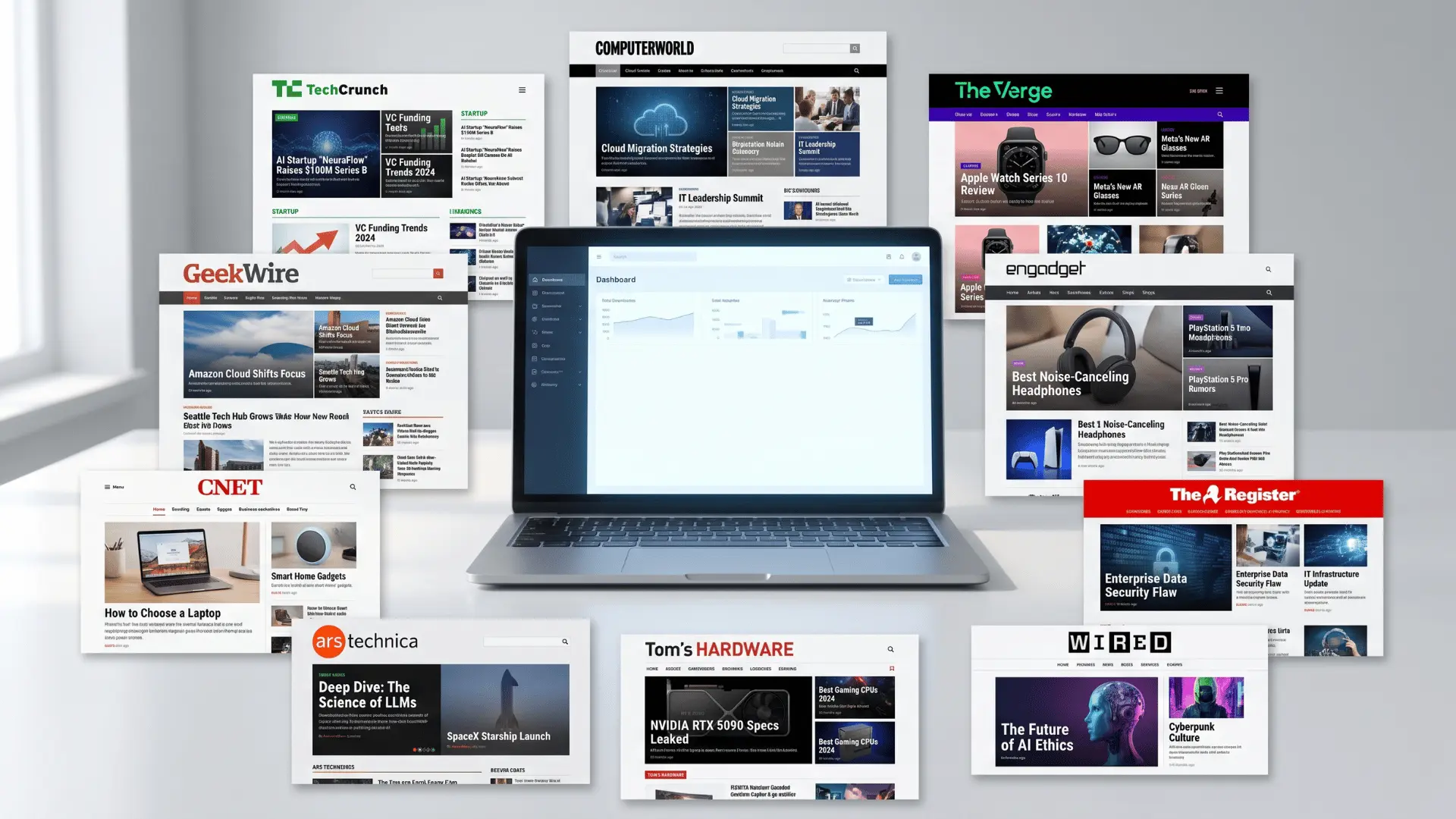
The list below isn’t ranked by quality. It’s grouped by what each outlet actually covers. Start with the category that matches what you need to follow.
1. Startup & Venture
Both outlets cover startup and funding news, but from different angles.
TechCrunch is the go-to for funding rounds, founder interviews, venture capital moves, and acquisitions across Silicon Valley.
Its reporting tracks deal flow, investor priorities, and company growth, especially right after a new round or launch goes public.
GeekWire covers tech and business through a Pacific Northwest lens, watching Amazon, Microsoft, startups, and regional funding closely.
I’ve found GeekWire catches Seattle stories national outlets miss entirely, especially when Amazon or Microsoft make a quiet move.
If that region matters to your work, GeekWire fills a gap TechCrunch leaves wide open.
2. Consumer Tech & Culture
These three overlap more than any group here. All three cover devices, apps, and consumer software. The difference is tone and depth.
The Verge treats tech as part of culture. It uses products as a starting point for stories about design, politics, and daily life.
It often moves past specs and launch details to ask how a device or trend actually changes behavior.
Engadget sticks closer to the product itself: hands-on impressions, reviews, and release news. It’s told in a lighter voice than most rivals.
CNET focuses on reviews, comparisons, and buying guides, built for someone deciding what to actually buy.
Here’s the shortcut I use: read The Verge for analysis, read CNET when you’re about to spend money.
3. Deep Technical & IT
These two assume you already know the basics. Neither one stops to explain what a kernel is.
Ars Technica covers science, cybersecurity, and systems-level tech in enough depth to satisfy engineers and researchers who dislike simplified summaries.
Its pieces explain how a technology works and why it failed, giving technical readers context shorter news skips over.
The Register covers enterprise IT, infrastructure, cybersecurity, and tech business, with a dry, sardonic voice that sets it apart.
I go here first whenever The Verge feels too shallow on the technical side.
4. AI & Emerging Technology
Both outlets cover AI, but for readers with very different stakes.
WIRED looks at emerging tech through culture, policy, and science, asking how innovation reshapes daily life and power.
Its AI coverage asks who benefits and who carries the risk, not just what shipped this week.
Computerworld covers tech through an enterprise lens: IT strategy, procurement, cybersecurity, and cloud decisions inside large organizations.
I keep both in rotation because AI’s social risk and its budget risk rarely get covered by the same writer.
Read both, and you get the full picture in one sitting.
5. Hardware & Components
Hardware sites are built for readers who care about performance, compatibility, and upgrade paths.
Tom’s Hardware covers component reviews, dependable benchmarks, and practical advice on processors, graphics cards, storage, and full PC builds.
I’ve watched enough builds go over budget to say: read the benchmarks here before you buy, not after.
If you build or upgrade your own machine, this belongs in your feed. If not, skip it.
Aggregators and Community Feeds: Reddit, Hacker News, and Daily.dev

Editorial outlets and aggregators do different jobs. Outlets report and explain. Aggregators surface links you’d otherwise miss.
How Editorial Outlets Work
Editorial outlets add structure. They pick the stories that matter, check the facts, and explain how each one fits the wider picture.
Here’s what that structure looks like day to day:
- Reporters and editors choose stories, verify details, and build original coverage on a set schedule.
- Editors decide what deserves attention, while journalists check claims before anything publishes.
I trust these outlets because someone checked the claim before I ever saw it. That’s the whole reason they’re worth your time.
Why Hacker News and Reddit Are Useful
Hacker News and Reddit both find things before the big outlets do. They just find them differently.
What makes each one worth checking:
- Hacker News runs on link voting. Developers rank posts from blogs, papers, and GitHub discussions, so niche technical work rises fast.
- Reddit runs on subreddits. Threads on r/technology or r/sysadmin surface personal recommendations and real-world stories no editor would ever assign.
I check Hacker News for the technical deep cut. Reddit is where I go for what actual IT people are dealing with this week.
Some of what surfaces here never reaches a mainstream outlet at all. If you’ve ever wanted to know what practitioners think before the press catches up, this is where you look.
Where Aggregators Fall Short
Aggregators are great for finding what got missed. They’re not built for reliable, day-to-day coverage.
Where the limits show up:
- Neither Hacker News nor Reddit covers announcements consistently. Rankings just reflect what a community found interesting that day.
- That makes both excellent for discovery, but unreliable as your only source for verified, timely reporting.
Use them to catch what editors missed, not to replace the editors. That’s a mistake I’ve made myself, and it cost me a week of missed context on a story that mattered.
Daily.dev and Feed Overlap
Daily.dev personalizes discovery around your interests, pulling from developer blogs and independent sources. It works like Hacker News, just tuned to you.
The tradeoff stays the same: strong discovery, thin editorial depth. It surfaces good material but never replaces actual reporting.
Run Daily.dev alongside Hacker News and you’ll mostly see the same links twice. I stopped bothering with both once I noticed the overlap wasn’t worth the extra tab.
How to Build a Feed That Stays Useful: RSS, Newsletters, and Reading Modes
A useful feed depends on more than picking good sources. Format and source count matter here too.
Combined with how you actually read, they decide whether a feed becomes a habit or a list you ignore.
| Feed Element | How It Works | Best For | Main Risk | Smart Approach |
|---|---|---|---|---|
| RSS readers | Pull articles from selected publications into one place. You decide when to open and read them. | Readers who prefer to catch up in one planned session. | Unread stories can build up quickly when too many sources are added. | Use a tool such as Feedly or FreshRSS and check it at a set time instead of trying to clear every article. |
| Newsletters | The publisher chooses when updates arrive in your inbox. | Readers who want a short, concise digest without having to check several websites. | Too many subscriptions can turn the inbox into another noisy feed. | Keep only newsletters you regularly open. Unsubscribe when several issues pass unread. |
| Community aggregators | Surface stories based on votes, comments, or community interest. | Finding discussions, emerging topics, and stories that editorial outlets may miss. | Popular stories can crowd out important but less engaging coverage. | Use one aggregator to support your editorial sources, not replace them. |
| Source count | Every added publication increases the number of daily stories. | Building coverage across different areas of technology. | Once the feed becomes too large, reading turns into fast scanning. | Aim for five to seven editorial sources plus one community aggregator. |
| Adding new sources | New publications fill gaps in topics your current feed does not cover. | Expanding coverage when a real need appears. | Adding sources out of habit creates repetition and overload. | Start small. Add a source only when you notice a clear gap. |
| Removing sources | Dropping weaker or repetitive outlets keeps the feed focused. | Protecting the time you spend reading each day. | Keeping every source can make the feed feel like work. | When you reach your limit, remove one source before adding another. |
RSS and newsletters aren’t automatically better together. Pick the format that matches how you already read.
Then keep your source list small enough that you still open it. I’ve seen people build 40-source feeds and stop reading within a month.
A focused feed you check every day beats a complete one you abandon after two weeks. That’s the whole point of this exercise.
Wrapping Up
A good tech feed isn’t about following the most sources. It’s about following the right ones for what you actually care about.
The outlets covered here serve different readers, reading levels, and professional needs. Treating them as one pool and picking randomly is why most feeds fail.
Start with your focus area. Choose two or three outlets that serve it well, add one aggregator, and pick a format that fits how you read.
That beats chasing every list of best tech news sources feedworldtech readers find online. The best feed is simply the one you open every day.
Frequently Asked Questions
What is the most trusted tech news source overall?
Ars Technica and The Verge consistently rank as the most trusted general-purpose tech outlets. Ars Technica is stronger for technical depth and IT coverage. The Verge leads on consumer technology and culture. Neither covers everything, which is why most readers use both alongside one niche source matched to their focus area.
Is Hacker News reliable for tech news?
As a discovery tool, yes. As a news source, no. Hacker News does not assign reporters, edit stories, or cover breaking news. Its value is surfacing technical and niche content from across the web that major outlets miss. That is genuinely useful, just not for the same reasons an editorial outlet is.
What is the difference between an RSS reader and a tech newsletter?
An RSS reader pulls articles from sources you choose into a single interface, on your schedule. A newsletter arrives in your inbox when the publisher sends it. RSS suits readers who prefer to batch their reading. Newsletters suit readers who want a pre-edited digest without having to manage a feed themselves.
How many tech news sources should I follow?
Five to seven editorial sources plus one community aggregator is a workable ceiling for most reading habits. Beyond that, daily volume tends to push you toward headline-scanning rather than actual reading. At that point, the feed is no longer doing its job, regardless of how good the individual sources are.