


Artificial Intelligence is changing the game in ways we never thought possible, and the battle between Generative AI vs. Agentic AI is at the center of it.
But to truly understand where these technologies are heading, it’s crucial to stay updated on the ongoing LLM Research, as it shapes the foundation of both Generative and Agentic AI systems.
One’s all about generating content based on what you give it, while the other takes things a step further, acting on its own to achieve a goal through a series of decisions.
But it’s not as simple as it sounds.
Today, I’m going to break down what sets these two apart; what they can do, where they struggle, and what their future holds. Stick around, and you’ll have a solid grasp on where both of these AIs fit in the bigger picture. Let’s start with Generative AI.
What is Generative AI?
Generative AI refers to artificial intelligence systems that create content, typically from text prompts.
These systems use algorithms to process input and generate outputs such as text, images, or music, often used for creative or informational tasks.
The most common example of Generative AI is language models like GPT-4, which produce human-like text based on the prompts it receives.
How Does Generative AI Work?
Generative AI operates reactively, responding to prompts by generating content that fits the given input.
For example, when you ask a Generative AI model to write an article or generate code, it relies on large datasets and statistical patterns learned during its training to produce an output that aligns with the request.
While the process of generating content is impressive, it is important to understand its limitations.
Generative AI, by nature, does not make decisions or plan ahead. It can fail when faced with complex, context-heavy tasks that require multi-step reasoning or decisions beyond the immediate scope of the prompt.
What is Agentic AI?
Agentic AI is an entirely different type of system. Unlike Generative AI, which reacts to input, Agentic AI is proactive. These systems can set goals and take independent actions to achieve them, often through multi-step processes.
They are designed to operate autonomously, performing tasks such as optimizing workflows, making real-time decisions, and interacting with their environment.
How Does Agentic AI Work?
Agentic AI is goal-driven. Once given a goal, an Agentic AI system can plan and execute tasks without requiring constant human input.
For example, an Agentic AI in a manufacturing plant might autonomously adjust operations, detect inefficiencies, and fix them without the need for explicit instructions from human operators.
Agentic AI systems are more complex than Generative AI. They rely on an understanding of the task at hand, the ability to plan, and a higher degree of autonomy.
Key Differences Between Generative AI and Agentic AI
The primary distinction between Generative AI and Agentic AI lies in their operational mechanisms.
Generative AI is reactive, creating content in response to input prompts. Agentic AI, however, is autonomous, capable of setting and pursuing its own goals without constant guidance.
| Aspect | Generative AI | Agentic AI |
|---|---|---|
| Functionality | Creates content from prompts | Operates autonomously to achieve goals |
| Decision Making | No decision-making or long-term planning | Makes independent decisions and plans |
| Complexity | Primarily handles simpler tasks | Handles complex, multi-step tasks |
| Interaction | Responds to input; content-based output | Interacts with environments and adjusts strategies |
| Goal Orientation | No goal-setting; passive interaction | Goal-oriented and proactive |
How Agentic AI Uses Generative AI
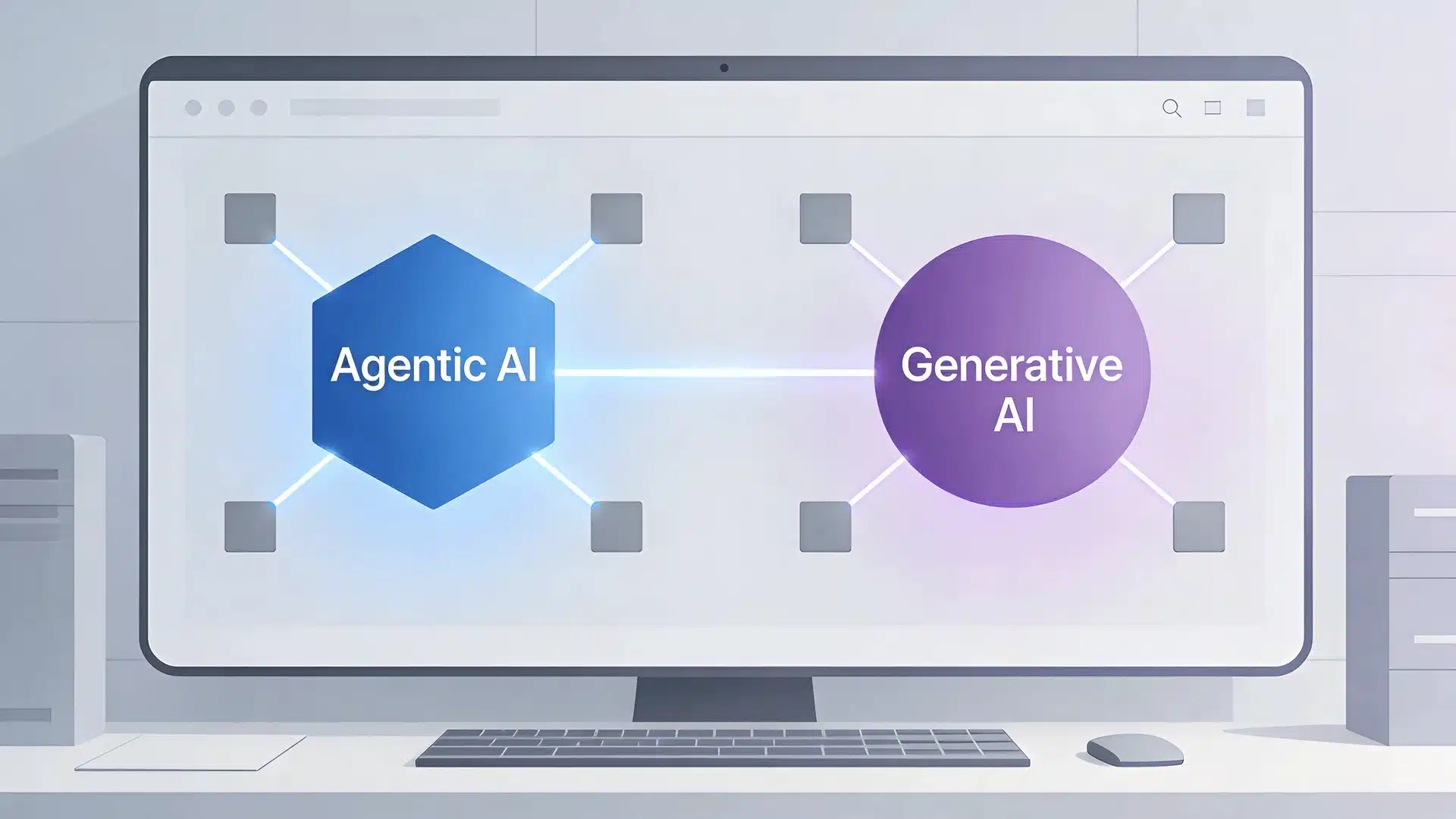
While Generative AI and Agentic AI are distinct, they can complement each other.
Recent updates in Agentic AI have pushed the boundaries, allowing these systems to leverage the content-generation capabilities of Generative AI more effectively. For a look into how these updates are reshaping Agentic AI, check out the latest post on Agentic AI Updates.
Agentic AI systems can leverage Generative AI to enhance their ability to generate content or solutions in specific contexts.
For instance, an Agentic AI tasked with designing a marketing campaign might use Generative AI to write copy or create visuals.
The synergy between these two technologies helps Agentic AI systems operate more effectively.
By integrating the content-generation capabilities of Generative AI, Agentic AI can focus on its primary task of achieving goals, while Generative AI handles the creative or content-based elements of the process.
The Future of Generative and Agentic AI
Looking ahead, both Generative AI and Agentic AI are on the path to significant advancements. These improvements will make each technology more reliable and capable, but also bring new challenges. Here’s what to expect:
- Training Efficiency Improvements: Expect better training methods that will make both Generative and Agentic AI faster, more accurate, and adaptable to diverse environments.
- Generative AI’s Expanding Capabilities: While Generative AI currently struggles with complex, multi-step tasks, advancements will allow it to handle more intricate content generation and provide deeper insights.
- Agentic AI’s Growth in Autonomy: Agentic AI will become more autonomous, able to make decisions and adapt more effectively to dynamic environments. However, this increase in autonomy raises concerns about control and ethical decision-making.
- Ethical Considerations: As these technologies evolve, it’s important to balance their capabilities with ethical concerns, ensuring that these AI systems don’t operate outside of human oversight or cause unintended harm.
While these changes bring exciting possibilities, they also require careful attention to ensure AI’s benefits are maximized responsibly.
Wrapping Up
The differences between Generative AI and Agentic AI lie in how they operate.
Generative AI is a reactive system, capable of producing content based on input prompts but lacking in long-term planning or decision-making. It excels at content creation but struggles with complex tasks.
On the other hand, Agentic AI is goal-oriented and proactive, autonomously setting and pursuing its objectives, which makes it more suitable for complex, long-term tasks that require decision-making and adaptability.
Looking to the future, both technologies will continue to evolve and complement each other.
As advancements in AI training and efficiency reduce existing limitations, we can expect both Generative AI and Agentic AI to play increasingly pivotal roles in industries ranging from creative content generation to autonomous systems management.
Frequently Asked Questions
Is ChatGPT Generative AI or Agentic AI?
ChatGPT is a form of Generative AI, as it generates text-based responses based on user input. It does not set goals or operate autonomously.
What is the main difference between Generative AI and Agentic AI?
Generative AI is reactive, creating content based on input prompts, while Agentic AI is proactive, setting goals and independently taking actions to achieve them.
Can Agentic AI replace Generative AI?
No, Agentic AI cannot replace Generative AI. They serve different purposes: Generative AI creates content, while Agentic AI manages tasks and makes decisions.
How does Agentic AI benefit businesses?
Agentic AI helps businesses by automating complex decision-making and optimizing workflows, leading to greater efficiency and improved performance across various industries.