

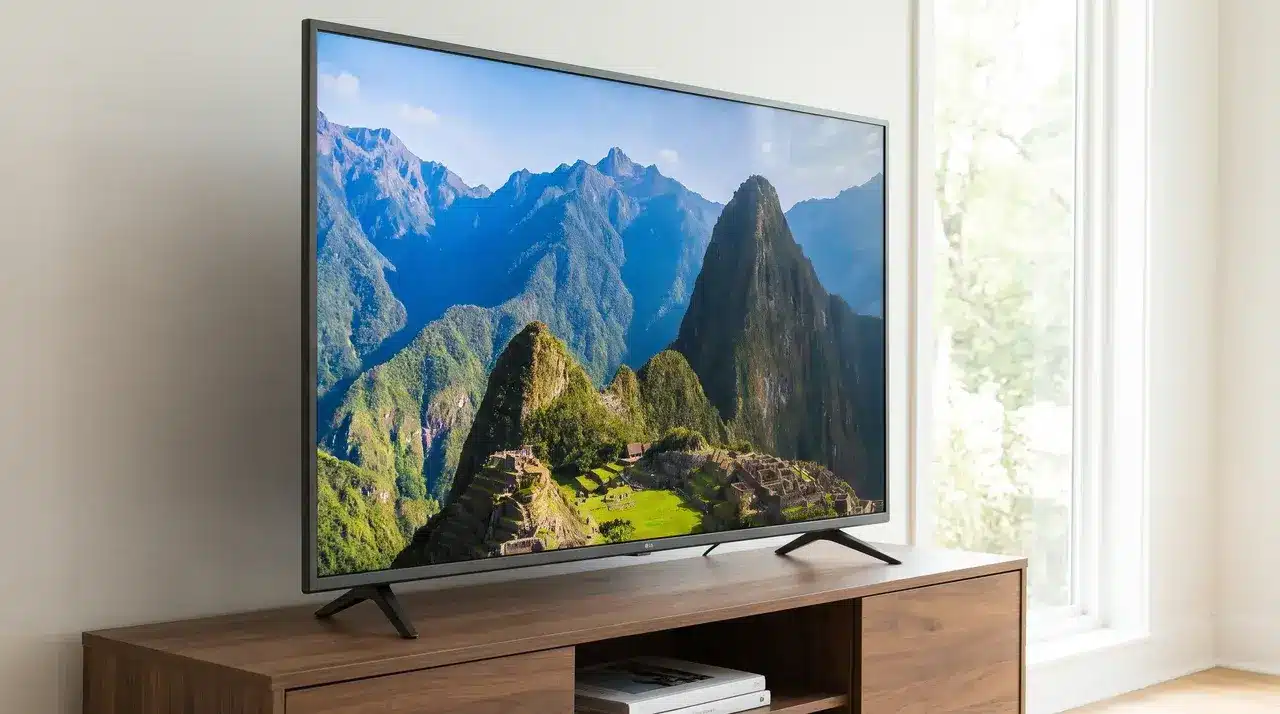
QLED TVs are everywhere, but the name can still leave you wondering what you’re actually getting.
Is QLED just another name for LED, or does the quantum dot technology really make a difference? I used to think the label told you most of what you needed to know, but there’s more to it.
A QLED TV uses an LED backlight and a quantum dot layer to improve color and brightness.
That makes it different from OLED, where each pixel produces its own light. Understanding how QLED works makes it much easier to compare TVs and decide which screen fits your room, viewing habits, and budget.
What is QLED TV?
QLED stands for Quantum Dot Light Emitting Diode and refers to an LCD TV that uses quantum dots with an LED backlight. Unlike a basic LED TV, a QLED model adds a quantum dot layer to help control and improve the color produced by the backlight.
The LCD layer still controls how much light reaches each part of the screen, so QLED pixels do not create their own light like OLED pixels do. QLED TVs can also use different backlight systems.
Some use conventional LED backlighting, while higher-end models may combine quantum dots with Mini-LED backlights and local dimming.
Because QLED is a display approach rather than a resolution, a QLED TV can also have 4K or 8K resolution.
How Do Quantum Dots Work?

Quantum dots are a key part of what gives QLED TVs their strong color performance. They are tiny semiconductor particles that respond to light and emit specific wavelengths.
In many current QLED designs, a blue LED backlight provides the light that excites the quantum dots, which then convert some of that light into red and green wavelengths.
- Tiny Particles: Quantum dots are nanoscale semiconductor particles whose size affects the wavelength of light they emit.
- Light Conversion: A light source excites the dots, causing them to emit narrow bands of colored light.
- Red and Green Light: In many QLED TVs, quantum dots convert part of the blue LED backlight into red and green light.
- Stronger Colors: This can help produce a wider, more saturated color range and maintain strong color at higher brightness.
- Color Volume: Better color performance at different brightness levels can help QLED TVs display bright HDR scenes with richer color.
The exact result depends on the TV’s panel, backlight, processing, and quantum-dot implementation. That is why two QLED TVs can still have noticeably different picture quality.
QLED vs. OLED: What’s the Difference?
QLED and OLED use very different methods to produce an image. QLED is still an LCD-based display that needs a backlight, while OLED uses self-emitting pixels that can control their own light.
That difference affects black levels, contrast, brightness, and viewing angles.
| Feature | QLED | OLED |
|---|---|---|
| Light source | LED backlight | Self-emitting pixels |
| Black levels | Can show some light in dark areas | Pixels can turn off for true blacks |
| Contrast | Depends heavily on backlight and local dimming | Excellent pixel-level contrast |
| Brightness | Often very bright, depending on the model | Can be very bright, but performance varies by model |
| Viewing angles | Usually narrower | Usually wider |
| Burn-in | Not prone to OLED-style burn-in | Can experience permanent image retention |
| Best suited to | Bright rooms and high-brightness viewing | Dark rooms and viewers who prioritize deep blacks |
QD-OLED is another option. It uses self-emitting OLED pixels together with quantum dots, combining OLED’s pixel-level light control with quantum-dot color conversion.
For a bright room, a good QLED can be a strong choice because its backlight can deliver high brightness. For dark-room movie watching, OLED generally has the edge in black levels and contrast. The specific TV still matters, since panel type, backlight design, local dimming, and processing can change the result.
What are the Benefits of QLED?
QLED TVs can offer several advantages, but the exact results depend on the model and its backlight system. Quantum dots mainly help with color performance, while the backlight and local dimming system play a major role in brightness and contrast.
- High Brightness: Many QLED TVs can reach high brightness levels, making them useful for rooms with plenty of daylight.
- Strong Color: Quantum dots can help produce a wide color range and maintain color at high brightness.
- Bright-room viewing: A bright backlight can make TV content easier to see in bright rooms.
- No OLED-Style Burn-In: QLED does not use organic self-emitting pixels, so it does not have the same burn-in risk associated with OLED.
- Many Choices: QLED is used across a broad range of TVs, from more affordable models to premium sets with advanced local dimming and Mini-LED backlights.
Keep in mind that the QLED name alone does not guarantee a certain level of picture quality. A model with better local dimming, higher brightness, and stronger processing can look very different from a basic QLED TV.
Is QLED TV Worth It?
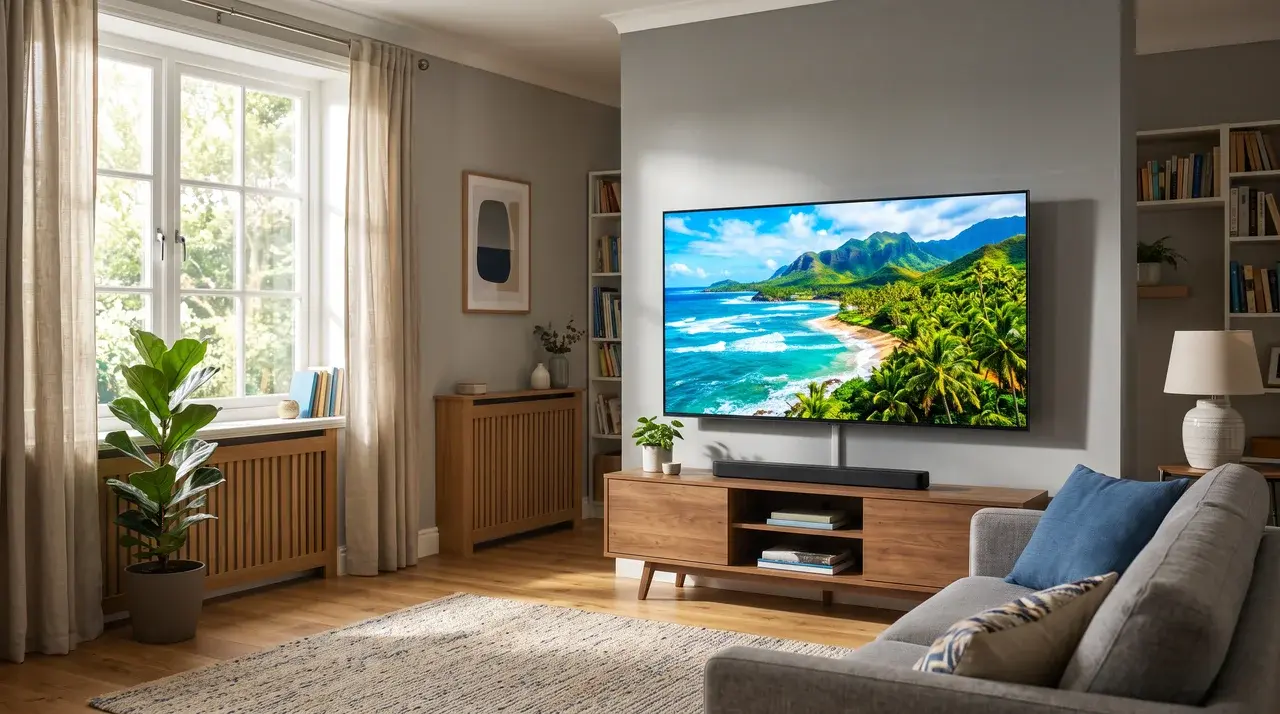
QLED can be a smart choice when brightness and strong color matter more than perfect black levels. It works especially well in rooms with windows or lots of daylight, where a bright LCD can stay easier to see.
It also avoids the same burn-in concern associated with OLED, which can matter for people who watch channels with fixed logos or use a TV as a monitor for long periods.
OLED may be a better fit if you mainly watch movies in a dark room and want the deepest blacks and strongest pixel-level contrast.
Getting the right screen size for your space also shapes how noticeable these picture differences feel day to day.
QLED covers a wide range of TVs, so compare the actual panel, backlight, local dimming, brightness, and picture processing instead of choosing from the QLED label alone.
Final Thoughts
QLED TVs sit between familiar LED technology and newer display designs, using quantum dots to improve color while keeping an LED backlight.
They can be a strong choice for bright rooms, HDR viewing, and anyone who wants rich colors without choosing OLED.
At the same time, OLED still has an advantage for deep blacks, pixel-level contrast, and dark-room movie watching. I’d also pay attention to the individual TV rather than choosing one based only on the QLED label.
Backlighting, local dimming, brightness, and picture processing can make a big difference. Which TV technology do you prefer for your home? Share your pick in the comments below.
Frequently Asked Questions
Does QLED Have Better Picture Quality Than LED?
QLED can offer better color and brightness than many standard LED TVs, but actual picture quality depends on the specific panel, backlight, processing, and local dimming system.
What is Neo QLED?
Neo QLED is Samsung’s term for QLED TVs that use Mini-LED backlighting. The smaller LEDs allow more precise local dimming, which can improve contrast and brightness control.
Is QLED Good for HDR?
QLED can be very good for HDR because many models offer high brightness and strong color performance. However, HDR quality also depends on local dimming and the individual TV.
Does QLED Have Better Colors Than OLED?
QLED can produce a wide color range and maintain strong color at high brightness. OLED also offers excellent color, so the result depends on the specific models being compared.