
A bigger TV isn’t always the better TV, and that catches people off guard. I once watched a friend return a 65-inch TV within a week because it sat too close to his couch, constantly straining his eyes.
Another friend settled for a 55-inch and instantly regretted it once the picture looked smaller than expected in his open living room.
The real question in a 55-inch vs 65-inch TV comparison was never about performance on paper. It comes down to whether the size fits your room, your seating distance, and your budget without forcing a compromise.
Keep reading to see how 55-inch and 65-inch TVs compare, so you can make the best choice for your space.
The Actual Size and Dimension Differences in a 55 Inch vs. 65 Inch TV
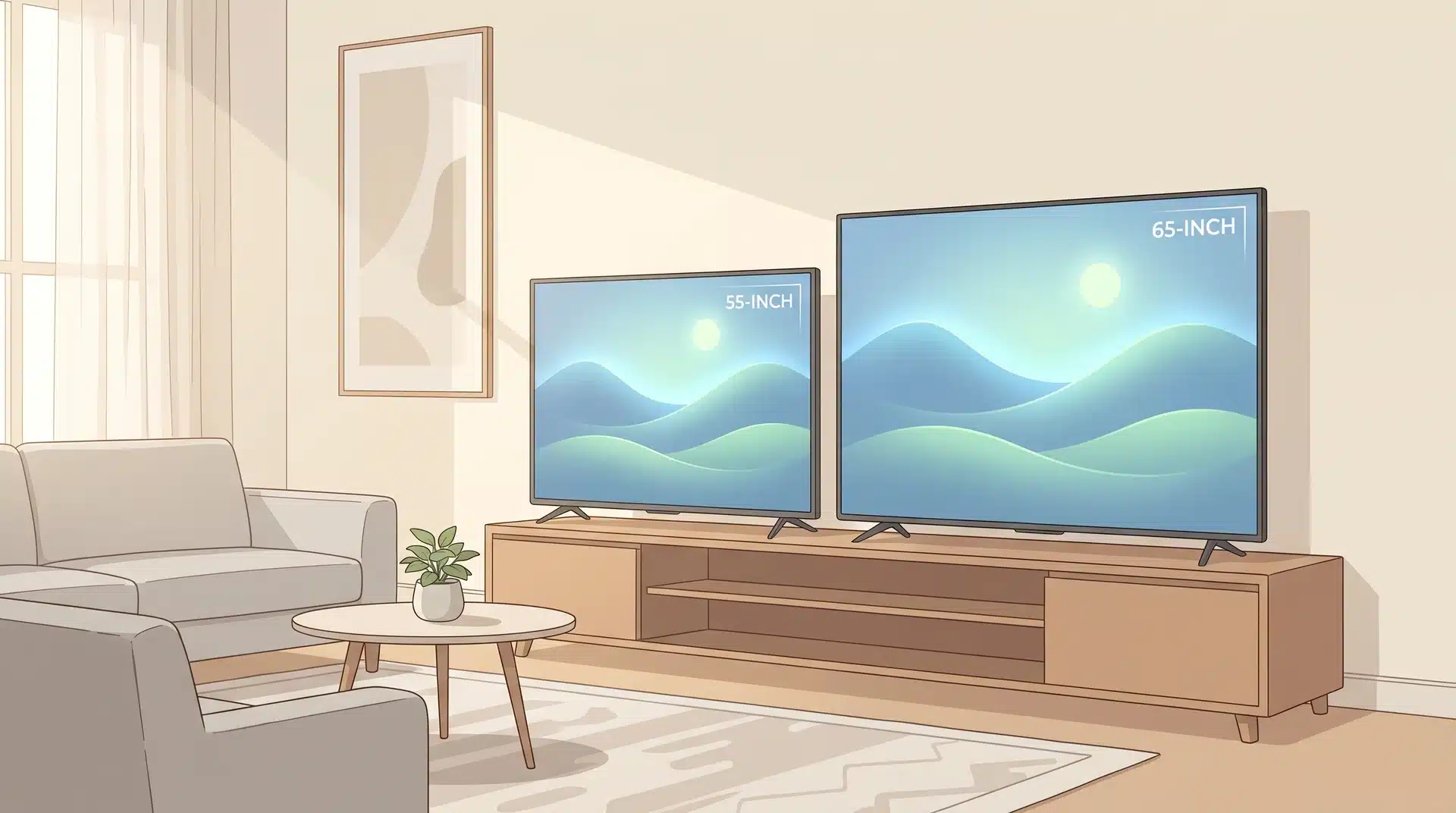
A 65-inch TV is about 9 inches wider than your 55-inch TV. In this TV size comparison, that extra width makes a bigger difference than most people expect.
| Spec | 55-Inch TV | 65-Inch TV |
|---|---|---|
| Width | ~48 inches (122 cm) | ~57 inches (145 cm) |
| Height | ~27 inches (69 cm) | ~32 inches (81 cm) |
| Screen area increase | Baseline | ~40% more |
| Best fit | Tighter consoles, fireplace mounts | Open wall space, larger units |
I’ve held both sizes up against the same wall, and the difference is bigger than most people expect. A 65-inch TV doesn’t just look “a bit bigger.” It changes how the whole room feels and how much space the screen takes over.
Before you buy, grab a tape measure and check your setup first. That size jump matters even more if your TV will go above a fireplace or sit on a built-in console where you have limited space.
Start with your console width. If your current 55-inch TV already fills the space, a 65-inch model may stick out beyond the edges and make the setup feel crowded rather than balanced.
How Far Should You Sit From a 55” or 65″ TV?
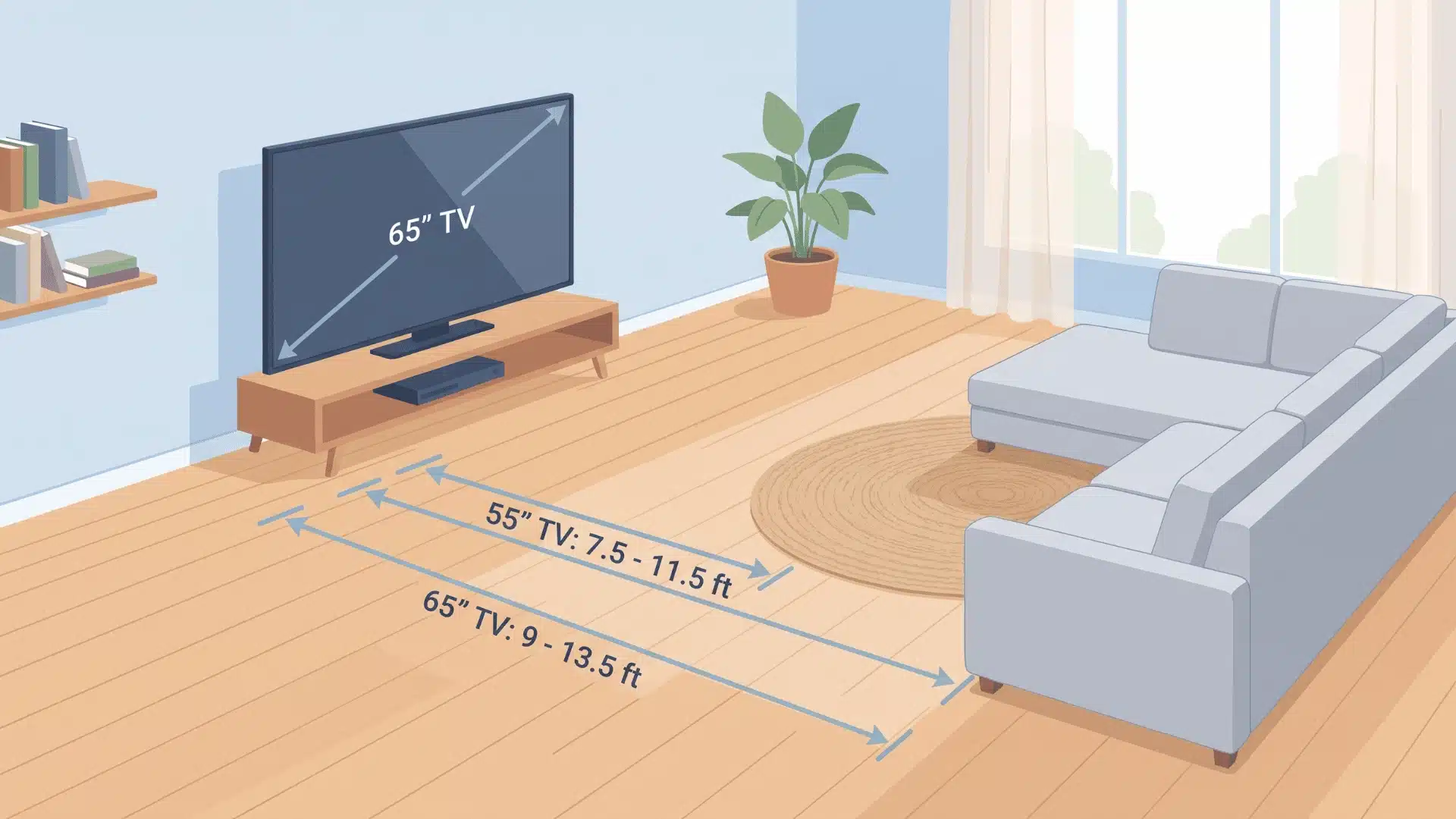
Those distance ranges are designed to keep your eyes within a comfortable 30- to 40-degree viewing angle. A 55-inch TV works best from about 7 to 9 feet away, while a 65-inch TV needs around 8 to 11 feet.
Sit too close, and the screen can feel overwhelming. Sit too far back, and the picture loses the immersive effect you wanted.
Viewing Angle and Why It Drives the Distance Math
Your viewing angle comes down to two things: how far you sit from the TV and how wide the screen is.
Sit too close, and the screen can take up more of your field of view than your eyes comfortably handle. Some people mistake this for a more immersive experience, but it can leave you feeling tired after a long movie or gaming session.
A viewing angle between 30 and 40 degrees usually gives you a better balance. The picture feels large enough to pull you in without making your eyes work too hard to follow everything happening on screen.
That is why viewing distance matters so much. The right distance helps the TV feel bigger without making the experience uncomfortable.
Which Size Fits Better in Your Room? (Space and Furniture Constraints)
Before you buy a 65-inch TV, measure your console or wall space. A proper TV size comparison is not just about screen measurements but also about how the TV fits your room and seating setup.
Here’s what to check before you buy:
- Stand or console width: It must be at least 57 inches to accommodate a 65-inch TV.
- Wall-mount clearance: Leave a few inches on each side instead of measuring edge-to-edge.
- Couch position: Make sure it isn’t pushed flush against the back wall.
These checks catch the two failure points buyers most often miss: a TV that overhangs its stand and a screen positioned too close to the viewer for a single glance. Both ruin the experience in different ways.
Viewing Distance Matters as Much as TV Size
I’ve seen a 65-inch TV sit at the “correct” viewing distance and still feel wrong. In one setup, the couch was pushed flush against the back wall. The screen looked impressive at first, but the constant head movement to catch the edges made longer viewing sessions uncomfortable.
Fitting on a stand and fitting your sightline are two different things. Check both: stand width confirms it physically fits, seating position confirms you can watch it comfortably.
Is the Price Difference Between 55″ and 65″ Worth It?
The price difference between a 55-inch and 65-inch TV can make the bigger screen tempting, but size alone should not decide your purchase.
Look at what you gain in screen space and whether the picture quality still matches your expectations.
When a 65-Inch TV Offers Better Value
Right now, the 65-inch model often offers better value per inch because the price gap between 55-inch and 65-inch TVs has narrowed.
Paying slightly more can get you a much larger viewing area. If both TVs have similar panel quality and the price difference is reasonable, the 65-inch usually makes more sense.
The larger screen feels more immersive for movies, sports, and gaming, especially when you have enough viewing distance.
When a 55-Inch TV Is the Better Choice
If the 65-inch upgrade pushes you into a lower-quality TV, the 55-inch may be the better buy. Picture quality factors like contrast, brightness, and motion handling matter more than screen size alone.
I’ve seen budget 65-inch TVs with weak edge lighting get outperformed by better-built 55-inch models. A bigger screen with worse picture quality is not a real upgrade.
So don’t choose based on size alone. Compare the panel quality first, then decide if the extra screen space is worth the added cost.
55 vs. 65 Inch TV: Which Should You Choose?
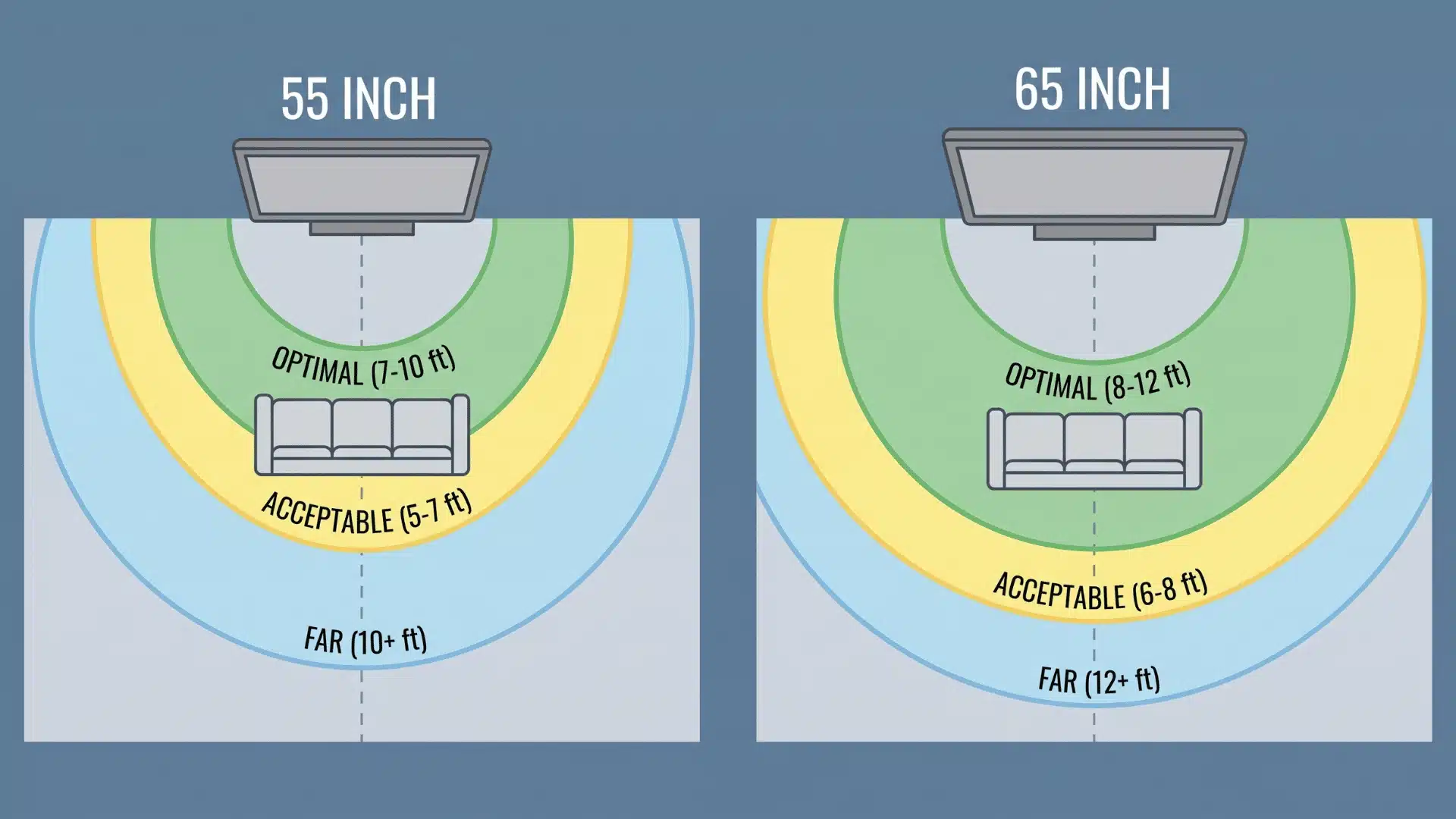
Pick the 65-inch if you sit 8 feet or more away, your space fits it, and your budget allows. Pick the 55-inch if any of those don’t hold.
| Factor | Choose 55-Inch | Choose 65-Inch |
|---|---|---|
| Seating distance | Under 8 feet | 8 feet or more |
| Space available | Tight wall/console space | Console or wall fits 57+ inches |
| Budget | Either way, this isn’t the deciding factor alone | Either way, this isn’t the deciding factor alone |
| Small room override | Always wins, even with a big budget | Skip it, regardless of budget |
Distance, space, and budget all need to line up for a bigger screen to be the right choice. If your couch is only 6 feet away in a small room, that larger TV may feel uncomfortable rather than impressive.
Wrapping Up
Choosing between a 55-inch vs 65-inch TV comes down to three things lining up: your seating distance, your room’s space, and your budget. Skip any one of these, and you risk a screen that looks great in the store but feels wrong at home.
The biggest mistake isn’t picking the wrong size. It’s picking based on price or looks alone, without first checking distance and space.
Get those two right, and your budget will naturally guide you to the better choice. Measure your room today before you scroll through another TV listing.
Take out a tape measure right now and check your seating distance and console width. You’ll know your answer in under five minutes.
Frequently Asked Questions
Is a 65-inch TV noticeably bigger than a 55-inch TV?
Yes, a 65-inch TV has roughly 40% more screen area than a 55-inch, even though the diagonal measurement is only about 18% larger. The width difference is around 9 inches. In a properly sized room, this translates to a clearly more immersive picture rather than a marginal upgrade.
How far should you sit from a 55-inch or 65-inch TV?
For a 55-inch TV, sit 7 to 9 feet away; for a 65-inch, 8 to 11 feet works best. These ranges keep your viewing angle within a comfortable 30–40 degree range. Sitting closer than recommended can make pixel structure visible and cause eye strain over time.
Is a 55-inch TV better than a 65-inch TV for a bedroom?
Often yes, since bedrooms typically have shorter seating distances where a 65-inch can exceed the comfortable viewing angle. A 55-inch TV fits the typical 7–9-foot bedroom viewing distance without forcing awkward head movement. Measure your actual distance before assuming bigger is automatically better.
Is it better to buy a 55-inch or 65-inch TV?
It depends more on your seating distance and room layout than on your budget. If you sit 8+ feet away and have adequate wall or console space, the 65-inch typically delivers better value and immersion. If your room is smaller or seating is closer, the 55-inch remains the safer choice.