

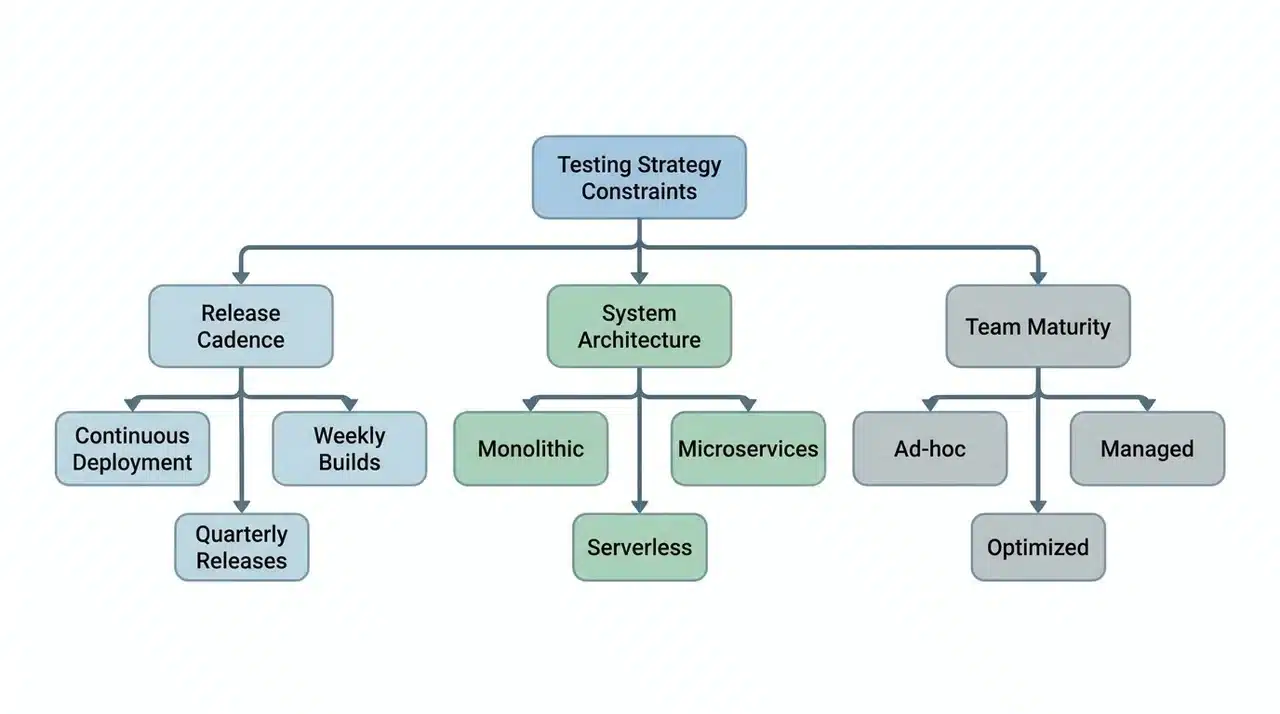
Most teams think they have a software testing strategy. What they actually have is a list of test types they run on a regular basis.
The difference between the two isn’t subtle; it shows up in production. A real strategy is built around constraints and tradeoffs. A list of test types is just pattern-matching to what everyone else does.
When teams confuse the two, every downstream decision gets made without a real foundation. What to automate, how to prioritize coverage, and when to explore, all of it drifts.
What follows breaks down how software testing strategies actually work, what drives the choice between them, where they fail, and how to pick one that fits your context.
What Is a Software Testing Strategy (and What It Isn’t)?
A software testing strategy is a set of decisions; what to test, how deeply, and in what order, made within real constraints of time, risk, and resources. It is not a list of test types. It is a set of priorities.
Most teams have a test plan. Fewer have an actual strategy. A test plan tells you what activities to run and when. A strategy tells you what those activities are optimizing for.
When those two get confused, teams end up running unit, integration, and regression tests because they’re standard. Not because someone made a deliberate decision about coverage depth or risk tolerance.
Picking test types is not the same as having a strategy. One is a shopping list, and the other is the reasoning behind it.
What Goes Into a Testing Strategy?
A strategy isn’t a document you file and forget. But it does need to capture a few things explicitly or it stops being a strategy and becomes a shared assumption.
Here are the components that need clear answers before anything else:
- Scope and objectives. What is this strategy trying to accomplish, and what is it not responsible for? Defining the boundary prevents gaps from going unowned.
- Testing levels. Which levels from unit, integration, system, or acceptance are in play, and who owns each? This is where strategy connects to how work actually gets divided.
- Entry and exit criteria. When does testing begin on a given build, and what marks it as complete? Without these, “done” is whatever someone decides it is at release time.
- Tools and environments. What infrastructure does the strategy depend on, and does it actually exist? A strategy that assumes stable environments in an org with none, fails on day one.
- Roles and ownership. Who makes coverage decisions? Who can block a release? These have to be explicit, or they get decided under pressure.
None of this has to be a formal document. But if your team can’t answer these questions quickly and consistently, the strategy exists only in theory.
What Drives Strategy Selection?
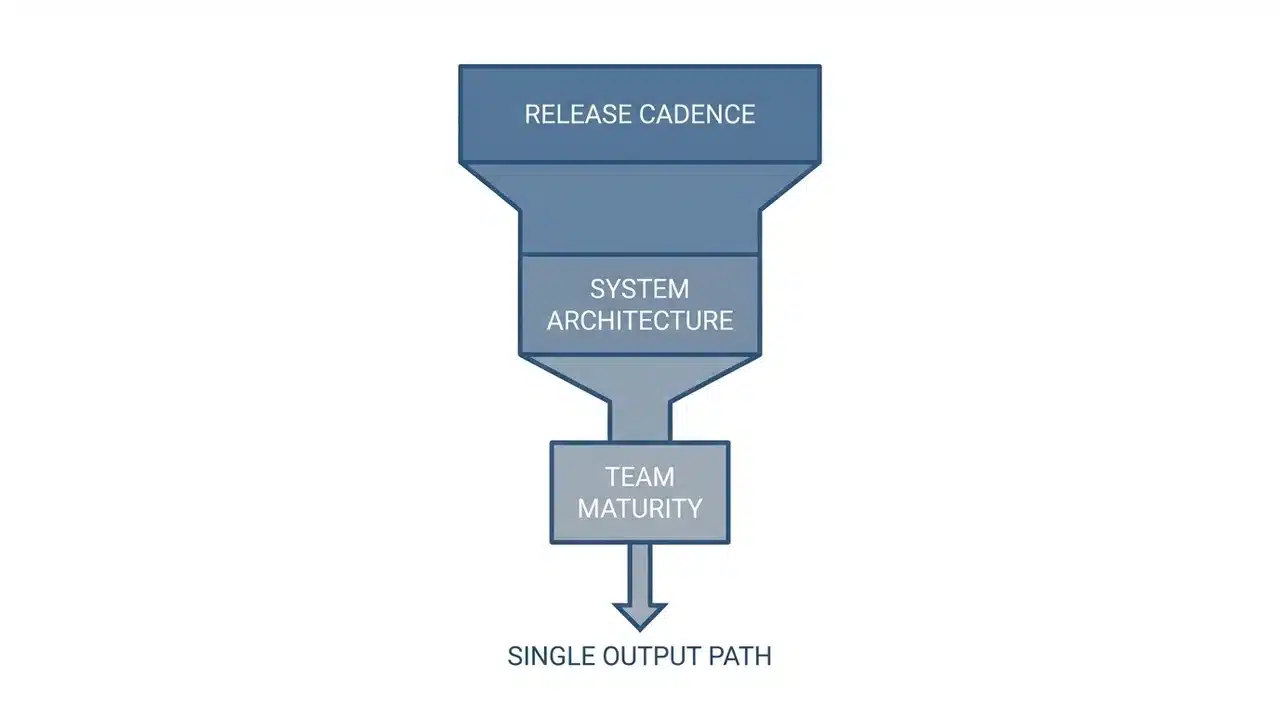
The textbooks list team size, project complexity, budget, and timeline. Technically that’s accurate, but not very useful.
The three things that actually constrain your strategy before preference enters the conversation are release cadence, system architecture, and team maturity. Not as factors to weigh, but gates that close off certain options before you’ve even started.
Release Cadence
If you’re shipping weekly, a strategy that leans on manual exploratory testing will break under the pace. The feedback loop it requires is too slow for the cycle.
When strategy and delivery rhythm don’t match, gaps appear by default; not through bad decisions, but through structural incompatibility.
System Architecture
A tightly coupled monolith and a distributed microservices system don’t just test differently. They make certain strategies structurally impractical.
Unit testing means something very different when service boundaries are unclear or shared state is everywhere.
Team Maturity
Low maturity doesn’t mean junior engineers. It means high test debt, unstable environments, and coverage numbers that don’t reflect actual risk.
In that condition, a risk-based or model-driven strategy won’t hold. Not because the approach is wrong, but because the foundation it assumes doesn’t exist yet.
You can’t prioritize by risk if you don’t have a reliable signal about where the risk actually is.
When that’s the situation, the right move is a stabilization pass before strategy selection. Reduce test debt in the highest-change modules. Establish a baseline of what coverage can actually be verified. Then choose.
Picking a sophisticated strategy on top of an unstable foundation doesn’t accelerate the work, it hides the problem.
How the Core Strategies Actually Differ
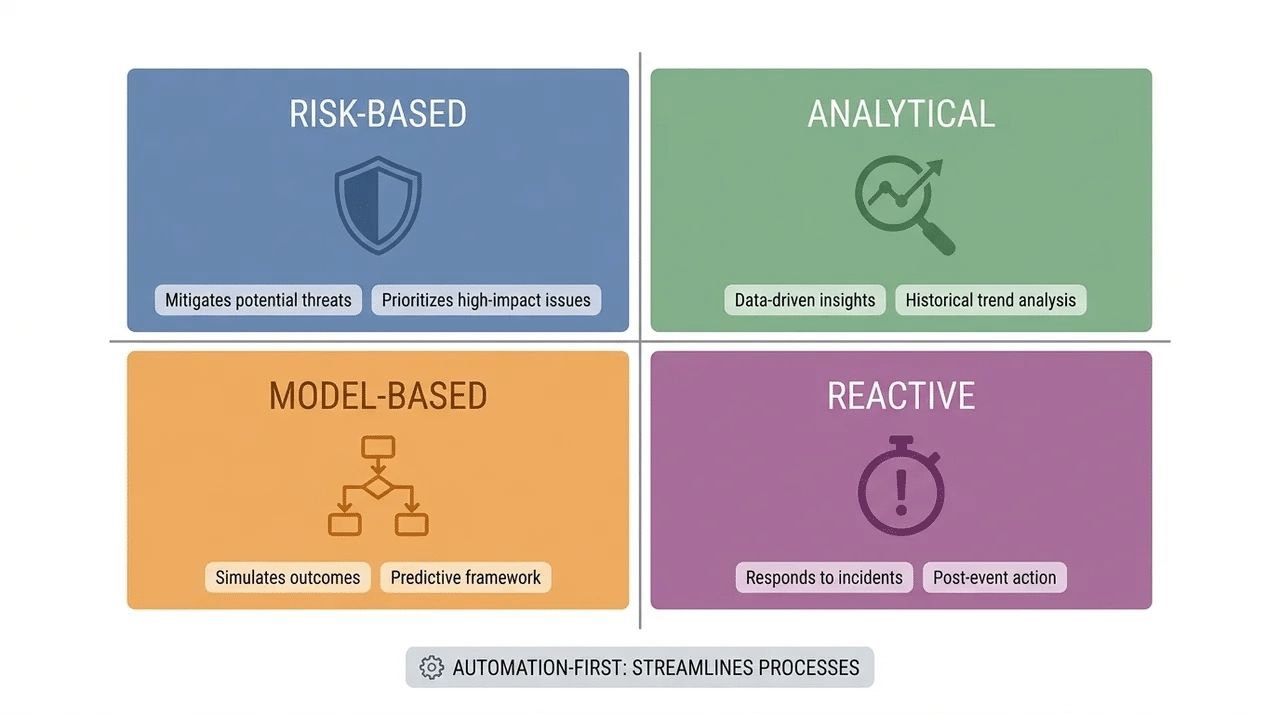
Strategy names get thrown around like they’re interchangeable options on a menu. They’re not. Each one is built around a different assumption about where the value of testing comes from, and that assumption shapes everything else downstream.
1. Risk-Based Testing
Risk-based testing optimizes for coverage where failure hurts most. Not all parts of a system carry equal consequence if they break, so effort should follow risk, not surface area.
Where it gets misapplied is in how risk gets defined. Most teams classify risk once, during planning, and never revisit it. But risk isn’t static. A module that was low risk six months ago may now sit at the center of three new integrations.
A frozen risk map applied to a moving codebase produces false confidence, not coverage. The real work in risk-based testing is maintaining the classification, not building it.
2. Analytical and Model-Based Testing
These two appear together in most lists but they’re structurally different.
Analytical testing derives coverage from requirements. You start with what the system is supposed to do, map it formally, and generate test cases from that map. The artifact driving test design is the requirement.
Model-based testing generates test cases from a behavioral model; a representation of how the system moves between states. The artifact is the model, not the requirement.
That difference matters in practice. Analytical testing breaks down when requirements are incomplete or ambiguous. Model-based testing breaks down when the model doesn’t reflect how users actually move through the system.
Same family. Different failure points.
3. Reactive Testing (Exploratory and Experience-Based)
Reactive testing gets dismissed as informal, but that framing misses what it’s actually good at.
Scripted testing assumes you can predict the failure. Reactive testing is for the conditions where you can’t: late-stage discovery, systems with high behavioral variance, domains the team is entering for the first time.
An experienced tester running structured exploration on an unfamiliar system will find things a scripted suite won’t. Scripts check whether the system does what you think it does. Exploratory testing is built around what the system actually does, including in states no one thought to write a test case for.
A tester following a session-based charter on a new payment flow will probe edge cases that never made it into a script, like partial submissions, currency switching mid-session, and browser back behavior mid-checkout.
Reactive strategies earn their place in the conditions scripted strategies were never designed for.
4. Automation-First vs. Manual-First as a Strategic Posture
This rarely gets named directly, but it underlies almost every strategy decision a team makes. The table below maps out what each actually requires and where each one breaks.
| Automation-First | Manual-First | |
|---|---|---|
| Treats the test suite as | Infrastructure | A flexible tool |
| Requires | Stability, environmental parity, and maintenance discipline | Human judgment and domain familiarity |
| Works best when | Behavior is stable, and the release cadence is predictable | The product is early-stage, and requirements are still shifting |
| Scales how | Coverage grows without proportional effort | Effort grows with coverage |
| Risk | Coverage numbers stay green while real coverage erodes, if infrastructure is neglected | Becomes inconsistent as the team or pace grows |
Neither posture is universally superior. The right one depends on where your product is today, not on what the industry currently favors.
Where Strategies Break Down
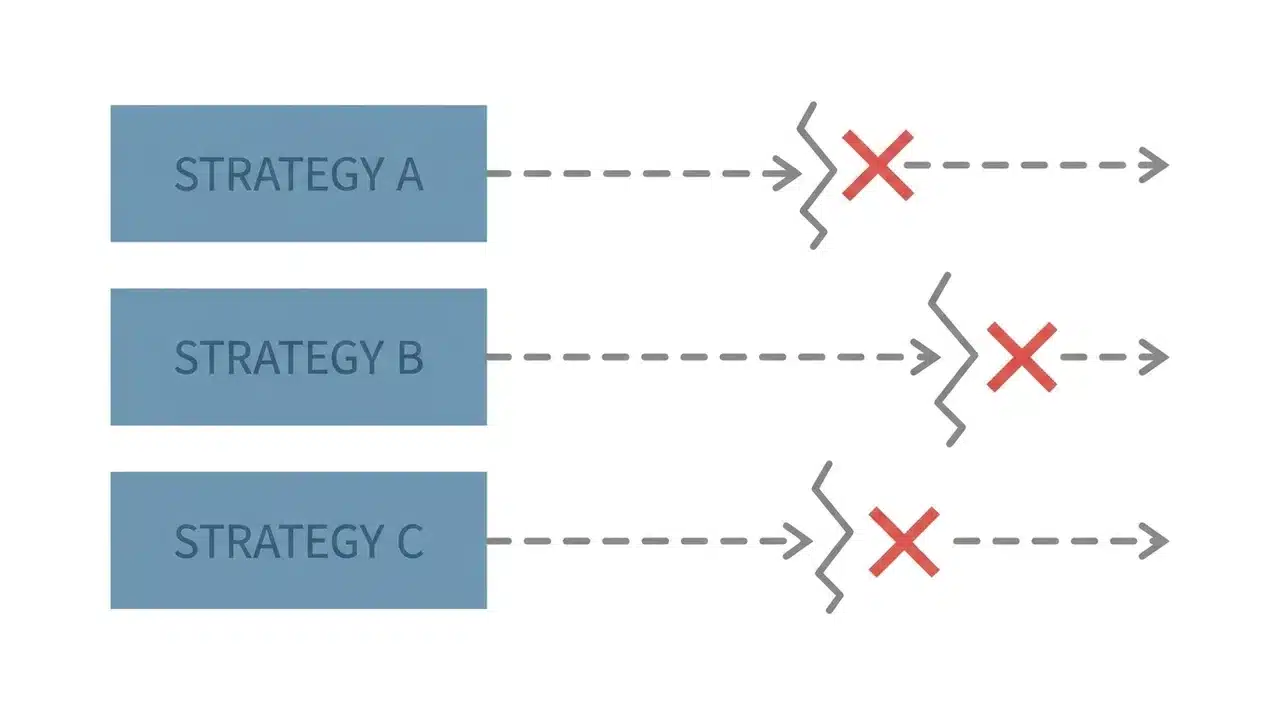
Choosing the right strategy is only half the problem. The more common failure is a correct choice applied beyond the conditions it was designed for.
Every strategy carries assumptions. When those assumptions no longer hold, gaps quietly appear and go unnoticed until they become incidents.
Risk-based strategies break down when risk classification stops being updated. The mapping gets frozen while the codebase keeps moving. What looked like smart prioritization turns into bets on last year’s system.
Automation-first strategies fail when test infrastructure isn’t treated like production code. Tests go flaky, environments diverge, and coverage metrics stay green while real coverage erodes. The numbers look healthy. The actual safety net has holes. And because the dashboard says otherwise, no one investigates until something breaks in production.
Reactive strategies break down under pressure. Exploratory testing needs time, focus, and experienced judgment. When release cycles compress, those conditions disappear first.
The failure that cuts across all three is the same. Every strategy is built around a particular delivery speed. Apply it to a pace it wasn’t designed for, and it doesn’t fail loudly. It just quietly stops working while appearing, on paper, to still be in place.
How to Choose a Strategy for Your Context
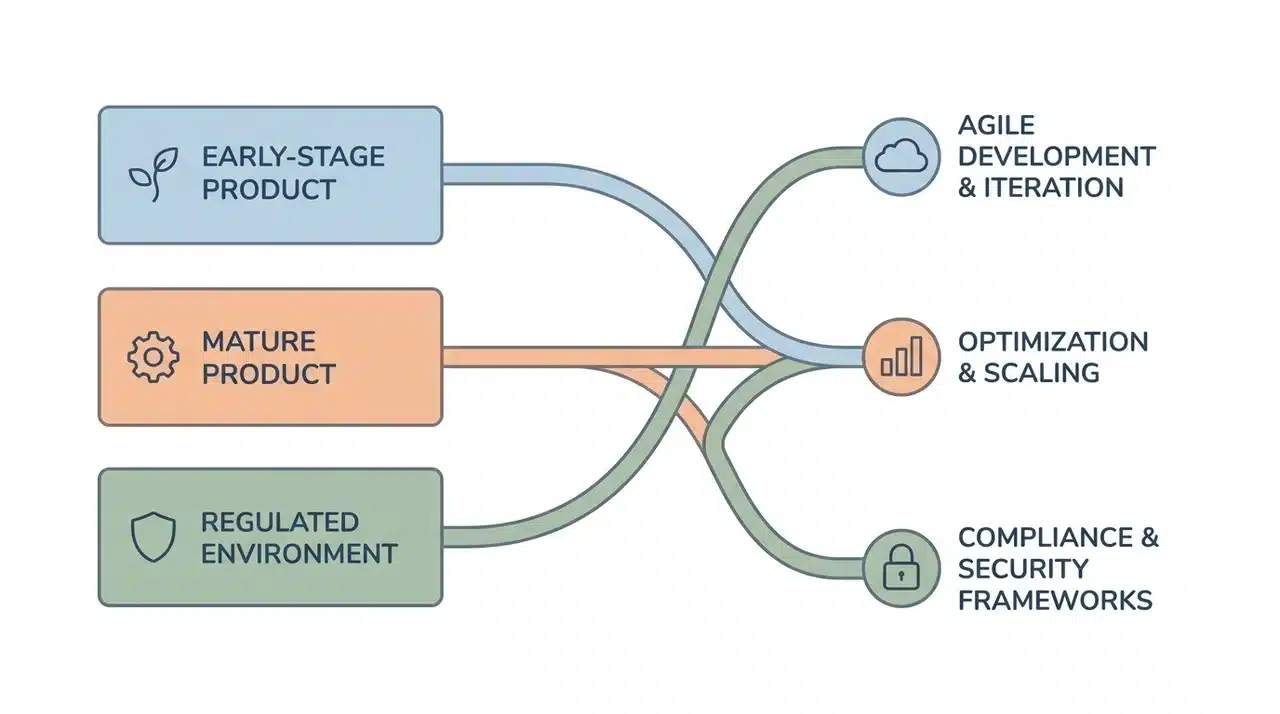
Everything in the previous sections narrows toward one question: what does your current release cadence actually allow? Answer that honestly and it eliminates more options than any framework will.
Early-Stage Product
Scripted, coverage-heavy strategies cost more than they return here. Requirements change fast, and automated suites become a maintenance burden overnight.
A manual-first, reactive posture fits; not because it’s rigorous, but because it’s honest about what you actually know.
Mature Product
This is where automation-first compounds. Behavior is stable enough to test reliably. Risk-based prioritization layered on a solid automated suite is the natural fit, and the investment pays back clearly.
Regulated Environment
The strategy isn’t fully yours to choose. Compliance frameworks mandate coverage types, documentation standards, and traceability of requirements.
The question shifts from “what should we optimize for” to “what must we demonstrate and to whom.”
Team Size
Small teams can run flexible strategies because coordination is cheap. Once the team grows past the point where everyone naturally shares context, flexibility becomes inconsistent.
Strategies need more formalization, not because the work changed, but because alignment no longer happens automatically.
Before any framework, answer this: what is the gap between the coverage your team believes it has and the coverage it can actually verify? That gap tells you more than any other single factor.
Wrapping Up
A software testing strategy isn’t something you set once and carry forward. It’s a decision that needs to be revisited honestly as conditions change.
Release cadence shifts, systems get more complex, and teams grow. The strategy that fit six months ago may already be producing gaps you haven’t noticed yet.
The teams that test well aren’t the ones with the most sophisticated approaches. They’re the ones who know what their strategy is actually optimizing for and change the answer when the conditions shift.
Frequently Asked Questions
What is the difference between a test strategy and a test plan?
A strategy defines what your testing is optimizing for. A test plan operationalizes that into activities and timelines. You write the plan after the strategy is set, not instead of it.
Can a team use more than one testing strategy at the same time?
Most do. The key is that each layer serves a different constraint. Combining strategies without mapping those constraints produces gaps; the coverage feels thorough, while the edges go untested.
What is the 80/20 rule in software testing?
Roughly 80% of defects originate in 20% of the codebase; typically the most complex or frequently changed modules. Risk-based strategies use this to concentrate effort where defect density is highest.
When does exploratory testing outperform scripted testing?
When behavior is highly variable, requirements are incomplete, or the domain is unfamiliar, and when the cost of a missed defect outweighs the cost of unstructured testing time. Scripted testing assumes you can define failure in advance. Exploratory testing is for the conditions where you can’t. Late-stage releases, new integrations, and first-time domain coverage are the clearest cases.