

Every kitchen tools list I come across has the same problem: they were written by cooks who’ve spent years accumulating tools and can no longer tell the difference between what they need and what they’re just used to having.
Today’s your lucky day, cause I’ll draw that line clearly. Essential means nothing else does the job as well, and you need it often enough that cooking is genuinely harder without it. Everything else is useful at best — and clutter at worst.
Here’s how to build a kitchen kit that actually matches the way you cook.
Must-Have Kitchen Gadgets That Actually Earn Their Place
A kitchen gadget is essential when it does something nothing else does as well, and you need it often enough that cooking is harder without it. That’s the whole test. If you can swap in something else and get the same result in roughly the same time, the tool is useful. Not essential.
Most lists collapse those two categories. They shouldn’t.
A garlic press is useful. A salad spinner is useful. A cherry pitter is useful… if you pit a lot of cherries.
None of them are essential the way a chef’s knife is essential, because a knife, used well, covers what they do. The essential tool has a function nothing replaces. The useful tool just makes one thing faster.
What counts as essential also depends on how you cook. A cook who makes stock every week and someone who reheats leftovers four nights out of five don’t share the same list.
Kitchen size changes things too. A narrow galley with two feet of counter can’t hold the same kit as a kitchen with an island. A tool that earns its place through daily use becomes dead weight if it comes out twice a year.
Here’s something I’ve noticed about must-have lists: they’re usually written by people who cook a lot, own a lot, and have forgotten what it felt like to start with nothing. Every item on their list genuinely earns its place in their kitchen. But their kitchen isn’t yours.
Before any purchase, ask yourself one thing: does my cooking right now hit a wall because I don’t have this? If the answer isn’t an immediate yes, wait.
The Non-Negotiables: Tools Every Cook Needs
These tools have no real substitute. They come up in almost every recipe, and they cost little enough that there’s no good reason to delay buying them.
This isn’t about brands or price tiers. It’s about functions you can’t cook around.
1. Chef’s Knife
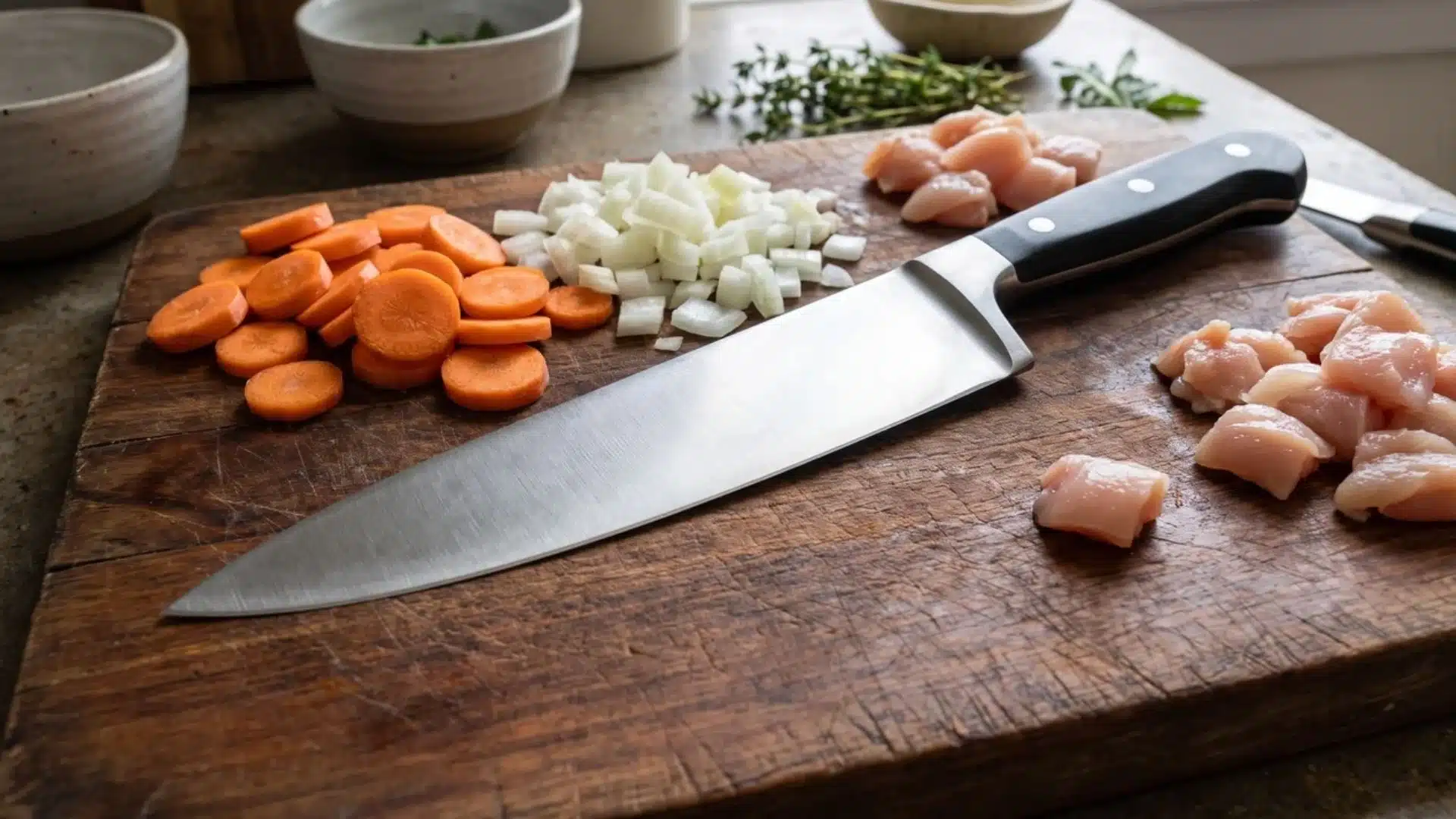
One sharp 8-inch chef’s knife beats a full block of dull ones. Not because of brand or steel type, because sharpness is the thing that actually governs performance.
Here’s what sharpness does physically: a sharp edge slices through food’s cell walls cleanly. A dull edge compresses and tears them. That means you push harder, the food shifts unpredictably, and the blade is more likely to skid off a curved surface toward your hand.
I know it sounds backwards, but a dull knife is more dangerous than a sharp one, not less.
To check if yours is sharp enough, hold a sheet of printer paper by the top edge and draw the blade down through it. Sharp cuts clean. Dull drags, folds, or tears. That test costs nothing. If it fails, a honing rod and a few minutes fixes it.
One good knife, kept sharp, does more work than six knives that never get maintained.
2. Instant-Read Thermometer
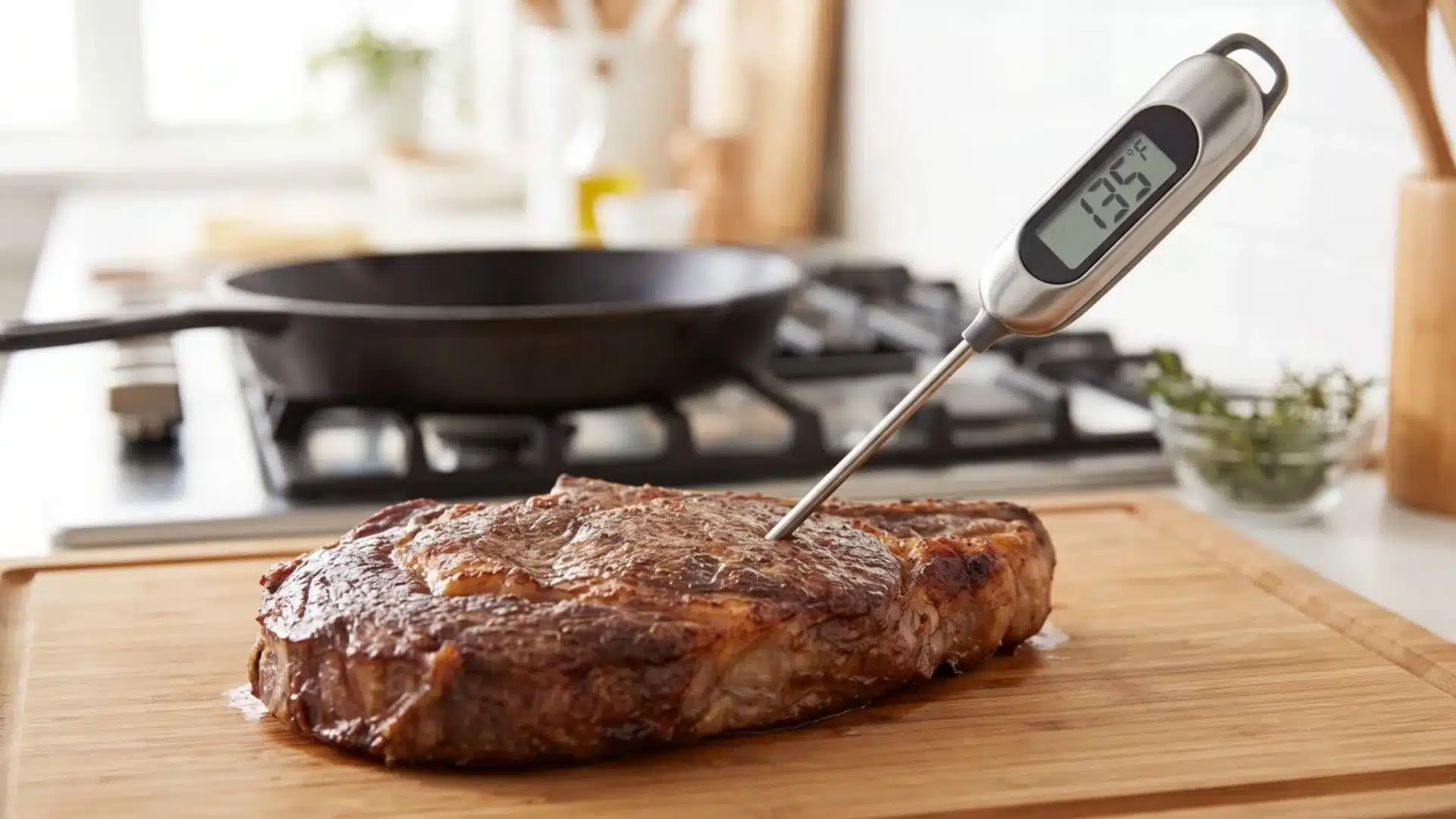
Color, texture, and timing all tell you what’s happening on the outside of your food. They say nothing reliable about the inside.
A chicken thigh can look golden and feel firm before the center hits 165°F. A cake can spring back from a light press while the crumb is still wet at the center.
Oven temperatures drift. Food thickness and starting temperature vary. Every one of those factors shifts the timeline, but internal temperature doesn’t lie.
An instant-read thermometer cuts through all of that in about two seconds. It works on meat, bread, candy syrups, frying oil, and custard.
The failure I see most often isn’t using it wrong, it’s leaving it buried in a drawer and not using it at all. Keep it on the counter or somewhere you’ll actually grab it.
3. Cutting Board
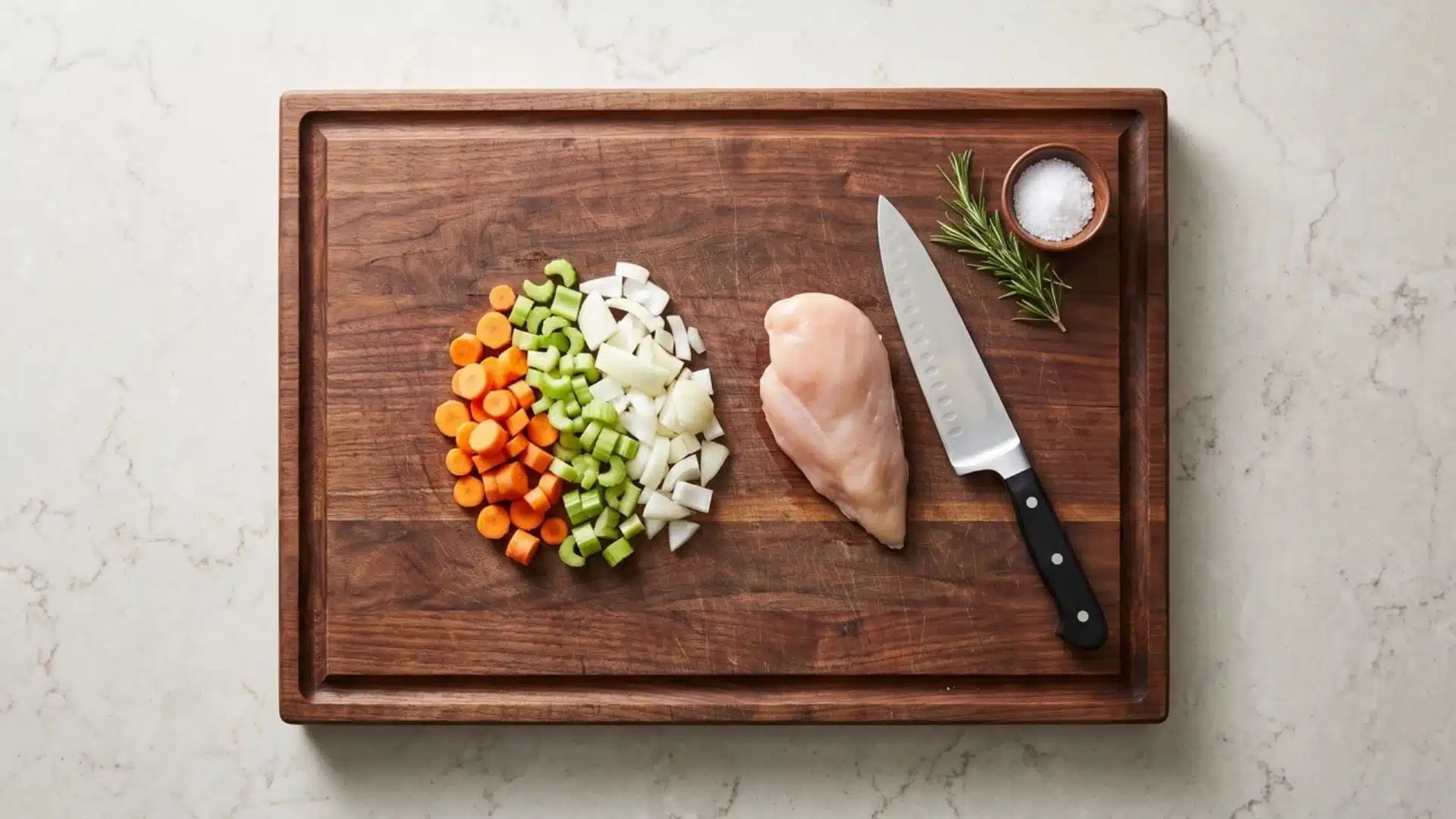
If you’ve ever had to cut in batches because your board was too small, you already know the problem. A small board slows prep down and forces you to shuffle food around a crowded surface, which creates real cross-contamination risk when you’re working with raw proteins.
At minimum, your board should fit a whole head of cabbage or a butterflied chicken with room to work around it.
On material:
Wood is gentler on knife edges and develops a grain structure that naturally resists bacteria over time; better than a plastic board that’s been cut up enough to trap bacteria in the grooves.
Plastic goes in the dishwasher, which is why most cooks end up with both. But the bigger point is that one board is never really enough. Raw proteins need their own surface. Prep for a full meal needs more room than one board provides.
4. Silicone Spatula

A silicone spatula is the one tool that actually retrieves everything from a container. Its flexible head bends to the curve of any vessel, like a saucepan, mixing bowl, or a blender jar, and scrapes cleanly to the bottom without scratching anything.
It handles heat up to around 600°F, so it goes from stirring cold batter to folding eggs in a hot pan without switching tools.
No other utensil does that across that range. It earns its place simply by being the right shape for almost every job.
5. Box Grater
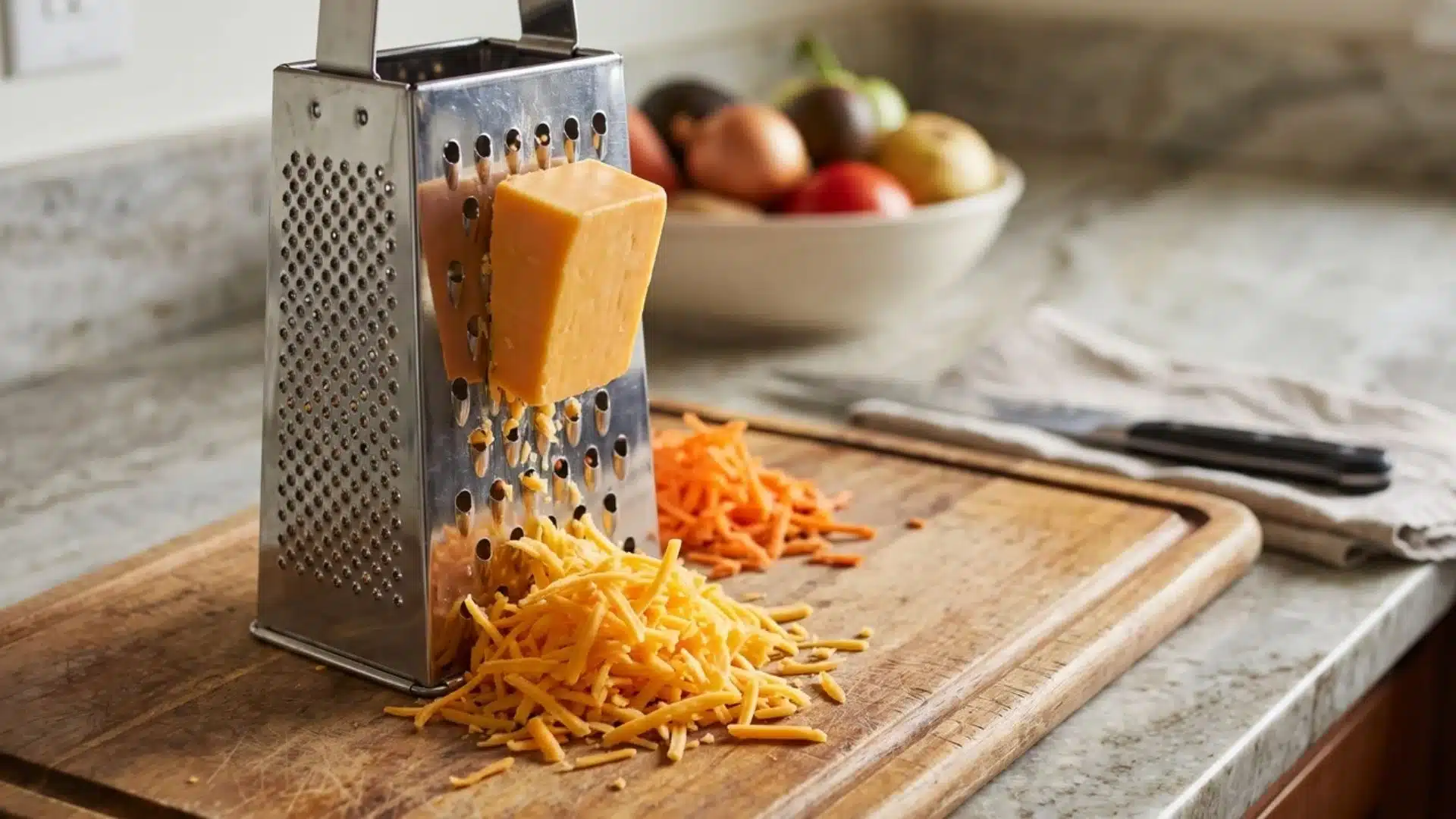
A box grater handles more than most people expect: hard cheeses, soft cheeses, citrus zest, fresh ginger, nutmeg, chocolate, raw potatoes for latkes, cabbage for slaws.
The large-hole side grates cheese for melting. The small-hole side produces finely grated cheese that disappears into sauces.
It’s one of the most-used prep tools in any serious home kitchen. It’s also one of the most skipped in beginner kits, because it looks too simple to matter. That’s a mistake worth correcting early.
Cookware that Does the Heavy Work
Pots and pans are not interchangeable. A skillet, a saucepan, and a Dutch oven each cover a distinct range of tasks, and each one handles the other’s tasks badly. Knowing which job belongs to which pot is more useful than any brand recommendation.
Here’s what each one actually does, and why it does it.
6. A 12-Inch Skillet
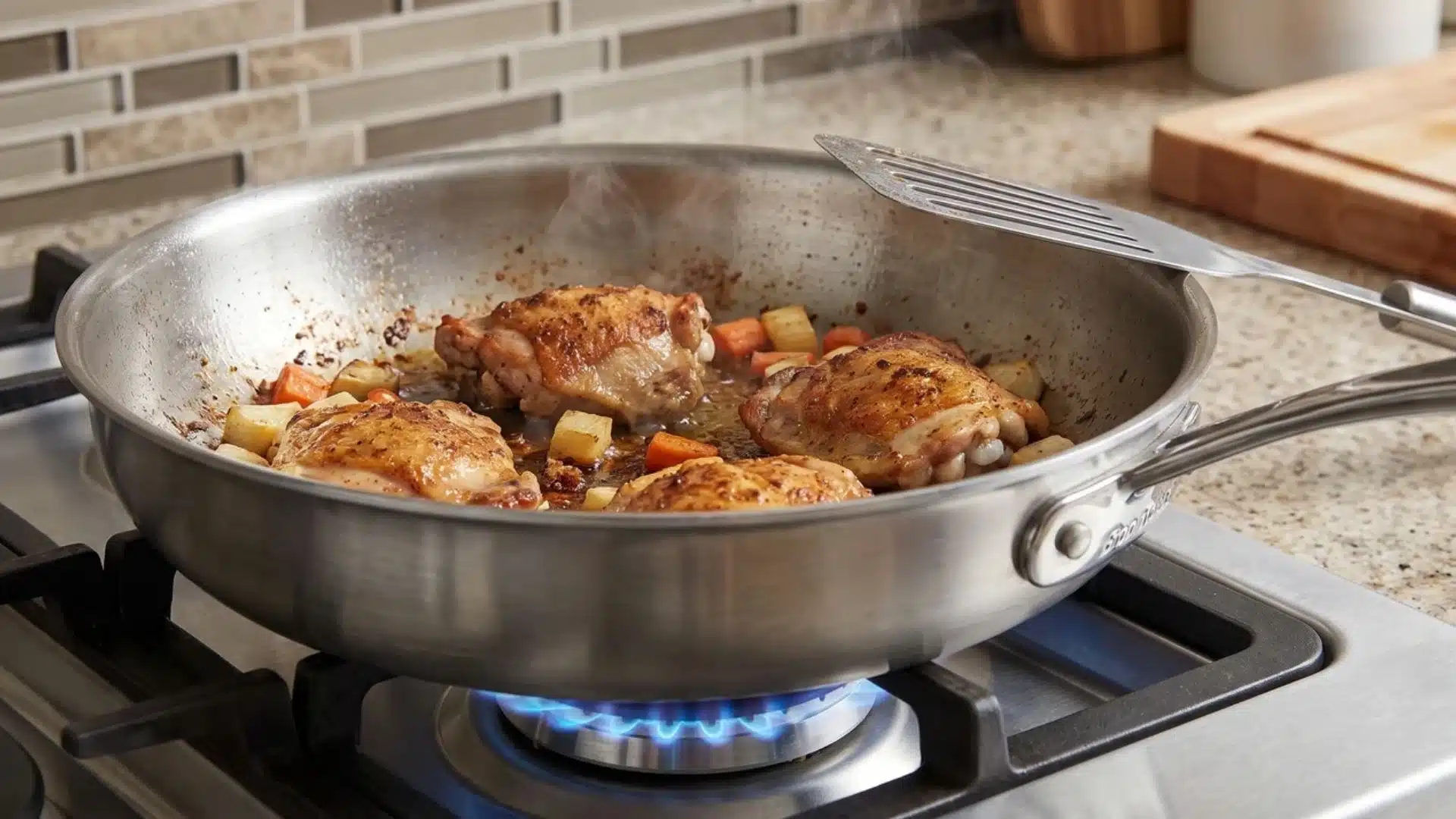
The case for stainless steel over non-stick comes down to two things: fond and heat range.
Fond is the brown, sticky layer of caramelized proteins and sugars that forms on a stainless pan surface when you sear food at high heat. It’s the foundation of every good pan sauce.
A non-stick surface is designed to prevent food from sticking, which also means it prevents fond from forming. You get browning on the food itself, but the pan stays clean, and there’s nothing to deglaze.
Non-stick also has a hard ceiling on heat. Most PTFE-based coatings, the slick surface on standard non-stick pans, degrade above 500°F. That means no preheating an empty pan, no high-heat sears, and real limits on oven use. Stainless has no such ceiling.
So stainless is the default. It does everything. Non-stick earns a secondary spot for eggs and fish; delicate things that need a frictionless surface to release cleanly. It’s a companion to stainless, not a replacement for it.
One thing that trips up almost everyone switching from non-stick to stainless: food sticking during a sear doesn’t mean the pan is wrong. It means you moved the food too early.
Protein releases from stainless on its own once the sear is done and the surface has dried out. Force it early and it tears. Wait, and it lifts clean. I’ve watched people throw out perfectly good stainless pans because they didn’t know that.
7. Saucepan
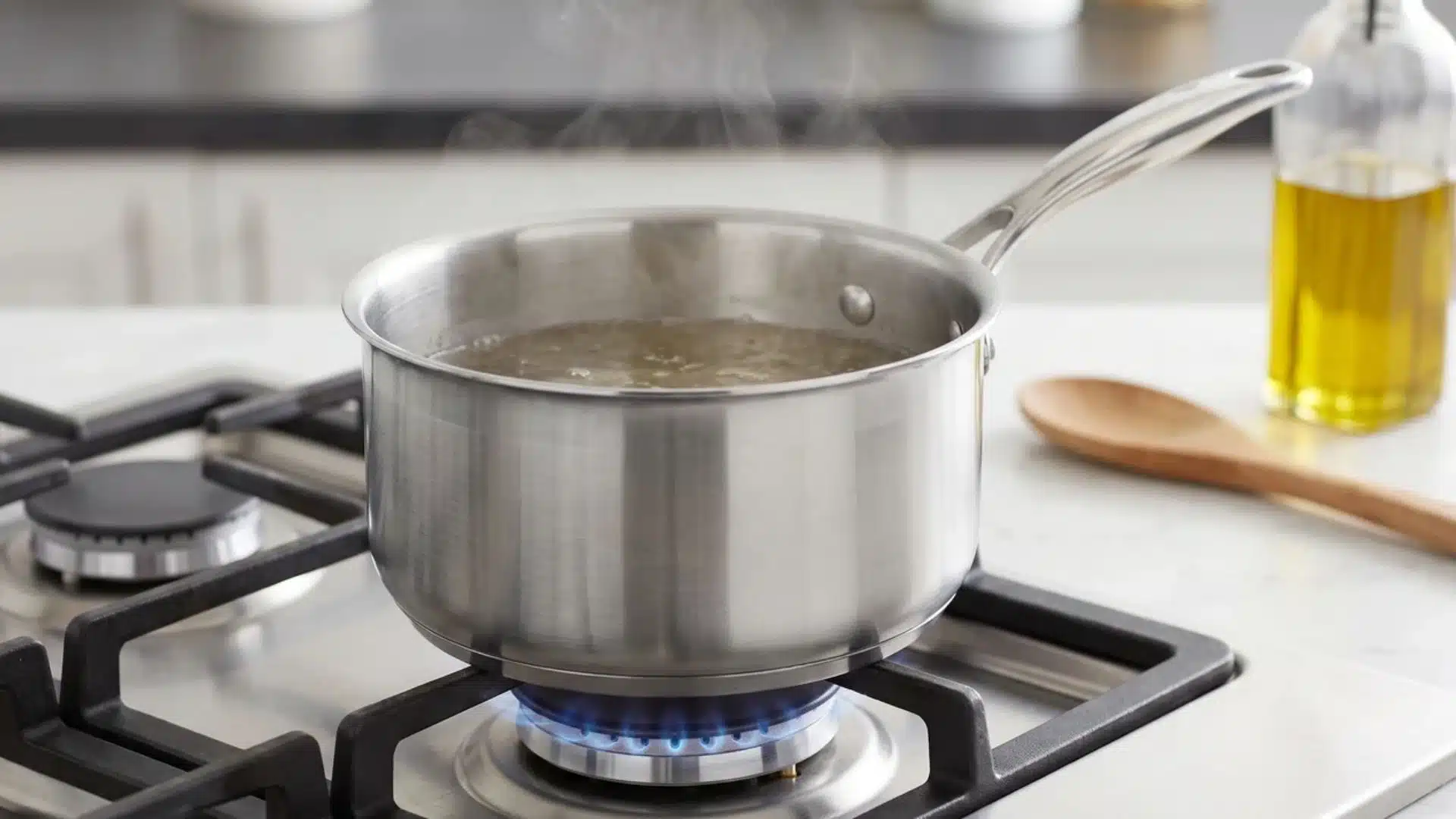
A 3- to 4-quart saucepan handles rice, grains, pasta water for two or three people, sauces, blanching, soups, and custard. The size range isn’t arbitrary; it’s the sweet spot between too small for a real batch and too heavy to pour one-handed.
Material matters here too. Stainless with an aluminum or copper core is the standard for a reason. Aluminum spreads heat faster and more evenly than stainless alone.
Without the core, stainless develops hot spots that scorch sauces, especially the milk-based and sugar-heavy ones that need gentle, even heat.
8. Dutch Oven
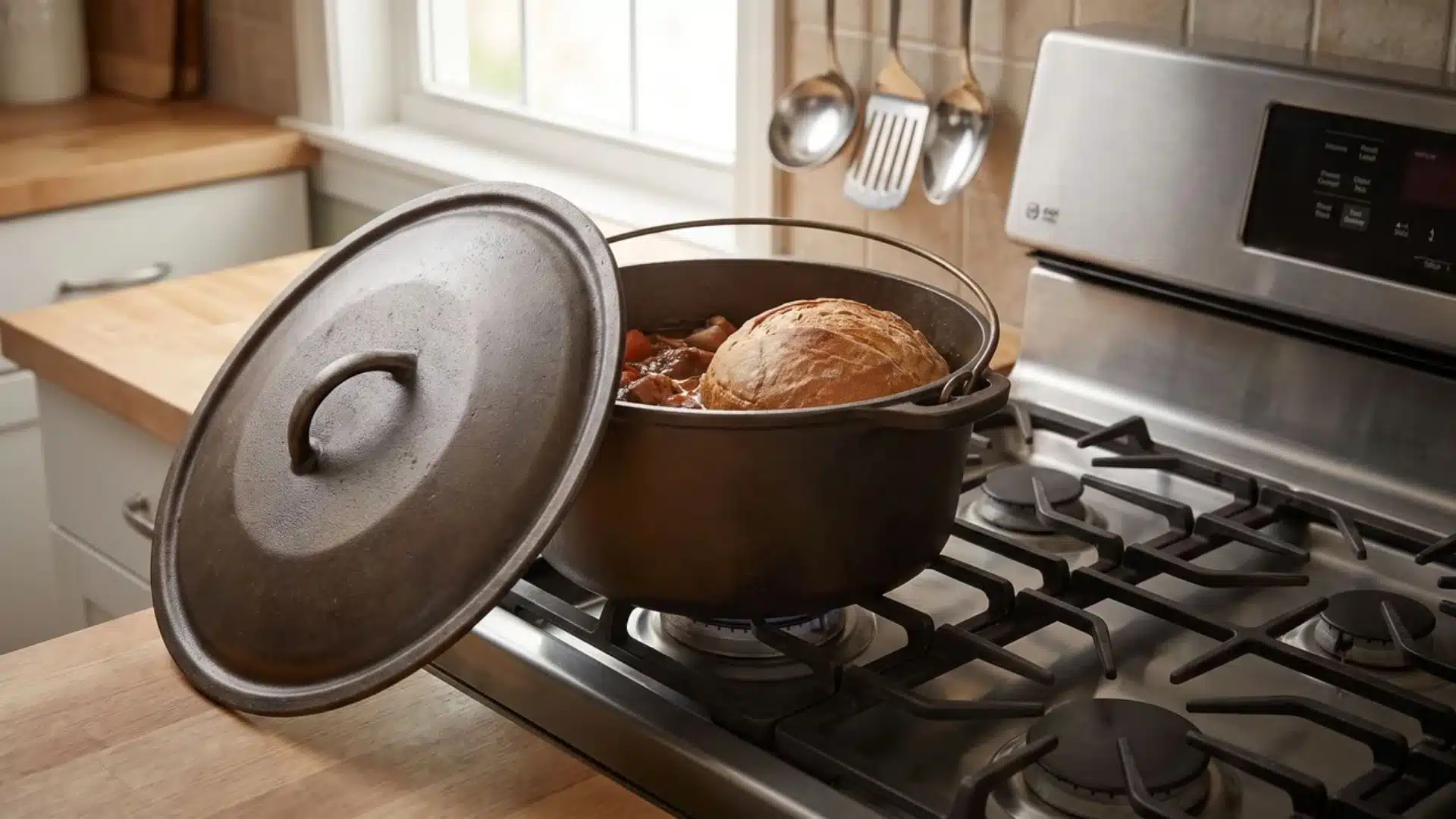
Nothing else in the kitchen earns its cost across as many uses as a Dutch oven. The same pot braises short ribs at 325°F for four hours, makes soup on the stovetop, bakes a no-knead loaf by trapping the steam that builds an open crumb, and holds frying oil at a stable temperature without spiking.
All of that comes from thermal mass; the thick walls and tight lid retain and distribute heat evenly. That makes it equally good for long, slow heat and for holding a steady fry temperature.
Enameled cast iron is the standard version for most home cooks. It doesn’t need seasoning, it handles acidic ingredients like tomatoes that would react with bare cast iron, and it goes from stovetop to oven to the table.
The 5- to 6-quart size covers everything above without becoming too heavy to move when it’s full.
Small Appliances Worth the Counter Space
Hand tools are essential by default. Appliances are different; they’re conditional. Each one earns its place only for the cook whose cooking habits actually use what it does. If you use it often enough to justify the space it permanently takes up, it belongs. If not, it doesn’t.
The honest conversation about every appliance includes what it does well and what a simpler tool handles just as well without the footprint.
9. Immersion Blender
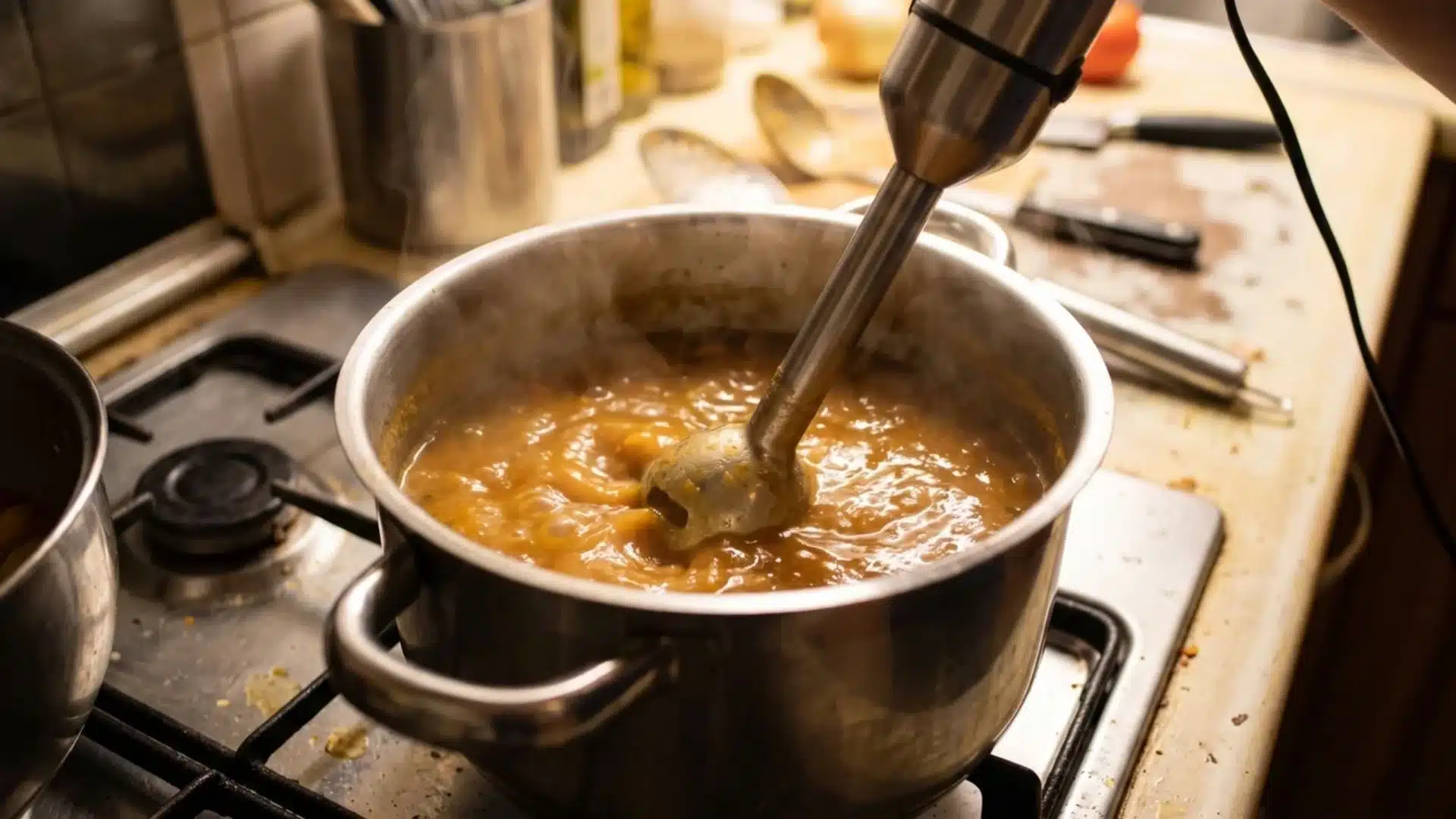
The reason I reach for an immersion blender over a countertop blender for most jobs is simple: it removes the transfer problem entirely.
To blend hot soup in a countertop blender, you have to let it cool first, work in batches, hold the lid down with a folded towel against the pressure, and then pour everything back into the pot. An immersion blender goes straight into the pot at full temperature. You blend to whatever consistency you want, in one vessel, with nothing to clean but the wand.
The same tool handles salad dressings in a jar, smooth pan sauces, and small batches of whipped cream. If you make soups or sauces more than twice a month, this earns its drawer space immediately.
10. Multicooker / Instant Pot
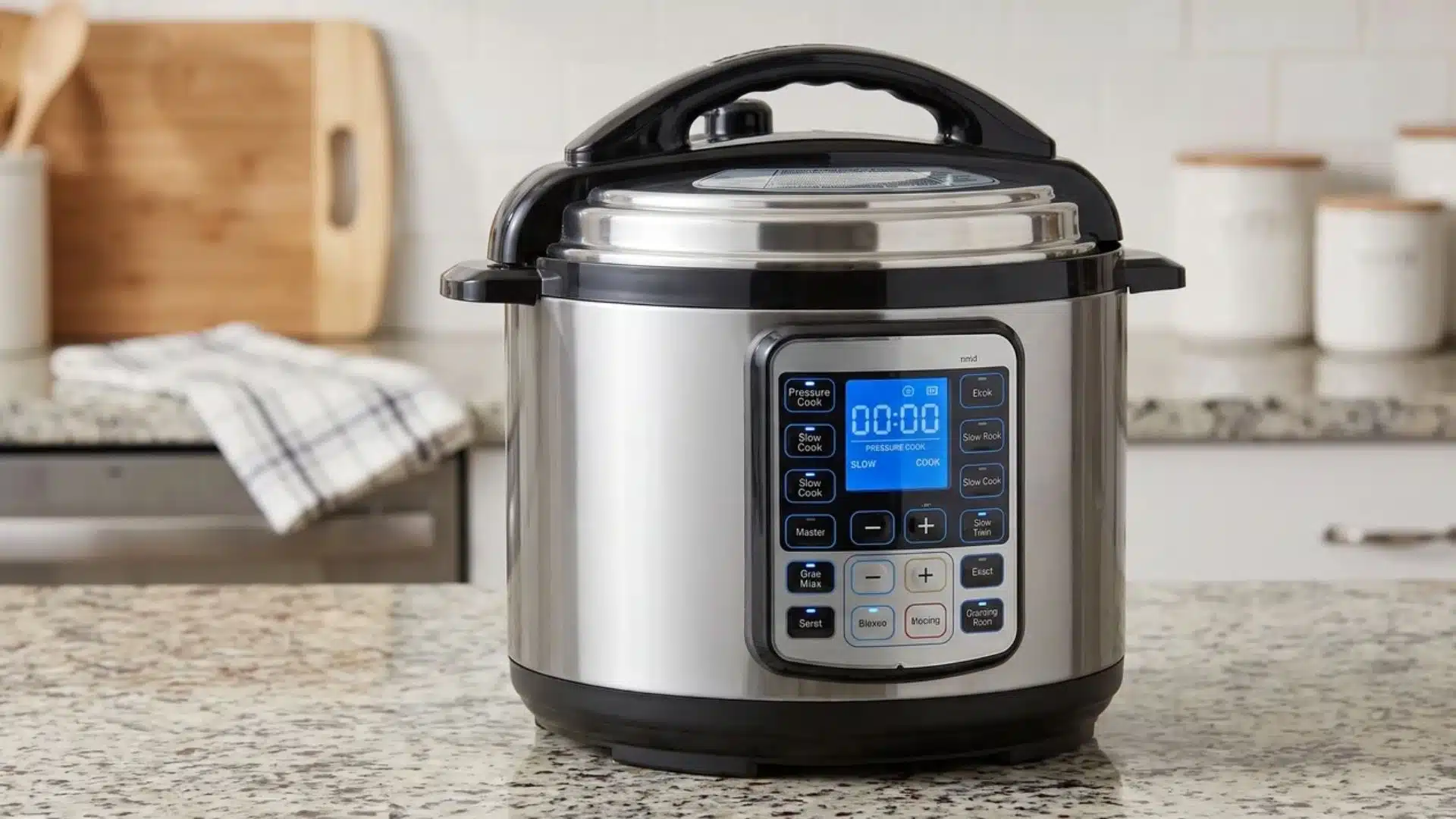
A multicooker genuinely pulls its weight for three things: batch cooking, dried legumes, and braising on a tight schedule.
Dried chickpeas that take 90 minutes on the stovetop take 35 to 40 minutes under pressure, with no soaking. A three-hour braise runs in under an hour. For anyone cooking beans from dried regularly, or who needs braised proteins on a weeknight, that time difference is real.
But here’s the honest flip side: if you braise on weekends when time isn’t tight, and you mostly use canned legumes, a Dutch oven does the same work. No learning curve. No sealing gasket that needs replacing.
The multicooker earns its place through frequency of time-constrained cooking, not through any gap in skill. If that’s not your situation, it probably isn’t your appliance.
11. Air Fryer
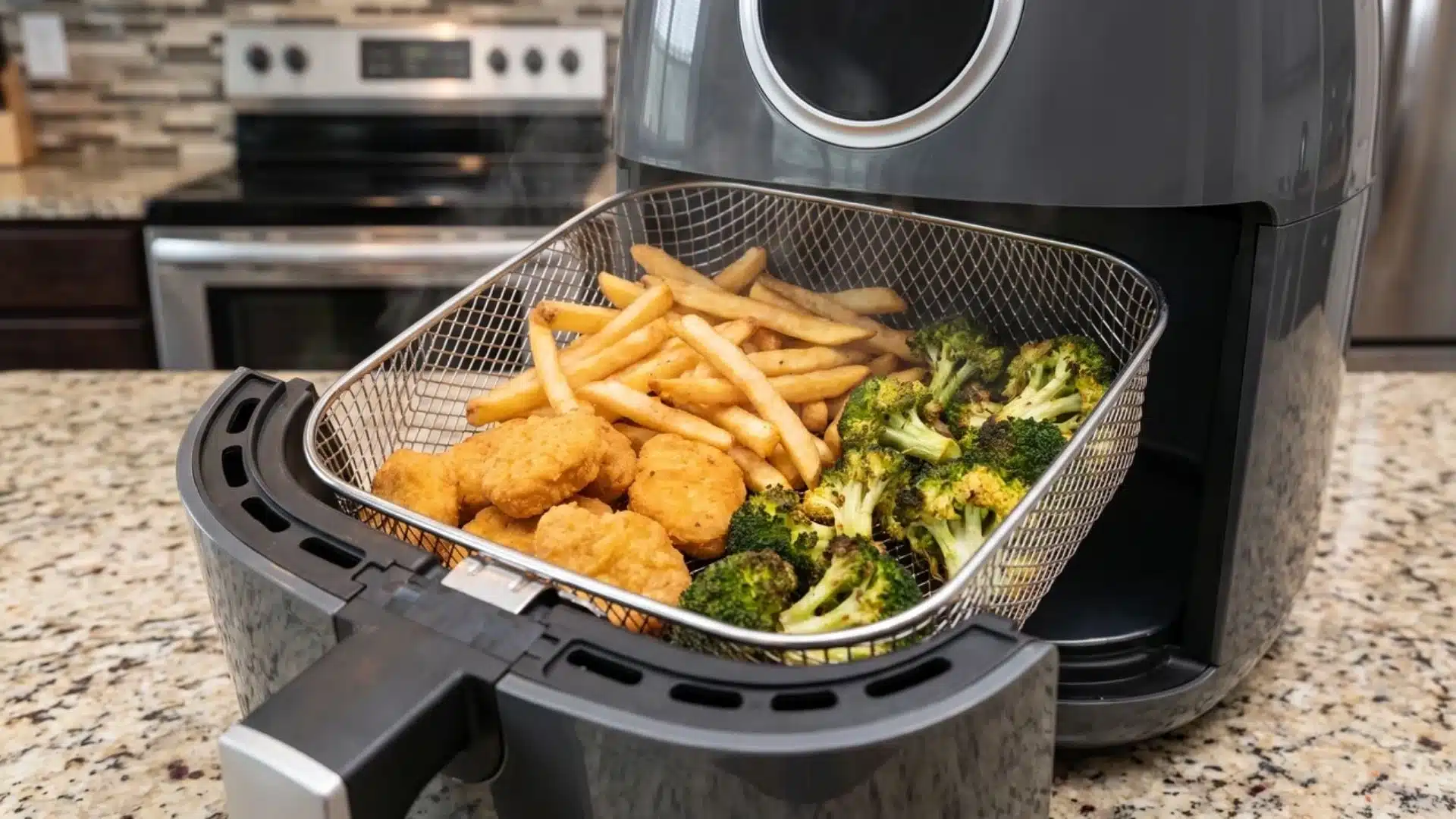
An air fryer pushes hot dry air around at high speed; faster and more focused than a conventional oven. That’s what makes it genuinely good at crisping: reheated fries, frozen foods, chicken wings, breaded items. These come out significantly better than oven-reheated versions.
What it can’t do is brown food across a large surface area at volume. A full sheet pan of roasted vegetables fills an oven. An air fryer basket holds a single layer of a smaller batch.
Airflow and radiant heat produce different results: faster and crisper on smaller items, but not a whole-oven replacement when you’re cooking for a crowd.
If you cook for two or three people, it fits. If you’re regularly feeding six, it supplements what you’re already doing rather than replacing anything.
Specialty Tools: High Value for Specific Cooks
Every tool here is genuinely good. That’s not the question. The question is whether your cooking makes it essential, or whether it becomes a very expensive piece of cabinet furniture.
Each one earns a place in roughly one kitchen in three. Figure out which one you are before you buy.
12. Stand Mixer
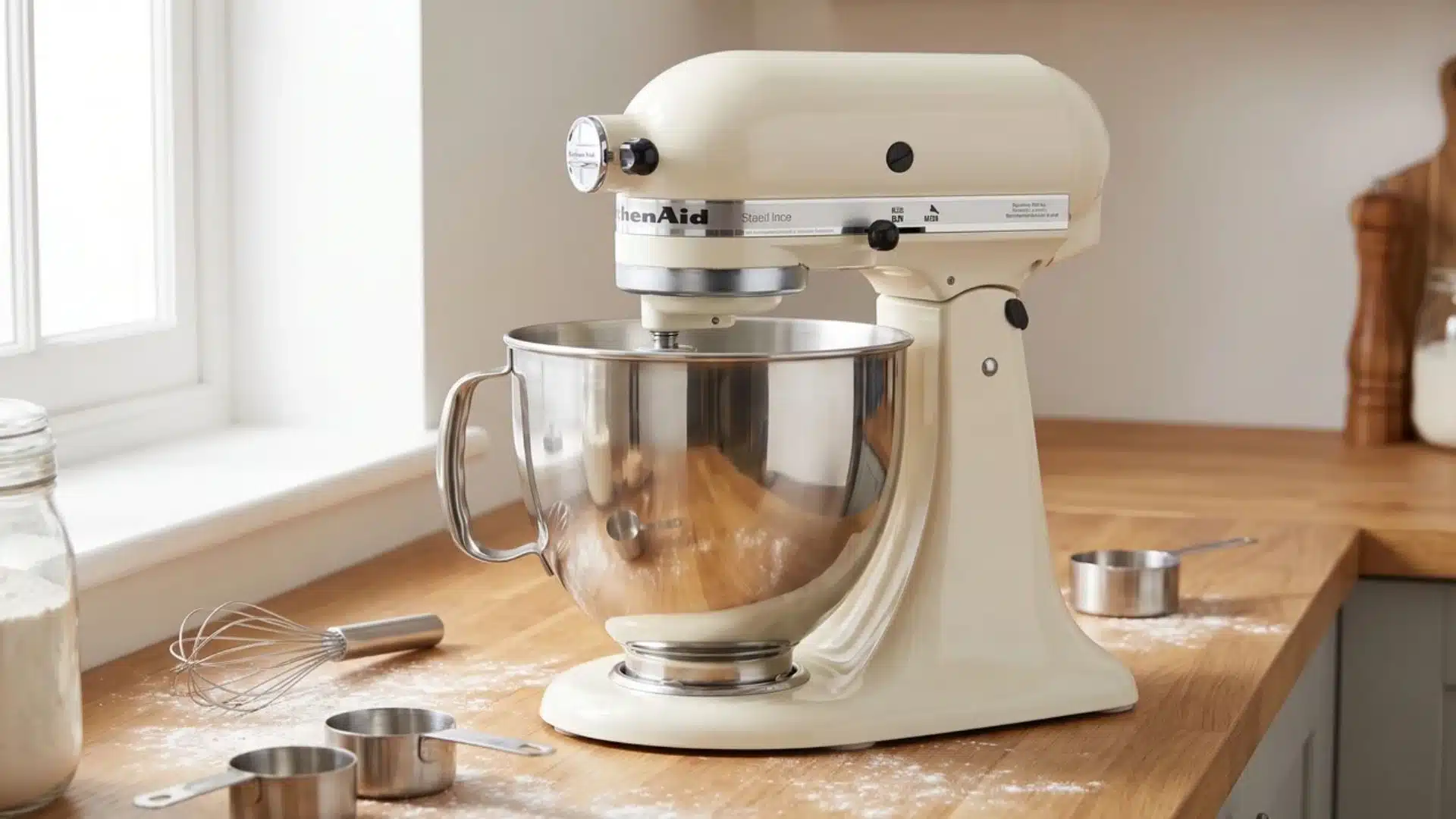
A stand mixer justifies its counter space when baking happens weekly.
The jobs it automates — creaming butter and sugar, kneading bread dough, whipping egg whites to stiff peaks — are slow by hand and hard to sustain at any volume.
Creaming butter and sugar in a stand mixer for three minutes produces a lighter, more aerated result than most bakers can achieve by hand. That aeration is what opens the crumb in a cake. Bread dough that needs ten minutes of kneading gets exactly that, without effort.
But if you bake monthly or less, the math doesn’t hold. A stand mixer is large and heavy. It either lives on your counter permanently or gets wrestled in and out of an overhead cabinet.
A handheld mixer handles most cake and cookie tasks well enough for occasional bakers.
The threshold is simple: weekly baking justifies it. Monthly does not.
13. Food Processor
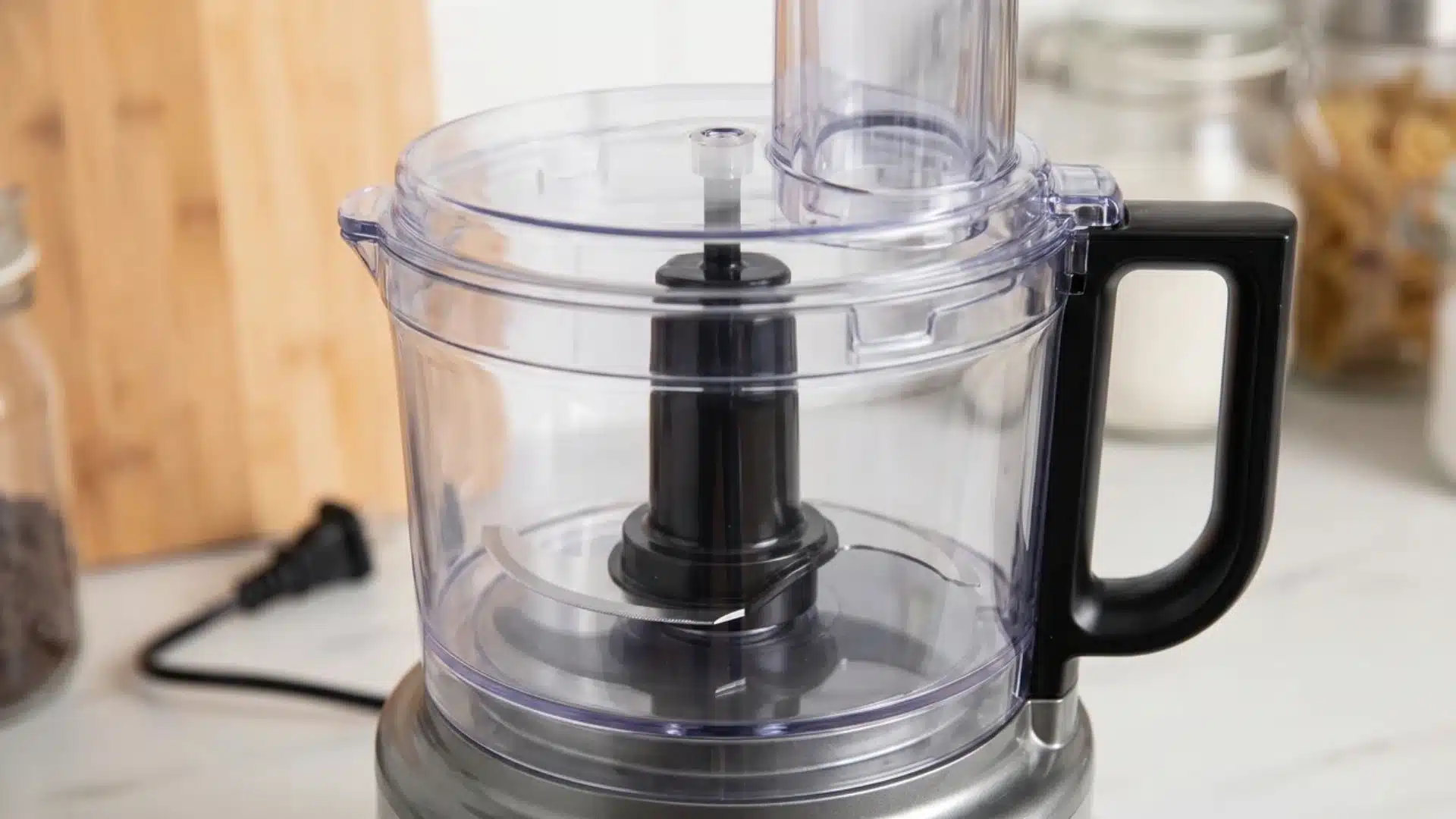
A food processor doesn’t expand what you can cook; a knife and a box grater already do what it does. What it changes is how long that work takes at volume.
Chopping three onions by hand takes four to five minutes. A food processor does it in twenty seconds. Grating two pounds of potatoes for latkes by hand is real effort; the processor handles it in one pulse sequence. Making pastry dough, it cuts cold fat into flour in seconds consistently, without warming anything up, and without overworking the gluten.
The honest case for buying one is speed at volume.
Prep large batches, cook from scratch multiple times a week, or make pastry regularly, and it pays off. Lower-volume cooking? A knife and grater do the same thing without taking up a cabinet shelf.
14. Sous Vide Circulator
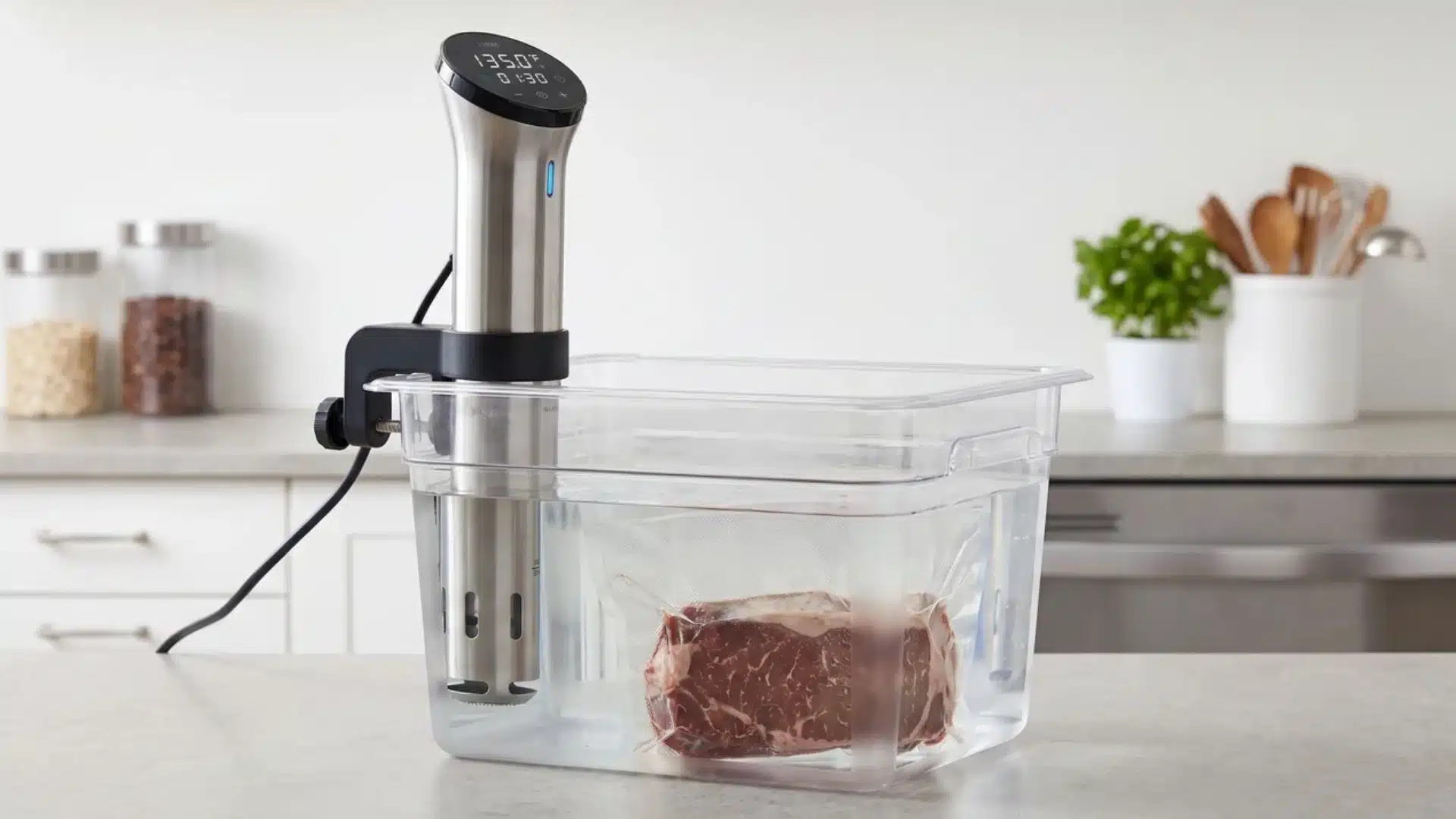
A sous vide circulator holds water at a precise, stable temperature, usually within 0.1 to 0.2 degrees, for the full length of a cook.
The result is edge-to-edge doneness that conventional heat can’t match, because conventional heat works from the outside in and overshoots the center before it’s done.
A steak cooked sous vide at 130°F is 130°F all the way through. Pull it, sear it for thirty seconds per side over high heat, and the crust forms without pushing the interior past temperature.
I want to be direct about where this actually fits: expensive cuts of meat where overcooking costs real money, poultry thighs cooked to a specific texture, and situations where repeatable precision matters more than speed.
It is not a faster method. A sous vide steak takes 60 to 90 minutes. A pan-seared steak takes eight. The value is precision, not efficiency, and that’s a narrower use case than most of the marketing suggests.
How to Build Your Kit Without Buying Everything at Once
A chef’s knife, a cutting board, a 12-inch skillet, and a saucepan cover the majority of what most recipes ask you to do. Everything else gets added when your current kit hits a specific wall.
Build in three stages.
Stage 1 — Foundation (under $150 total)
Chef’s knife, cutting board, 12-inch skillet, saucepan, silicone spatula, instant-read thermometer, box grater.
This is where spending on quality pays off most.
A $30 knife that dulls in six weeks costs more over time than an $80 knife that holds its edge with basic maintenance. Mid-range stainless cookware outlasts budget non-stick over three years because it doesn’t degrade. Spend here. Defer the rest.
Stage 2 — Expansion ($150–$300)
Dutch oven, immersion blender, second cutting board. Add these when the foundation tier’s limits show up as real friction.
You’ve made soup twice and transferred hot liquid to a countertop blender both times; that’s the signal for the immersion blender. You want to braise something and realize you have no vessel for it; that’s the signal for the Dutch oven.
Stage 3 — Discretionary (appliances, when the habit is clear)
Multicooker, air fryer, stand mixer, food processor, sous vide. Buy these when a specific cooking habit is already established and the appliance directly serves it. Not before.
The one rule that prevents over-buying: wait until your current kit can’t do what you’re regularly trying to cook, then buy the one thing that removes that specific bottleneck.
Wrapping Up
Most kitchen gadget lists are written by cooks who’ve accumulated tools over years and can’t imagine cooking without any of them. That’s how “must-have” ends up meaning “nice to have.”
The real list is shorter than you think. A sharp knife, a thermometer, a board big enough to work on, a skillet that can handle high heat, a saucepan, and a Dutch oven, that’s the core. Everything beyond it earns its place one specific use case at a time.
Buy the foundation first. Buy the rest only when you’ve hit the limit of what you already own. Your kitchen will be more functional for it and a lot less cluttered.
Frequently Asked Questions
What is the single most important kitchen tool to own?
A sharp 8-inch chef’s knife. It handles most prep work like chopping, slicing, mincing, and breaking down proteins better than any other single tool. Everything else on an essentials list is secondary to having one good knife that you keep sharp.
Are expensive kitchen gadgets actually better?
For knives and cookware, yes, material quality directly affects how they perform and how long they last. For most other tools, no. A $12 instant-read thermometer reads as accurately as a $90 one. Spend more where build quality changes the result. Spend less where it doesn’t.
What kitchen gadgets are worth it for a small kitchen?
Buy tools that do more than one job. A Dutch oven replaces a stockpot, a braiser, and a bread vessel. An immersion blender covers most of what a countertop blender does. Skip single-use gadgets entirely. In a small kitchen, every item needs to earn its space by doing at least two things well.
How do I know when I need a new kitchen tool?
When you keep working around the same limitation, cutting in stages because your board is too small, guessing at doneness because you have no thermometer, that friction is the signal. Buy the tool that removes the specific bottleneck you’re hitting. Not the one that sounds useful in theory.