

Your device passed every test in the lab. Then it hit the field and broke in ways you never saw coming.
That gap almost never comes down to how the device was built. It comes down to how it was tested. IoT testing is a multi-layer problem; hardware, firmware, network protocols, and cloud all running together and standard QA wasn’t built for it.
Here I’ll cover what IoT testing actually validates, the five types that form any complete strategy, why standard QA instincts break down on IoT, and how to build your approach around the failure that matters most for your device.
What Is IoT Testing?
IoT testing checks that connected devices like hardware, firmware, network protocols, cloud platform, and UI work together as one system under real conditions. It’s not software QA applied to a device.
Standard software testing runs in a controlled environment. Inputs are predictable. Failures repeat. IoT doesn’t give you that.
A connected device runs across multiple layers at once. Any layer can fail on its own. Any layer can also trigger a failure in another through the way they interact.
That interaction problem is what makes IoT its own discipline. I’ve seen devices pass every unit test at the component level and still break when protocol negotiation and a cloud handshake run at the same time under memory pressure. Neither component failed. The interaction did.
On devices with limited RAM and CPU, lab results and field results often look nothing alike. The gap isn’t a mystery. It’s what happens when you test components separately and then deploy them as a system.
If you think IoT testing is just standard QA with extra steps, that’s the assumption that produces incomplete coverage. The layers, and how they interact, are the whole point.
What Are the Main Types of IoT Testing?
Each type of IoT testing exists because a specific failure stays hidden until a device is in the field — and by then it costs real money to fix. The five types below form the base of any solid coverage plan, whether you’re testing in-house or working with Internet of Things testing services.
| Testing Type | What It Checks | Failure It Prevents |
|---|---|---|
| Interoperability | Communication across Wi-Fi, Bluetooth, Zigbee, MQTT, and other protocols | Unpredictable behavior when multiple protocols compete on the same connection |
| Security | Firmware, web interfaces, and network ports using OWASP IoT as the baseline | Attackers getting in through IoT-specific gaps a standard app scan won’t find |
| Performance | How the system handles big data loads and many requests at once | Devices that work fine at ten connections but fall apart at a thousand |
| Usability | Companion app UX and physical device controls | Support failures at scale when real users interact differently than engineers expected |
| Continuity & Reliability | Device behavior during outages, power drops, and unexpected data spikes | Silent data loss when a device reconnects after an outage but drops what it held during the gap |
Think of the table as a coverage map. Each row is a failure category your strategy has to account for, skip one and you’re testing a subset of IoT, not the whole thing.
The tools matter as much as knowing which type applies.
For network and protocol testing, Wireshark captures and analyzes live packet behavior. For API and message testing, MQTT.fx and Postman let you inspect message flows directly. MQTT.fx is built for MQTT broker interactions specifically, Postman alone won’t get you there.
Security testing runs against the OWASP IoT Security Testing Guide.
Firmware analysis and web interface scanning are the two attack surfaces a standard app scan misses. I’ll also cover DDoS resilience and spoofing protection; both part of the IoT attack surface that standard frameworks ignore.
On compliance: if your device targets consumer markets in the EU, ETSI EN 303 645 sets the baseline security standard for connected devices. It shapes what your security testing has to cover. That’s not something to schedule for later; it determines scope from day one.
I’d use the table to audit your current coverage, not just read through it once. If any row has no test assigned to it, that’s a gap with a real cost attached.
Why Is IoT Testing Harder Than Standard Software Testing?
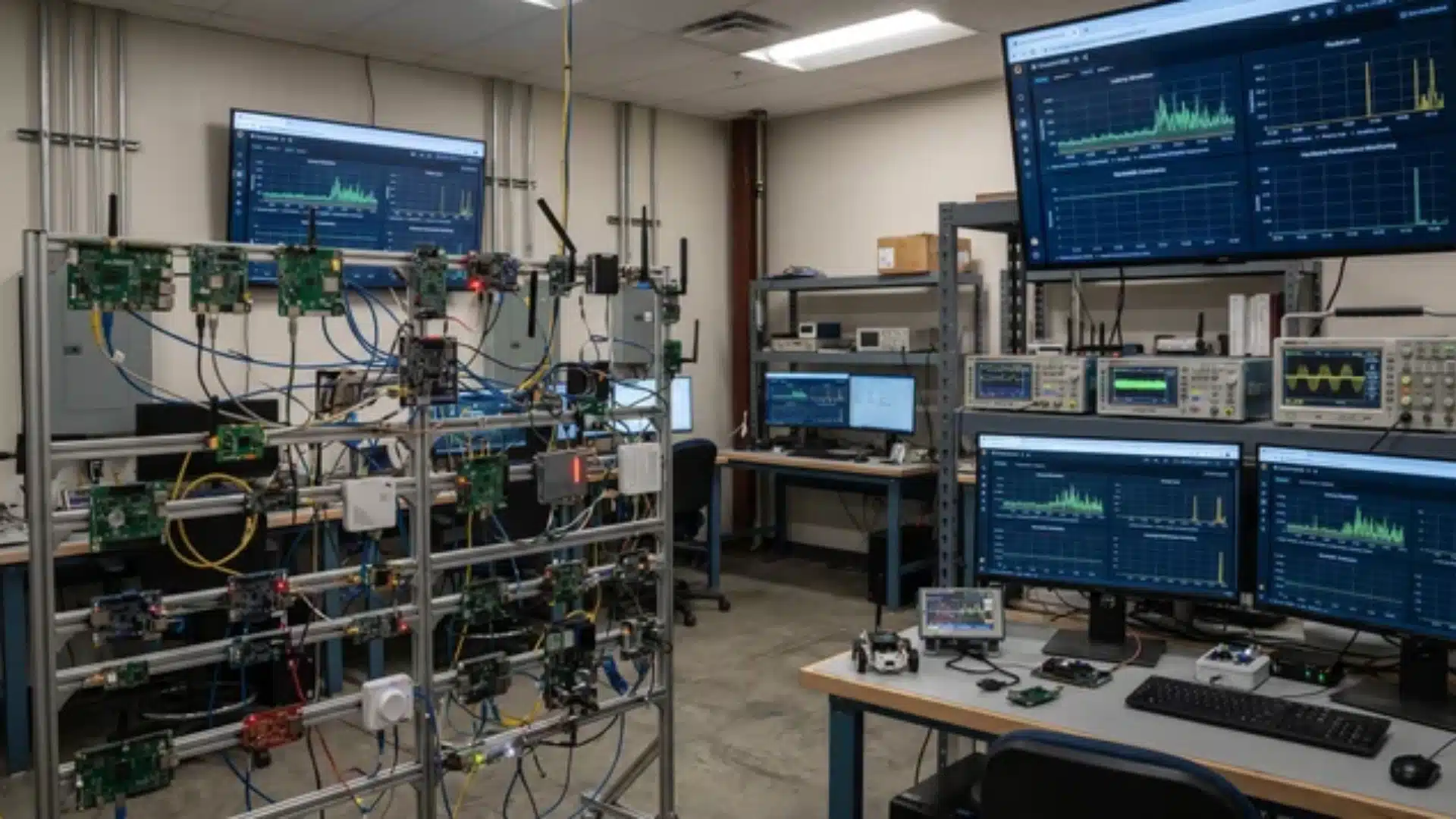
Most QA teams know how to test software. The instinct is to apply the same approach to IoT and adjust as needed. That instinct is what causes most early strategies to fall apart.
IoT brings three problems that standard QA wasn’t built for. If you’re coming from a software background, here’s where the gap shows up.
1. Simultaneous State Management
Dozens or hundreds of devices run at the same time, each with its own state, data traffic, and connection status. You can’t control inputs the way you would in standard software testing. The environment is the variable, and it never stays still.
2. Scale
Behavior that looks stable at ten devices can break completely at a thousand concurrent connections. Physical hardware alone can’t replicate that. Automated simulators and message-replay tools are how IoT testing actually works at real deployment scale.
3. Physical Constraints
Low-power devices have limited RAM and CPU. A device can pass every lab test and still fail when power fluctuates, RF interference hits, or battery drain kicks in. The lab never replicates those conditions unless you build them in deliberately.
None of these show up clearly until you push the system past comfortable conditions. That’s the happy path problem, you test under clean lab conditions and miss packet loss, latency variance, and bandwidth failures entirely.
tc/netem is a Linux tool that fixes this. It lets you set artificial latency, packet loss rates, and bandwidth caps to replicate real network stress before a single device ships.
I’ve seen teams skip it and spend weeks tracing field failures that ten minutes of simulated packet loss would have found.
Testing only what works isn’t testing. It’s confirmation.
How Do You Build an IoT Testing Strategy?
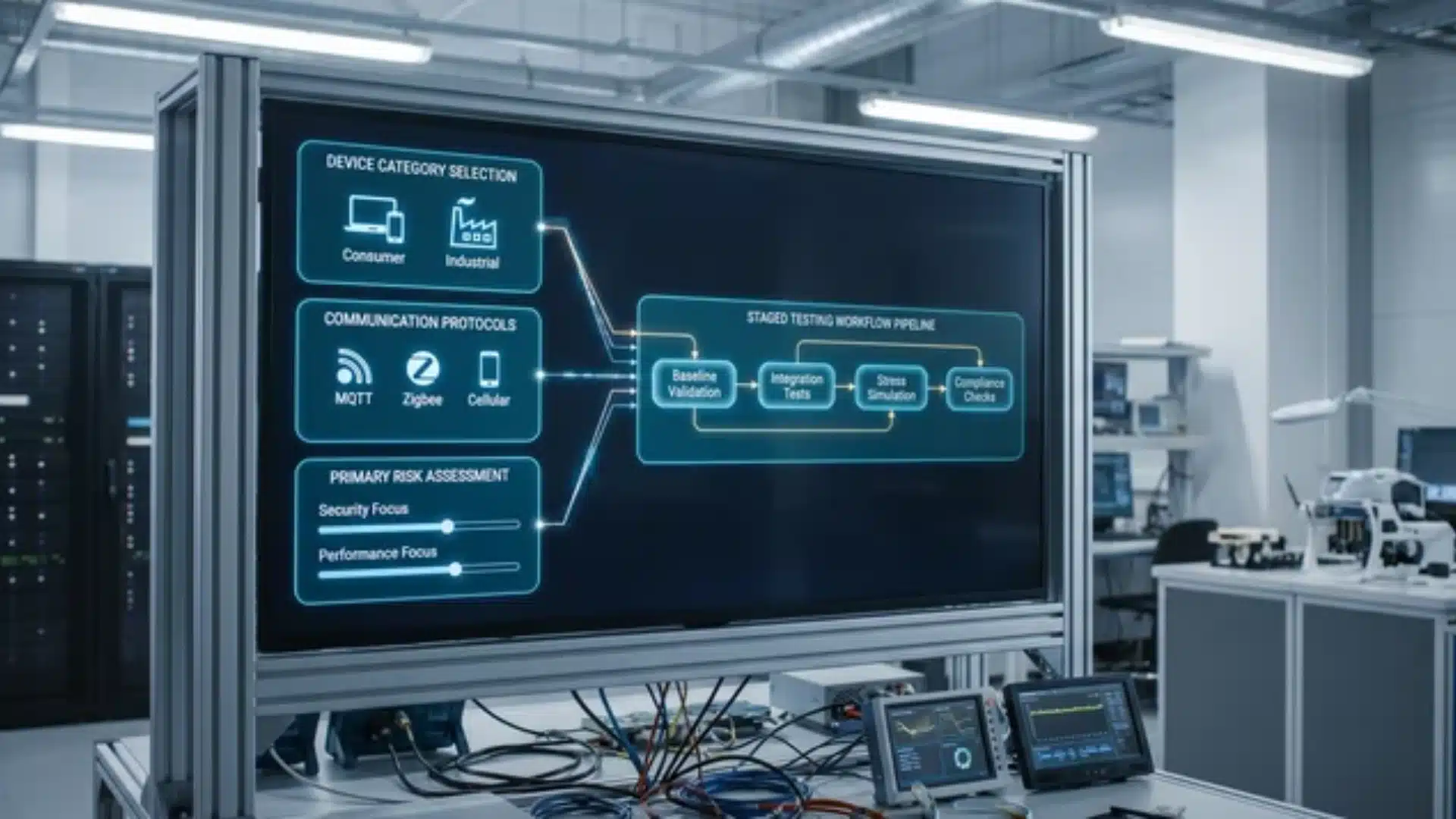
A solid IoT testing strategy starts with three decisions: device category, protocols in use, and primary risk before you pick a single tool. Teams that skip this end up with tools before they have a target, and that’s a slow way to find out what you missed.
This applies whether you’re building in-house QA or scoping Internet of Things testing services externally.
These are the three questions to answer first. Each one directly activates a set of test types, so getting them right shapes everything that follows:
- Device category: A consumer smart-home device and an industrial sensor carry different risks. Consumer devices put usability and security first. Industrial and medical devices often have regulatory standards like FCC, CE, UL that override your internal priorities. Your category tells you which test types you can’t skip.
- Protocols in use: Your protocol stack is your attack surface map. A device running MQTT over cellular has a different exposure than one running Zigbee in a local mesh. The protocols you use determine which interoperability and security tests are in scope.
- Primary risk: Pick one: security vulnerability or performance at scale. Both matter, but they need different priorities and different tools. Trying to treat them equally from the start usually means you handle neither well.
Once you have those three answers, structure the sequence the same way every time.
Start with one variable at a time. Test under controlled conditions first and write everything down. Then add adversarial conditions one at a time: packet loss, latency, power instability, concurrent load.
Don’t jump to stress testing before you know baseline behavior per layer.
I’ve watched teams skip baseline isolation and spend days trying to untangle failures that touched three layers at once. There’s no clean root cause when you never had a clean baseline. Isolating variables is how you find failures quickly; end-to-end system testing finds them slowly, after they’ve already compounded.
If your device is in a regulated space like something related to medical, automotive, or industrial, compliance testing against FCC, CE, or UL isn’t something you schedule after QA wraps.
It runs alongside everything else from day one. Teams that treat it as a final gate almost always hit it late and pay for it in rework.
The goal isn’t to test everything at once. It’s knowing which failure matters most and making sure your strategy finds it before your users do.
Conclusion
IoT testing is a multi-layer problem. Gaps between lab results and field performance almost always come down to which layers were tested and under what conditions, not to device quality.
The five types here, interoperability, security, performance, usability, and continuity, each target a failure class that stays invisible until a device is deployed.
The challenges that separate IoT QA from standard software testing don’t go away with more effort applied to the wrong framework. They go away when you scope your strategy to your device’s actual risk before you touch a tool.
A device that holds up in the field was tested against the conditions the field actually creates. That’s the standard worth building toward.
Frequently Asked Questions
What is IoT testing?
IoT testing checks that connected devices; hardware, firmware, network communication, and cloud integration, work together as a system under real conditions. It differs from standard software testing because IoT failures usually happen at the interaction layer between components, not inside any one of them. A device can pass every unit and integration test and still fail when multiple protocols compete under load.
What does IoT testing cover beyond basic functionality?
Beyond checking that a device does what it’s supposed to, IoT testing covers security vulnerabilities in firmware and web interfaces, interoperability across protocols like Wi-Fi, Bluetooth, and Zigbee, performance under high concurrent load, and behavior during outages or power drops. Each category targets a failure class that functional testing alone won’t find.
What is the OWASP IoT Security Testing Guide?
The OWASP IoT Security Testing Guide is the standard method for penetration testing IoT systems. It covers firmware analysis, web interface vulnerabilities, and network port exposure. It works as a structured checklist that makes sure teams cover the full IoT attack surface, not just the entry points a standard web app security scan would catch.
Do IoT devices need to be physically present to test them?
Not always. Device simulators and message-replay tools let teams stress-test cloud infrastructure and communication protocols at scale without physical hardware for every scenario. Physical testing is still needed for hardware-specific behavior: power cycling, RF performance, sensor accuracy, and battery drain that simulation can’t reliably replicate.