

Building an IoT system is not just about connecting devices. I have seen projects involve firmware, cloud pipelines, communication protocols, and security, all running together, all depending on each other.
And most projects that fail? They do not fail because of bad hardware. In my experience, they fall apart because the software architecture was never properly planned from the start.
Here, you will learn how data moves from a physical sensor all the way to a user dashboard, what gets built at each layer, and how to execute each stage without costly mistakes.
Whether you are starting your first IoT project or trying to build more reliably at scale, you will find a clear framework to work from.
What is IoT Software Development?
IoT software development builds systems that connect physical devices to digital platforms. These systems collect data, process it, and automatically trigger actions.
It includes embedded software on devices, backend systems for processing, and applications for monitoring or control.
All layers work together as one connected pipeline. Physical events happen, sensors convert them into digital data, and software processes that data into alerts or automation.
This loop runs continuously.
IoT differs from traditional software because it handles continuous data streams and is constrained by hardware limitations. Many use cases also require real-time processing.
It is not just app development or hardware integration. It is the design of a distributed system where devices, networks, and software operate as one.
How an IoT System Works (End-to-End Data Flow)
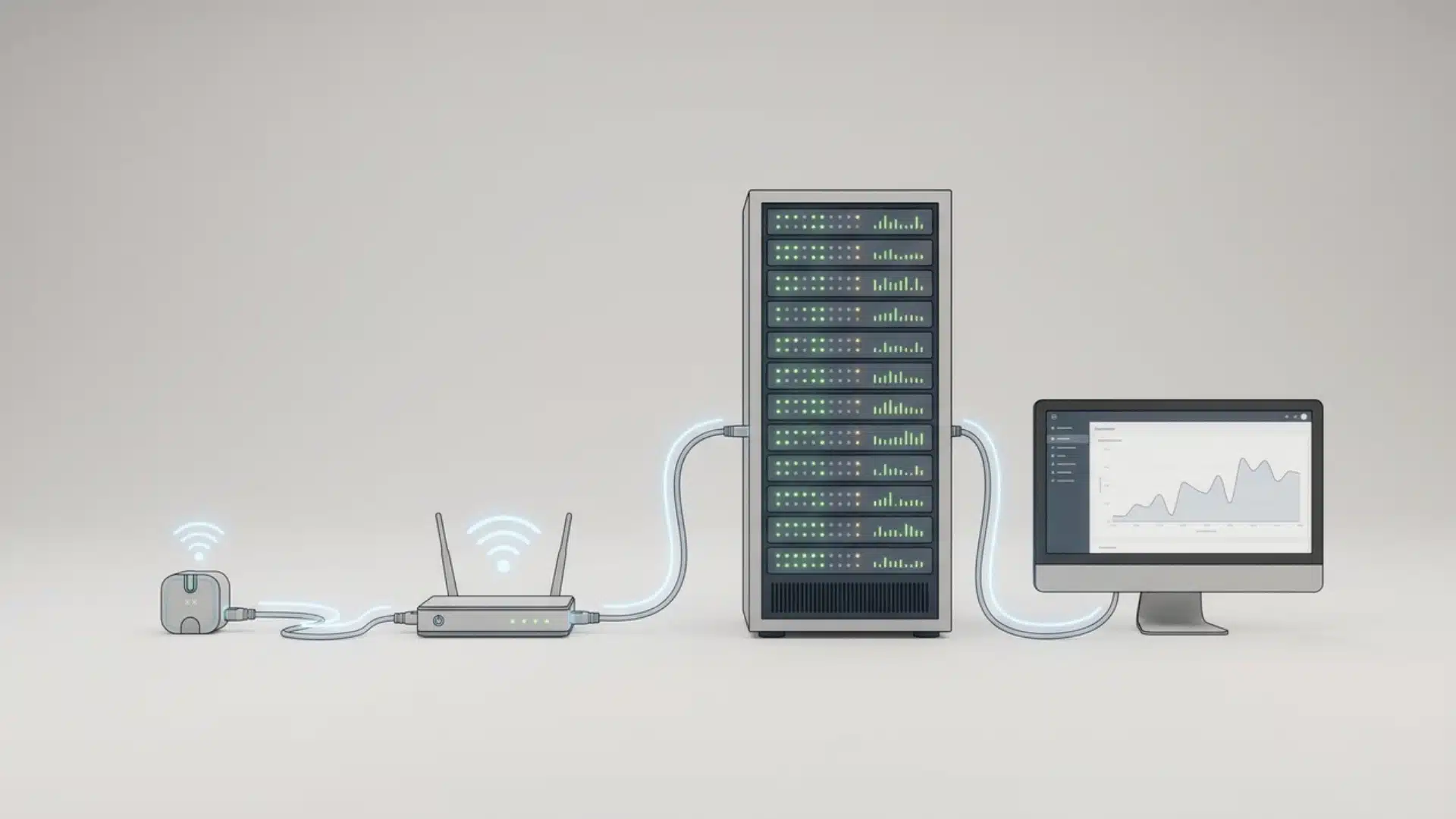
An IoT system follows a continuous flow:
sensors → device → network → cloud/backend → application → user or automated action.
Each layer passes data forward until it results in insight or control.
- Sensors detect physical changes such as temperature, motion, or pressure and convert them into digital signals. These signals become the raw data that powers the entire system.
- The device collects this data and transmits it through a network using communication protocols. Reliable connectivity ensures the data reaches backend systems without delay or loss.
- The backend validates, stores, and processes incoming data in real time or batches. This processing turns raw inputs into meaningful outputs.
- Applications display the processed information on dashboards or mobile apps. They may also trigger automated responses based on predefined rules.
The device layer focuses on capturing data from the physical world. The network layer ensures secure and consistent communication between components.
The backend layer manages processing, storage, and analytics. The application layer enables user interaction and system control.
If this end-to-end flow is misunderstood, architecture decisions become flawed. That often leads to latency issues, integration failures, and scaling problems.
Where IoT Software Development Is Applied
Knowing how IoT works is easier when you see it in action. Here are three use cases that cover the full system lifecycle I covered above:
Predictive Maintenance (Manufacturing) Vibration sensors attached to industrial machines feed real-time data to a backend system. When patterns shift, the system flags a likely failure before it happens. Engineers get an alert on a dashboard and schedule repairs, instead of reacting to a breakdown mid-production.
Remote Patient Monitoring (Healthcare) Wearable devices track heart rate, blood oxygen, and movement. That data streams continuously to a cloud backend. If a reading crosses a threshold, an alert goes to the care team. The patient never needs to be in a clinic for routine monitoring.
Smart Energy Management (Buildings) Sensors track temperature, occupancy, and power consumption across a facility. The backend adjusts HVAC and lighting automatically based on usage patterns. Over time, this reduces energy waste without requiring manual intervention.
Each of these follows the same device → network → backend → application flow. The use case changes. The architecture does not.
IoT Software Development Process (Step-By-Step Execution)
IoT development follows a structured, iterative workflow. Decisions made early directly shape performance, scalability, and long-term reliability.
Step 1: Define the Problem and System Requirements
Identify what must be monitored or automated. Define the data type, frequency, and expected outputs. Include constraints like power limits, environmental factors, and latency needs.
Clear requirements align technical decisions with business goals. Poor definition leads to the wrong architecture and expensive redesigns down the line.
Step 2: Design the System Architecture
Divide the system into four layers: device, network, backend, and application. Choose protocols like MQTT, HTTP, or CoAP based on your bandwidth and latency requirements.
Architecture controls how data flows and scales. Weak structural decisions cause bottlenecks and integration failures that are hard to fix later.
Step 3: Select Hardware and Integrate Devices
Choose sensors based on accuracy and environmental durability. Decide between microcontrollers for efficiency or single-board computers for higher processing needs.
Hardware defines your system’s ceiling. A mismatch restricts scalability and cannot be easily corrected after deployment.
Step 4: Build Firmware for Devices
Firmware manages data capture, filtering, and communication. It keeps devices running reliably under real-world conditions.
Efficient filtering reduces bandwidth usage and cloud costs. Sending raw, unfiltered data continuously can overload your backend fast.
Language choice depends on device constraints. C and C++ are the standard for resource-limited microcontrollers. They run fast, use little memory, and give direct hardware access.
Python works well on more capable devices like Raspberry Pi, especially when development speed matters more than raw efficiency. Java occasionally appears on mid-tier devices that need cross-platform compatibility.
Most firmware projects use C or C++ at the device level and Python or higher-level languages closer to the cloud side of the stack.
Step 5: Develop Backend and Data Pipeline
Design a pipeline that covers ingestion, processing, storage, and analytics. Build it to support both real-time alerts and batch insights.
A strong pipeline handles data reliably at scale. Poor design creates delays, bottlenecks, and potential data loss.
You will also need to choose a cloud platform to host your pipeline. The most widely used options are AWS IoT Core, Azure IoT Hub, and Google Cloud IoT. Each handles device connectivity, data ingestion, and storage, but they differ in tooling and integration depth.
AWS IoT Core is the go-to for teams already in the AWS ecosystem. Azure IoT Hub fits Microsoft-heavy environments and supports a wide range of protocols out of the box. Google Cloud IoT works best when machine learning and advanced analytics are core to the plan.
None of these requires you to build from scratch. Most offer managed services for ingestion, rules engines, and storage, which cuts backend complexity significantly.
Cloud vs. Edge: Where Should Processing Happen?
Not all data needs to travel to the cloud. Edge computing processes data directly on or near the device before it leaves the local network.
This matters when latency cannot be tolerated, like in automated machinery or real-time safety systems. Processing at the edge cuts response time from seconds to milliseconds. It also lowers cloud costs by filtering out unnecessary data before transmission.
In practice, most systems use both. Edge handles time-sensitive decisions locally. Cloud handles storage, long-term analytics, and system-wide insights.
Step 6: Build User Applications and Interfaces
Create dashboards or mobile apps connected via secure APIs. Interfaces should present data clearly and make control actions easy to execute.
Usability determines how well users act on what the system surfaces. A confusing interface reduces the value of everything built beneath it.
Step 7: Implement Security Across the System
Secure devices, networks, and backend systems using encryption and authentication. Apply strict access control at every layer, not just at the application level.
Security protects both data integrity and device control. Weak protection exposes the entire system to breaches and operational risk.
Step 8: Test the Entire IoT System
Run integration, performance, and environmental testing. Validate system behavior under high load and unstable network conditions.
Testing confirms stability before deployment. Skipping this stage consistently leads to failures in the field.
Step 9: Deploy, Monitor, and Maintain
Provision devices correctly and configure cloud infrastructure with care. Set up monitoring for device health, data flow, and system performance from day one.
Continuous monitoring prevents silent breakdowns. OTA (over-the-air) updates keep devices secure and functional long after initial deployment.
Core Components of IoT Software: What You Actually Build
An IoT system comprises distinct components that work together to move data from the physical world into meaningful action. Each component handles a specific stage of the data lifecycle.
| Component | Role in the System | Mechanism (How It Works) | Failure Impact |
|---|---|---|---|
| Embedded Software (Device-Side Logic) | Controls sensors and device behavior | Captures, filters, and prepares data before transmission | Unstable firmware causes unreliable data and device crashes |
| Connectivity (Protocols & Networks) | Transfers data between devices and the backend | Uses protocols like MQTT, HTTP, or CoAP to send data securely | Poor connectivity design leads to latency, data loss, or battery drain |
| Backend Systems (Processing & Storage) | Processes, stores, and analyzes incoming data | Ingests → validates → processes → stores data for real-time or batch use | A weak backend creates bottlenecks and scaling limitations |
| Applications (User-Facing Layer) | Enables monitoring and control | Uses APIs to display insights and trigger actions | Poor UI makes insights unusable and reduces system value |
Each component supports a different stage of the data journey: capture, transmit, process, and interaction. If any one layer is weak or missing, the entire IoT system flow breaks down.
Key Challenges in IoT Software Development
IoT systems operate in distributed, hardware-dependent environments, which introduces challenges at every stage of development. These issues are structural, not accidental, and must be addressed early in the design process.
- Interoperability: Different devices, operating systems, and communication protocols often struggle to work together without middleware or standardization.
- Data Volume: Continuous sensor streams generate massive data that can overwhelm storage and processing systems without filtering or edge logic.
- Scalability: As the number of connected devices grows, backend systems face increased load, requiring horizontal scaling and distributed architectures.
- Latency: Delays in data transmission or processing can disrupt real-time use cases such as automation, predictive maintenance, and safety systems.
- Security: A large number of connected devices expands the attack surface, increasing the risk of unauthorized access and data breaches.
Ignoring these challenges during planning often leads to performance failures and expensive system redesigns after deployment.
IoT Software Development vs. Traditional Software Development
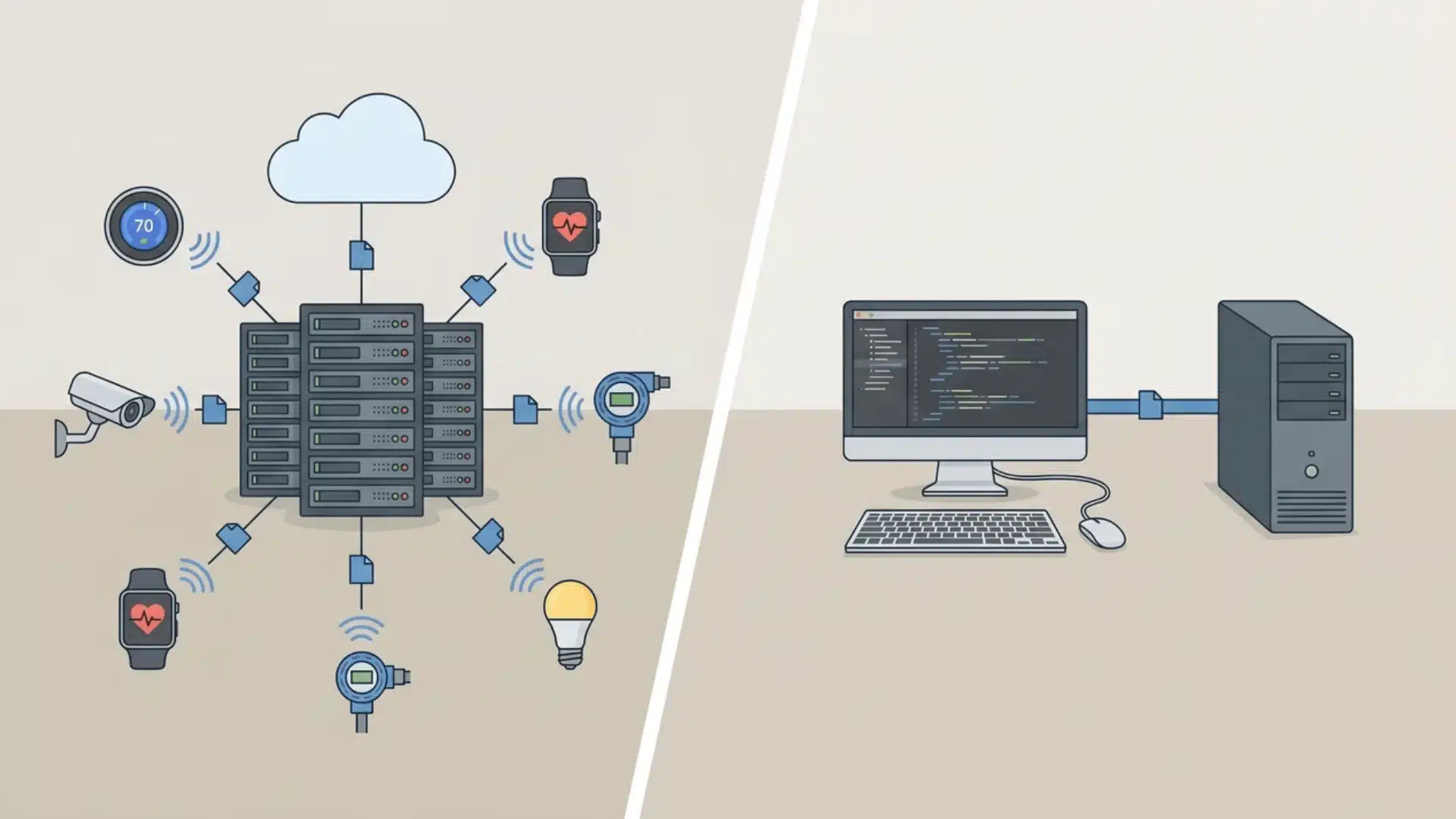
IoT and traditional software differ in architecture, data handling, and system design. These differences directly impact how systems are built and scaled.
| Aspect | IoT Software Development | Traditional Software Development |
|---|---|---|
| System Nature | Distributed systems connected to physical devices | Centralized or client-server applications |
| Data Flow | Continuous real-time data streams | User-triggered or batch-based processing |
| Device Interaction | Direct interaction with sensors and hardware | Primarily, user interaction through interfaces |
| Architecture Design | Multi-layered (device, network, backend, app) | Typically, application + database structure |
| Scalability | Scales across devices, data volume, and networks | Scales mainly across users and transactions |
| Security Scope | Device, network, and backend protection required | Mostly application and database security |
| System Complexity | High due to hardware and protocol diversity | Moderate, mainly software complexity |
Applying traditional centralized patterns directly to IoT often causes performance and scalability issues.
Quick Execution Checklist
Use this checklist to quickly verify that your IoT development process covers all critical stages.
- Define the use case clearly and document system requirements
- Design a structured architecture across device, network, backend, and application layers
- Select appropriate hardware and build efficient firmware
- Develop a scalable backend and reliable data pipeline
- Create intuitive dashboards or mobile applications
- Implement security across devices, communication, and backend
- Test the system under real-world and high-load conditions
- Deploy properly and continuously monitor performance and updates
Covering each of these points ensures the system remains reliable, scalable, and secure after deployment.
Conclusion
IoT software development combines hardware, connectivity, backend systems, and applications into one integrated pipeline. Every layer shapes performance, security, and how well the system holds up over time.
You now understand end-to-end data flow, core components, step-by-step execution, and the structural challenges that trip up most projects. That knowledge makes a real difference when you are planning architecture or debugging failures.
The most reliable IoT systems are not the most complex ones; they are the ones built on clear requirements and disciplined execution at every stage.
Use what you have learned here to plan smarter and build with confidence.
Frequently Asked Questions
What skills are required for IoT software development?
IoT software development requires embedded programming, networking fundamentals, knowledge of cloud architecture, data processing skills, and cybersecurity basics, along with an understanding of hardware constraints and distributed system design.
How long does it take to develop an IoT system?
Development timelines vary based on complexity, hardware selection, integration needs, and testing requirements, but full-scale IoT systems typically take several months from planning to deployment.
Can IoT systems work without cloud infrastructure?
Yes, IoT systems can operate using edge computing for local processing, but cloud infrastructure is usually required for scalability, centralized analytics, and long-term data storage.