

The rise of generative artificial intelligence (AI) in recent years hasn’t just revolutionized the way we interact with software—it’s also caused seismic shifts in the physical world. Behind every smart chatbot, image generator, or data analytics system is a massive, complex, and extremely power-hungry hardware infrastructure.
The huge demand for modern chips has completely changed the world’s supply chain. To build these powerful systems and keep up with innovation, companies need a reliable AI electronic components supplier today more than ever. This is the only way they can secure key areas in a world where shortages have become everyday.
Anatomy of AI Hardware: Why Is It Different?
Standard servers mostly relied on classic processors (CPUs), built for everyday, general tasks. However, AI workloads require parallel processing of massive amounts of data. That’s why graphics processing units (GPUs) and specialized AI accelerators have become the “gold standard” of today’s industry.
In addition to the processors themselves, AI systems require high-bandwidth memory (HBM), advanced networking components for fast data transfer between servers, and a completely new power and cooling system.
AI servers consume significantly more electricity and generate huge amounts of heat, which means that data center infrastructure must switch from air to technical cooling. All of these factors are drastically changing the type of electronic components that are ordered and manufactured.
Bottlenecks and Shock to the Global Supply Chain
This sudden shift to AI infrastructure has caught many parts of the supply chain off guard. While demand for standard electronics (like smartphones and personal computers) has stagnated, demand for AI components has exploded.
The main bottleneck has emerged not just in silicon production itself, but in the so-called “advanced packaging” of chips (like TSMC’s CoVoS technology), which is necessary to combine GPUs and HBM memory into a single powerful module. Due to limited capacity in these highly specialized factories, lead times for key AI components have been stretched to a staggering 40 to 50 weeks.
Original equipment manufacturers (OEMs) and electronic manufacturing service providers (EMS) have faced a new challenge: how to design and manufacture equipment when key parts are months behind schedule?
Industry Confirmation: The Scale of the Growth
The numbers are the best way to show how extreme this growth really is. While analyses from various vendors (such as Avnet and RandTech) have already pointed to dramatic changes in inventory, the broader market picture is striking.
The broader picture of the market is best illustrated by the research of the analytical company Gartner. According to their data, global revenue from AI chips will exceed $71 billion in 2024, achieving a 33% year-over-year jump. The study predicts that this number will climb to almost $100 billion by the end of 2026. This hyper-growth is a major reason why the entire supply chain must be restructured from the ground up, not just slightly adjusted.
A New Era of Planning: From Just-in-Time to Just-in-Case
For decades, the rule was that parts arrive at factories exactly when they are needed for production in order to reduce storage costs. However, the incredible growth of AI technology and the geopolitical crisis revealed all the weaknesses of this Just-in-Time approach.
Today, companies are moving to a Just-in-Case model. The supply chain is being redesigned to be more resilient:
- Create strategic inventory: Instead of ordering at the last minute, companies are now pre-provisioning key AI components to avoid production downtime.
- Expanding the supplier network: Relying on just one manufacturer is considered too risky, so companies increasingly turn to partners in geographically closer and more reliable countries (near-shoring).
- Long-term partnerships: Customers sign multi-year contracts with manufacturers, as this is the only sure way today to ensure guaranteed quantities of chips and memory on time.
The Evolution of Data Centers and Manufacturing Plants
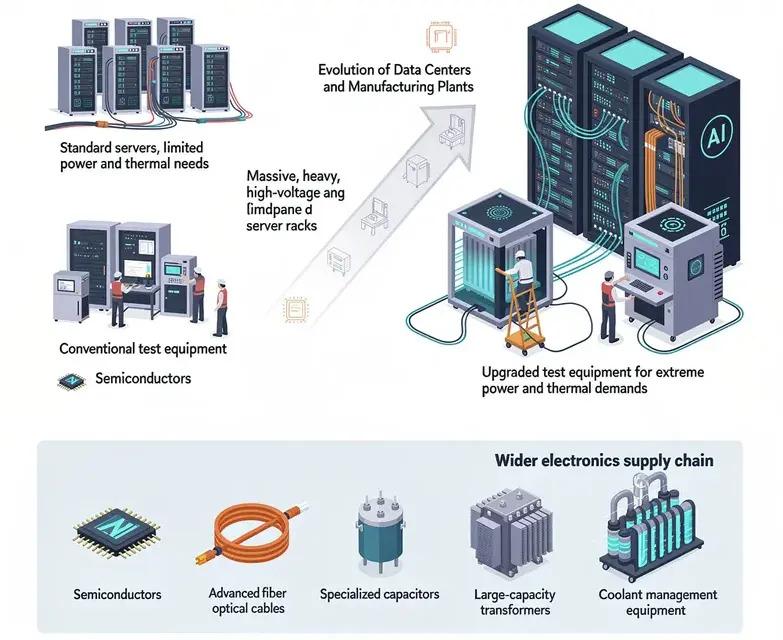
The impact of AI hardware demand is being felt all the way down to the factory floor. Electronics manufacturers must upgrade their plants to be able to test and assemble massive, heavy, and high-voltage server racks designed for artificial intelligence. Standard test equipment is often unable to handle the thermal and power demands that AI servers place on them.
The supply chain is also now spanning a wider range of industries. It’s no longer just about semiconductors; demand is equally high for advanced optical cables, specialized capacitors, large-capacity transformers, and coolant management equipment.
Conclusion
Artificial intelligence is no longer just a passing software trend—it has turned into a real industrial revolution that requires serious hardware resources and impeccable logistics. The smarter and more demanding the algorithms become, the greater the pressure on electronics manufacturers will be.
These supply chain changes we are witnessing today are not just a temporary phase, but are now literally laying the foundations for the decades ahead. For companies to succeed in this new era, they will need to think one step ahead. This implies close cooperation between engineers and the procurement sector, but also relying on proven partners who know how to navigate this complex, but also incredibly exciting AI electronics market.