
Walk into almost any distribution center right now and you’ll feel it. The pace has changed. Online orders keep climbing, delivery windows keep shrinking, and the workers needed to keep up simply aren’t showing up in the numbers they used to.
For decades, warehouses ran on a simple formula: more volume meant more people. That formula is breaking down in the modern warehouse. Labor is harder to find, harder to keep, and more expensive to replace than it’s ever been, and mistakes made under that kind of strain cost real money.
This is the backdrop that’s pushed AI and warehouse automation solutions to become the staple infrastructure, the starting point of a modern supply chain management system.
Warehouses And Automation: Why It’s a Winning Combination Why Warehouses Are Racing Toward AI and Automation
None of these pressures are showing up in isolation.
A tighter labor pool feeds higher turnover; higher turnover feeds more mistakes from undertrained or overworked staff, and every mistake chips away at margins that were already thin.
Automation didn’t become the obvious answer because it’s trendy, but because it’s the one lever that addresses several of these problems at once instead of just one.
A Growing Shortage in Labor
Industry surveys consistently show that finding and keeping warehouse staff ranks among operators’ top challenges, with more than half describing retention as a serious struggle.
This isn’t a post-pandemic blip. It’s a structural shift in how many people want this kind of work, especially among younger generations entering the labor force.
The Hidden Cost of Turnover
Warehouse turnover rates hover around 36% a year.
Every time a role needs refilling, it can cost anywhere from a quarter to one and a half times that employee’s salary once recruiting, onboarding, and lost productivity are factored in. Multiply that across a facility with hundreds of workers, and the number gets uncomfortable fast.
Human Errors Human Error Carries a Real Price Tag
Even well-run teams make mistakes. That’s unavoidable when people are moving fast under pressure.
Research suggests human error accounts for roughly 80% of process deviations in warehousing, and businesses spend somewhere around a fifth of their operational budget just correcting them.
A single picking error might only cost $20 to $60 to fix, but at scale, across thousands of daily orders, that adds up to a serious drain on margin.
The Consistency of Machines
This is the part that tends to surprise people outside the industry: automated systems aren’t just faster, they’re dramatically more accurate.
- A skilled human picker might operate at 96 to 98% accuracy.
- Automated picking technology routinely hits 99.9%.
E-commerce Will Keep Growing
Global online retail has passed the $6 trillion mark and keeps climbing, and warehousing employment has grown more than a third since early 2020 just trying to keep pace. At some point, hiring alone can’t scale fast enough to match order volume. The math stops working.
ROI and Warehouse Automation: The ROI Finally Makes Sense
For years, automation was a hard sell because the upfront cost was steep and the payback period was long. That’s changed.
Companies adopting warehouse automation now report labor cost reductions in the 25-30% range, and order fulfillment speeds up to three times faster.
At the same time, newer financing models like Robotics-as-a-Service are cutting total ownership costs and getting equipment to pay for itself in as little as a year, as HotShot experts confirm.
What This Looks Like on the Warehouse Floor
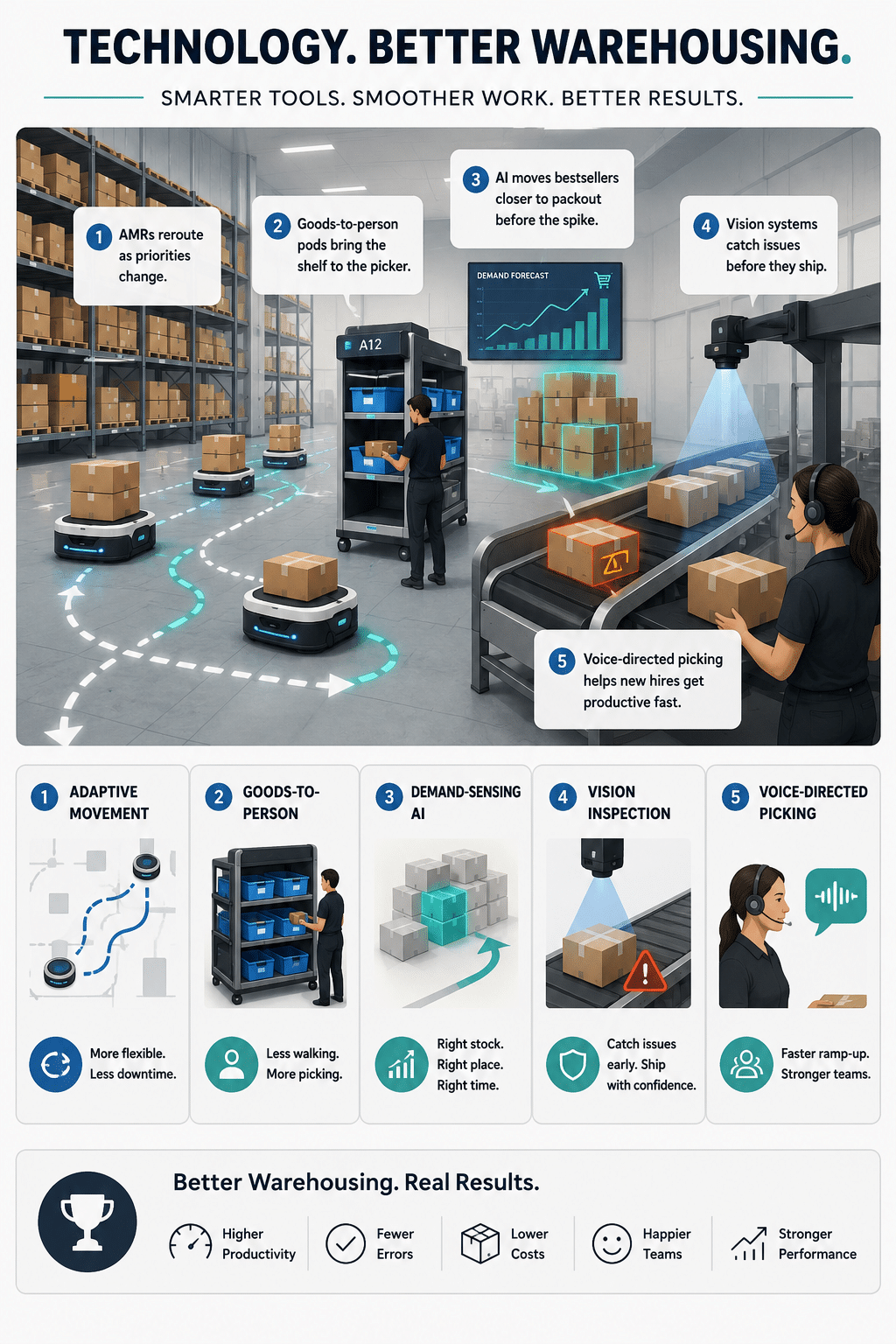
None of this is one giant robot replacing a workforce overnight. It’s smaller shifts, stacking on top of each other.
- AMRs aren’t just looping the same path anymore — they reroute mid-shift as priorities change.
- Goods-to-person pods skip the walk altogether, bringing the shelf to the picker instead of sending them off hunting for it.
- Demand-sensing AI moves bestsellers closer to packout before a spike even hits, so the stock’s already waiting when the order comes in.
- Vision systems flag a damaged case or a mispick right at the conveyor before it’s boxed up and halfway to someone’s door.
- Voice-directed picking means a new hire isn’t spending weeks just learning where things are.
Where Warehouses Go From Here
Warehouse leases and builds run 10 to 15 years. That’s the real reason the blueprint stage matters; a decision made this year locks in what that building can and can’t do for over a decade.
Older facilities can’t just retrofit their way to the same result.
Ceiling height, floor load capacity, power supply — these are physical constraints that automation has to work around, not requirements it can create after the fact.
A building designed without automation in mind often can’t fit it in later without major structural work.
That’s why the gap between early adopters and everyone else won’t close on its own. New builds are solving for automation from day one. Older ones are stuck retrofitting around limits nobody planned for.