

Generative AI has moved from experimentation into everyday enterprise work. Employees use public chatbots to summarize documents, write code and draft customer communications, while sanctioned copilots increasingly search across email, files, collaboration platforms and internal knowledge bases. The result is a new security layer that sits across data protection, cloud security, application security and governance.
The immediate risk is not limited to organizations building their own models. Shadow AI can expose source code, financial information, personal data and confidential business plans through prompts sent to unapproved services. At the same time, enterprise AI applications face model-specific threats such as prompt injection, jailbreaks, insecure tool use, data poisoning and sensitive information disclosure.
The five vendors below approach these problems from different directions. This comparison focuses on enterprise visibility, prompt-level data controls, AI application protection, model and agent discovery, runtime defense, deployment fit and integration with the wider security stack.
Key Takeaways
- AI security covers both the governance of employee AI use and the protection of AI applications, models and agents.
- Shadow AI creates a distinct data-loss problem because sensitive information can leave the organization inside ordinary prompts and file uploads.
- Enterprise copilots can amplify existing oversharing and permission problems by retrieving information users did not realize was broadly accessible.
- Prompt injection, jailbreaks, insecure agent actions and model data exposure require controls beyond conventional web and endpoint security.
- The strongest vendor fit depends on whether the priority is workforce AI governance, application protection, cloud-native deployment or ecosystem integration.
What Is an AI Security Solution?
An AI security solution helps organizations control how artificial intelligence is used and protect AI-powered systems from attack. In practice, the category covers two connected requirements: governing access to third-party generative AI services, and securing the models, applications, and autonomous agents an organization develops or deploys itself.
For workforce use, the platform should discover sanctioned and unsanctioned AI applications, distinguish corporate accounts from personal accounts, inspect prompts and uploads for sensitive information, and apply policies without unnecessarily blocking productive use. For internally built AI systems, important capabilities include asset discovery, model and agent inventory, posture assessment, red teaming, prompt-injection defense, runtime monitoring, and protection of data flowing into and out of the application.
The category overlaps with DLP, SSE, cloud security and application security, but AI introduces new context. A domain-level block is often too blunt, and a conventional data classifier may not understand how a prompt, retrieved document, and model response combine to create risk. Buyers therefore need controls that understand AI-specific workflows while fitting into existing security operations.
At a Glance: Enterprise AI Security Solutions
| Vendor | Core Strength | Best Fit |
| Check Point | Unified protection for workforce AI use and enterprise AI applications | Enterprises seeking AI security connected to a broader network, cloud, and data-protection architecture |
| Microsoft | Native governance for Microsoft 365 Copilot and Azure AI | Microsoft-centric organizations prioritizing permissions, data posture and platform-native controls |
| Zscaler | Inline control of AI application access and prompt data through SSE | Distributed enterprises already routing user traffic through the Zero Trust Exchange |
| Palo Alto Networks | Discovery, assessment and runtime protection for AI apps, models and agents | Organizations seeking broad AI application security within a Prisma-centered environment |
| Cloudflare | Edge-based protection for AI applications, APIs and model traffic | Engineering-led teams deploying AI services through Cloudflare infrastructure |
Check Point
Check Point treats AI security as an extension of enterprise data, network, cloud and application protection. That broad view is useful because AI risk rarely exists in a single control plane: employee prompts may cross web gateways, copilots may reach sensitive SaaS data, and internally developed AI applications may connect models to cloud services and business systems.
The Check Point AI-powered firewalls combine visibility into generative AI use with controls designed to reduce sensitive-data leakage and protect AI-powered applications from model-specific attacks. Its value is strongest when organizations want to connect AI governance with an existing prevention-first security architecture rather than operate a separate AI security island.
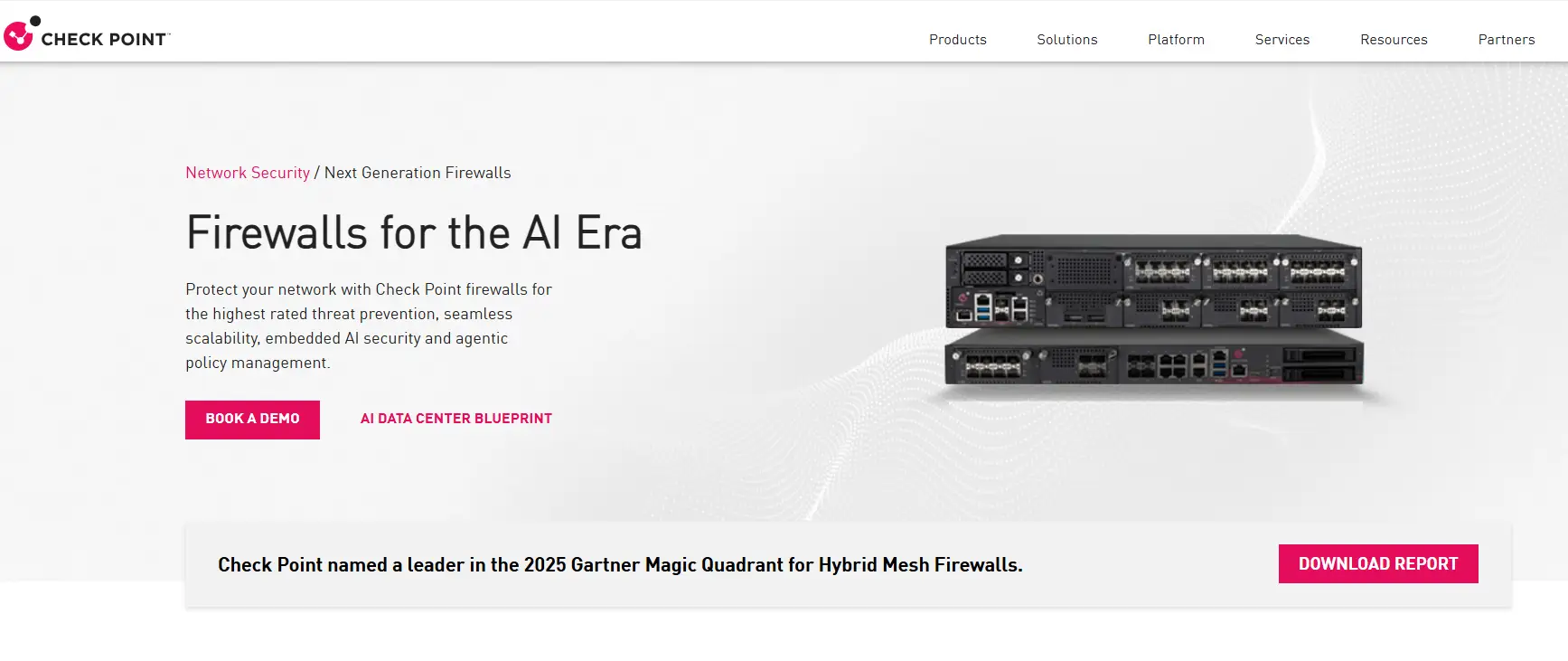
Check Point is a balanced fit for enterprises that need to address both sides of the category: governing employee access to public AI tools and defending AI applications the business deploys itself. Buyers should validate the exact coverage they require across prompt inspection, application discovery, model protection and agent security, then test how findings and policies flow into their broader security operations.
Key Capabilities
- Shadow AI and generative AI usage visibility
- Prompt- and data-aware policy controls
- Protection for enterprise AI applications and services
- Integration with broader network, cloud and data security
- Prevention-focused threat intelligence and centralized management
Microsoft
Microsoft occupies a distinctive position because it provides many of the AI services enterprises are adopting while also supplying the governance and security controls around them. Microsoft Purview can surface data exposure and oversharing risks that affect Copilot, while Defender products extend monitoring and threat protection across Microsoft 365 and Azure environments.
The Microsoft AI security solution is most compelling when the organization already depends on Microsoft 365 Copilot, Azure AI and the Microsoft data estate. Sensitivity labels, permissions, data-security posture and activity signals can be evaluated within the same ecosystem, reducing the need to reconstruct context in a separate platform.
Microsoft is a strong fit for organizations whose immediate AI risk is tied to Copilot adoption and Azure-based AI development. Its advantage is native context, but buyers should still assess how well the platform governs non-Microsoft AI services, personal accounts, and externally hosted models that sit outside the core Microsoft environment.
Key Capabilities
- Native controls for Microsoft 365 Copilot and Azure AI
- Data security posture management for AI
- Sensitivity-label and permission context
- Integration with Defender and Purview workflows
- Strong fit for Microsoft-centric compliance programs
Zscaler
Zscaler approaches AI security from the enterprise traffic path. Because the Zero Trust Exchange already brokers access to web and SaaS applications, it can identify AI tools in use, distinguish different risk levels, and enforce inline controls before prompts, files, or sensitive data leave the organization.
The Zscaler AI security solution is particularly relevant to distributed workforces that need to manage a fast-changing catalog of public AI applications without deploying new appliances at every location. Policies can allow approved services, restrict risky functions, control personal tenants, and apply data protection directly in the session.
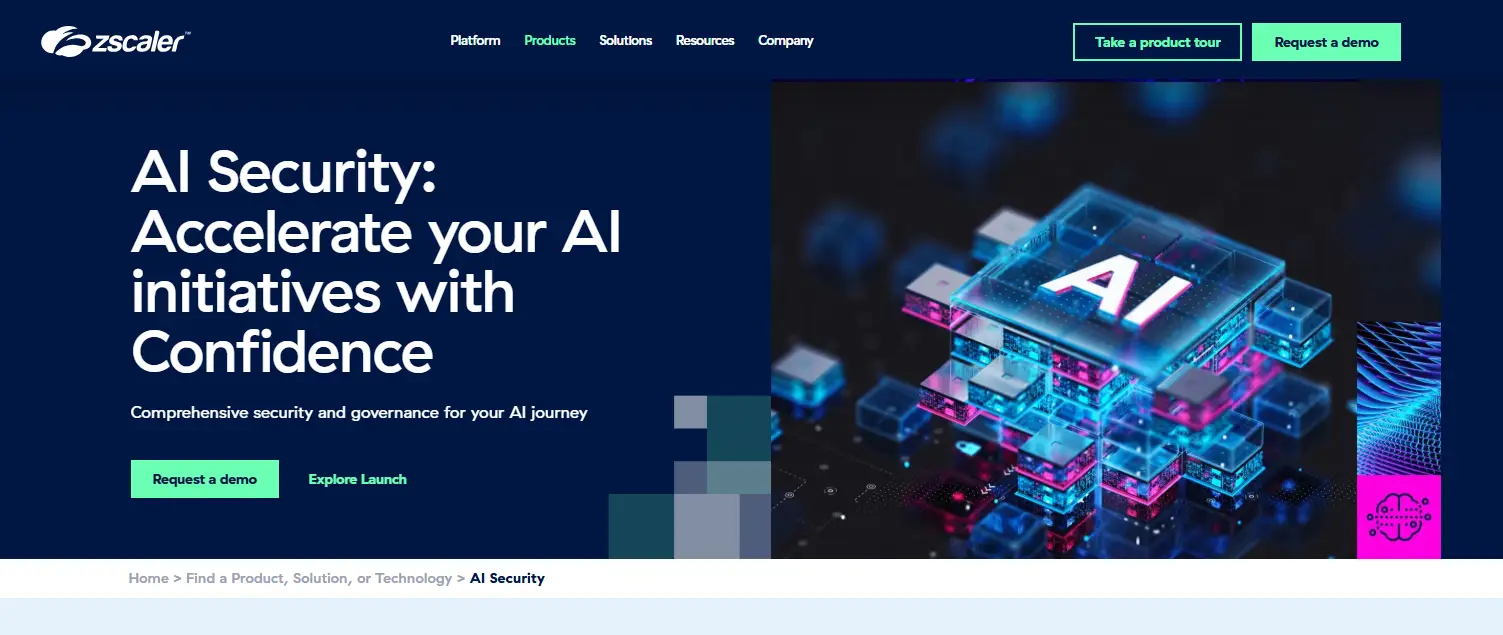
Zscaler is best suited to enterprises already operating an SSE or Zero Trust model through its platform. The key evaluation question is whether its workforce-focused controls cover the organization’s primary risk, or whether additional tooling is needed for red teaming, model posture, and runtime protection of internally developed AI applications.
Key Capabilities
- Discovery and categorization of generative AI applications
- Inline prompt and upload inspection
- Tenant and account restrictions
- Policy enforcement through existing SSE traffic paths
- Strong fit for distributed and remote workforces
Palo Alto Networks
Palo Alto Networks focuses heavily on the security of AI applications, models and agents through Prisma AIRS, while also drawing on its broader network and cloud-security portfolio. The platform is designed to discover AI assets, assess them before deployment and apply runtime controls against prompt injection, data leakage and other model-specific threats.
The Palo Alto Networks AI-powered firewalls is a strong option for enterprises building or operating a growing portfolio of AI services across cloud environments. Its breadth is especially relevant when security teams need model scanning, posture assessment, red-team-style testing and runtime protection rather than only governance of employee chatbot use.
Palo Alto Networks is best suited to organizations that want AI application security integrated into a larger Prisma and cloud-security strategy. Buyers should examine deployment complexity, coverage across third-party models and agents, and how effectively the platform also addresses everyday shadow-AI and workforce data-loss scenarios
Key Capabilities
- Discovery of AI applications, models and agents
- Pre-deployment assessment and AI red teaming
- Runtime prompt-injection and data-leakage protection
- Integration with Prisma cloud and network security
- Strong fit for complex enterprise AI development programs
Cloudflare
Cloudflare secures AI systems from the network edge. Its AI Gateway and Firewall for AI can sit in front of model APIs and enterprise AI applications to inspect requests, control traffic, reduce abuse, and identify threats such as prompt injection or sensitive information leaving through model responses.
The Cloudflare AI security solution is most relevant to engineering teams that want protection close to the application and API layer. Cloudflare’s global edge can also help with observability, rate limiting, and control of model traffic without requiring every development team to build those protections independently.
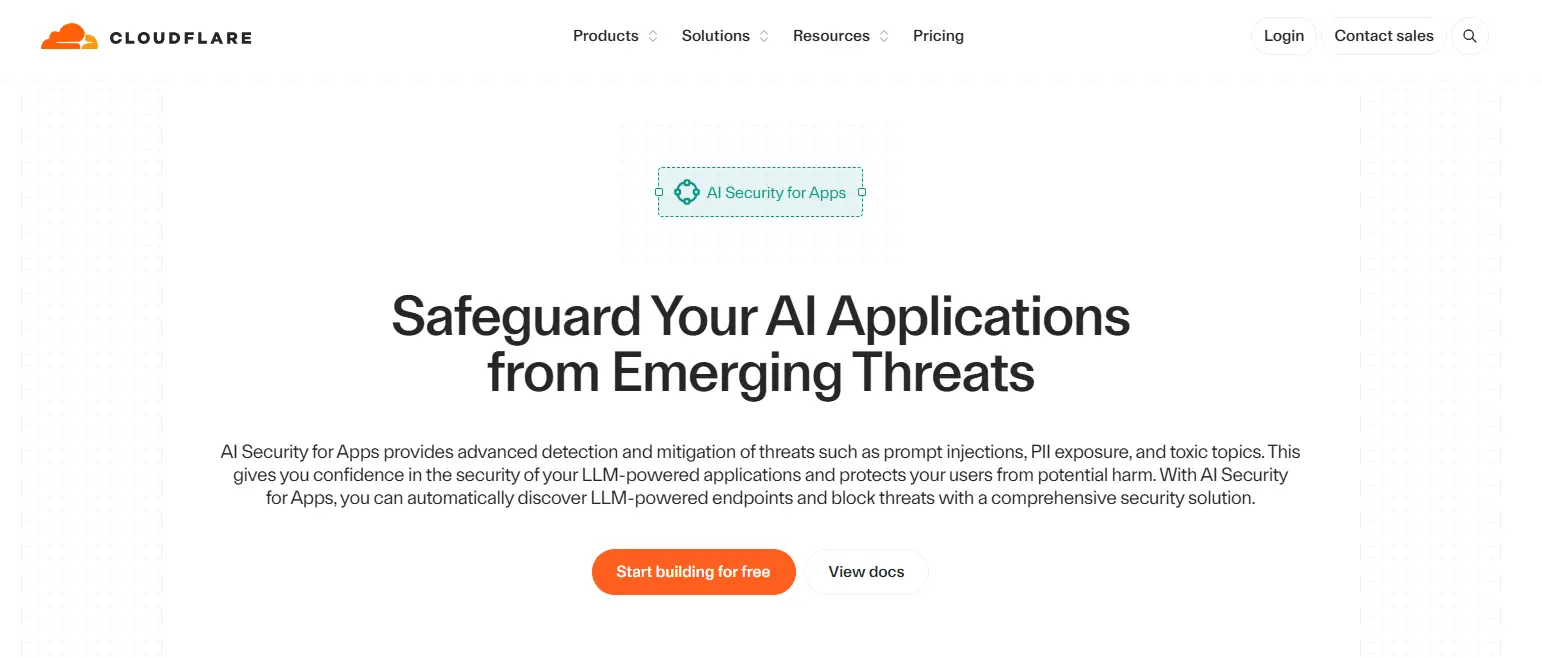
Cloudflare is a strong fit for organizations already using its application and developer platform to deliver AI services. Its strength is deployment-layer enforcement, while enterprises needing comprehensive employee AI governance, deep data posture management or broad model inventory may require additional controls alongside it.
Key Capabilities
- AI Gateway visibility and traffic management
- Firewall controls for model and prompt traffic
- Prompt-injection and sensitive-data protections
- Global edge enforcement and rate limiting
- Strong fit for developer-led AI applications and APIs
How to Choose an AI-Powered Firewall for IoT
Start by separating workforce AI governance from AI application security. An organization mainly concerned about employees pasting data into public chatbots needs strong discovery, tenant controls, and prompt-level DLP. A company building copilots, agents or model-powered APIs needs asset inventory, testing, posture management and runtime defense. Many enterprises need both, but few vendors are equally deep in every area.
Next, test data context. Ask the vendor to identify sensitive information in realistic prompts, uploaded files and retrieved documents, then explain why a transaction was allowed, warned or blocked. Effective controls should recognize business context and user intent without generating so much friction that employees move to personal devices or unmonitored accounts.
For internally developed AI systems, evaluate the complete lifecycle. The proof of concept should cover discovery, pre-deployment assessment, prompt-injection testing, model and agent behavior, runtime monitoring, response handling, and evidence for audits. Controls should also account for third-party models, plugins, tools and data sources rather than protecting only the model endpoint.
Finally, examine operational fit. AI security should share identity, data classification, cloud, network and incident context with the rest of the security program. The strongest platform is not necessarily the one with the longest AI feature list; it is the one that reduces blind spots and creates clear, manageable action for the teams responsible for data, applications and security operations.
Why Enterprise AI Security Matters Now
AI adoption changes the speed and scale of familiar security problems. A single prompt can expose information that previously required a file transfer, while a copilot can surface years of excessive permissions in seconds. AI agents raise the stakes further because they can retrieve data, call tools, and take actions across connected systems.
At the same time, AI applications introduce attack paths that traditional controls were not designed to understand. Prompt injection can manipulate system behavior, retrieved content can influence model output, and poorly governed tools can act with more privilege than intended. These risks do not eliminate the need for established data and application security; they make that foundation more important and add a new AI-aware control layer above it.
For enterprise buyers, the practical goal is not to purchase “AI security” as a label. It is to establish visibility over AI use, prevent sensitive-data exposure, secure the systems being built, and create governance that can keep pace as models, copilots, and agents evolve.
FAQ
What is shadow AI?
Shadow AI is the use of AI tools, models, or services that have not been reviewed or approved by the organization. It often includes employees using public chatbots or personal accounts for work-related tasks.
Is AI security just another form of data loss prevention?
No. DLP is an important component, but AI security also includes application discovery, model and agent inventory, posture assessment, red teaming, prompt-injection defense and runtime monitoring of AI-specific behavior.
Do companies need AI security if they do not build their own models?
Yes. Many organizations face immediate risk from employee use of third-party AI tools and from enterprise copilots that can retrieve broadly shared data. AI governance matters even without an in-house model-development program.
How is an AI application different from a traditional web application?
AI applications can be influenced through prompts, retrieved content, and model behavior. Threats such as prompt injection, jailbreaks, and unsafe agent actions require controls that understand the AI workflow in addition to standard web and API security.
What should an AI security proof of concept measure?
Measure AI application discovery, prompt and file inspection accuracy, policy explainability, false-positive rates, model and agent coverage, runtime protection, integration with existing data classifications, and the effort required to investigate and remediate findings.