

Most conversations about edge AI for real-time analytics focus on speed. And yes, the latency numbers are compelling.
But the deeper story isn’t about milliseconds; it’s about what becomes possible when the decision and the data source are the same device.
That shift changes not just how fast systems respond, but where they can operate, what data they expose, and how they fail when things go wrong. Speed is the outcome. Architecture is the reason.
This piece covers the structural logic behind edge AI, where the major platforms fit, how the cloud and edge layers divide responsibility, and where deployments quietly break down.
What Is Edge AI and Why Does Processing Location Matter?
Edge AI runs machine learning models directly on local devices like sensors, cameras, and gateways, so inference happens before data ever leaves the source. The model lives on the device. When data comes in, the decision happens right there.
It’s not that the distance shrinks. It’s that the network trip disappears entirely: no packet leaves, no response waits, and nothing travels.
That difference matters because latency has a floor. That floor is set by where inference runs, not how fast your hardware is.
A faster chip on a cloud-connected device still waits for the round-trip. A modest chip running inference locally doesn’t. The network path is the bottleneck, and edge AI removes it rather than optimizing it.
This is why edge AI can return a result in under 10 milliseconds. Not because edge hardware is faster than cloud servers. Because there’s no network leg to wait on.
Everything that follows, the speed advantages, the reliability, and the privacy, comes back to this one structural fact.
Why Real-Time Analytics Specifically Requires Edge Processing
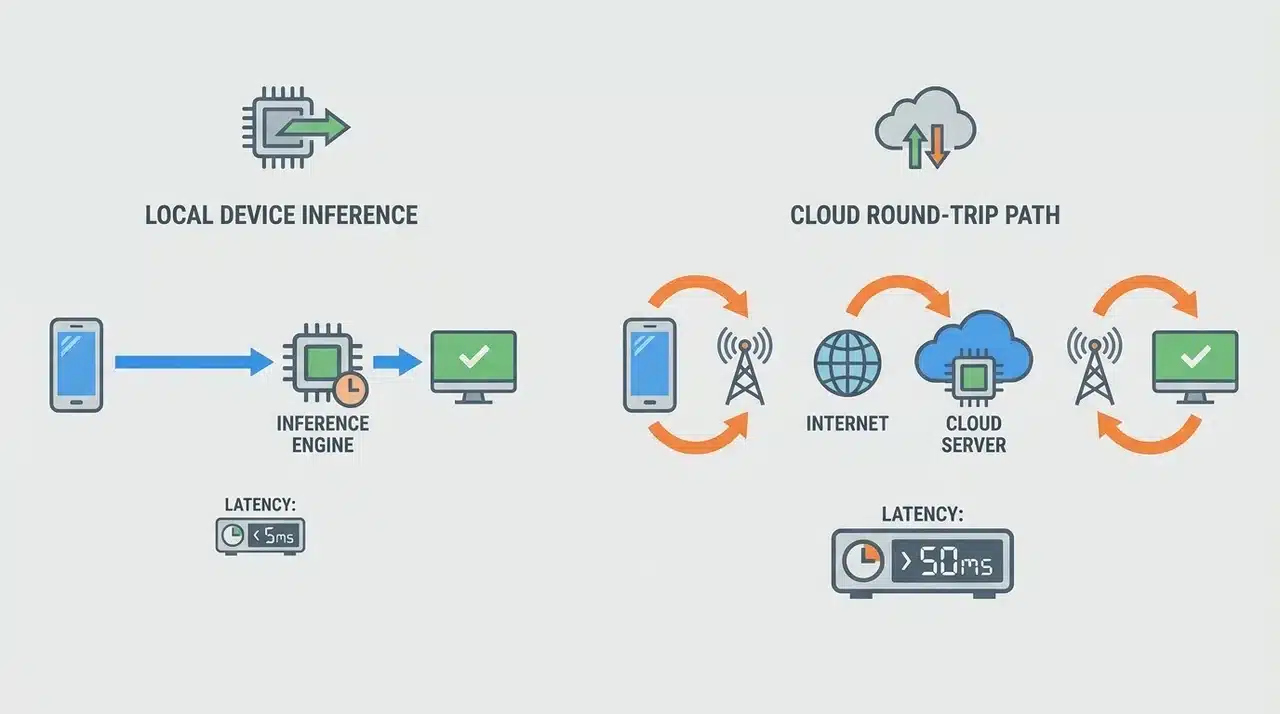
Real-time analytics sounds like a performance upgrade. It’s actually an architectural requirement for certain applications. The difference matters when you’re deciding whether edge AI solves your problem or just speeds it up a little.
Cloud analytics adds 50–200ms of round-trip latency. For most applications, that’s acceptable. For some, it’s disqualifying.
Latency Thresholds by Application Class
The latency gap becomes critical only when the decision window is shorter than the round-trip time.
A robotic arm on an assembly line needs to react in under 10ms to avoid a collision. A medical monitor detecting arrhythmia has a similar window. An autonomous vehicle processing a pedestrian stepping into the road can’t wait 100ms for a cloud response.
In each case, cloud latency doesn’t slow the system down; it makes the system structurally unable to function. The response arrives after the moment has passed.
For applications where decisions are made in seconds rather than milliseconds, the cloud works well. The threshold is the deciding factor, not a preference for speed.
Offline Operation and Infrastructure Reliability
Cloud dependency is a second axis entirely separate from latency.
Guaranteed Uptime
A factory floor running 24/7 can’t pause automated decisions when a network connection drops. Neither can a remote oil rig running anomaly detection, nor infrastructure in areas with intermittent connectivity.
Edge AI doesn’t just tolerate offline conditions; it’s often deployed specifically because they exist. The system keeps running because it never needed the connection in the first place.
Bandwidth and Cost Savings
When inference runs locally, only the result travels, not the raw data that produced it.
A factory camera running edge AI sends an alert flag, not a continuous video stream. A retail edge deployment sends aggregated counts, not raw footage.
Research published on ResearchGate measuring fog and edge computing deployments found that traffic between edge nodes and the cloud can be reduced by over 90%, because the data that used to travel now never leaves.
That reduction compounds. Lower bandwidth means lower transmission costs, which matters at scale across hundreds or thousands of devices. These savings don’t drive the architecture, but they’re a real outcome of the decision, not a footnote.
Where Edge AI for Real-Time Analytics Is Already Running
The latency and reliability arguments become concrete when you look at where edge AI is deployed today. Each of these verticals shares the same structural logic: the decision window is shorter than the round-trip, the data can’t leave the source, or both.
1. Manufacturing
Edge AI handles inline quality control and predictive maintenance on production lines. A vision system running at 100+ parts per minute can’t wait on a cloud round-trip. By the time the result returns, the defective part has already moved down the line. Edge inference catches it in under 10ms, at speed.
Predictive maintenance follows the same logic. Sensors on motors and conveyors run anomaly detection locally, flagging degradation patterns before failure. The cloud never sees the raw vibration data — only the structured alert.
2. Healthcare
Wearables and bedside devices running local inference can flag arrhythmias, oxygen drops, or sepsis indicators in real time, without sending raw patient data off-site. That matters both for response speed and for HIPAA compliance.
When a device never transmits protected health information, the compliance surface shrinks significantly. There’s no transmission to log, no cloud storage to audit, no third-party processor to certify.
3. Autonomous Vehicles
A pedestrian detection system that depends on a cloud response at highway speed isn’t a system, it’s a liability. All safety-critical inference runs on-board. The cloud handles map updates and model retraining, not real-time decisions.
The split is deliberate. Anything that requires a reaction in under 50ms stays on the vehicle. Everything that can wait, like telemetry, fleet analytics, and model updates, goes to the cloud on a schedule.
4. Retail
Computer vision at checkout, shelf analytics, and customer flow monitoring all run at the camera level.
Processing happens in the store, which means insights are immediate and no raw video stream leaves the premises.
Smart checkout systems can recognize products and process transactions without traditional scanning; all decided locally, in real time.
How Edge AI Handles Privacy and Security at the Source
Processing data locally changes more than where inference runs. It changes what’s exposed, and to whom.
Here’s what that shift means in practice:
Data that never travels can’t be intercepted.
When inference runs on-device, no packet leaves the source. There’s nothing to capture mid-route, log by an intermediary, or expose in a downstream breach.
The threat surface shrinks because the exposure window closes.
It’s not an encryption argument; it’s a surface area argument. Fewer transmission points mean fewer places an attacker can access the data.
Some industries have no choice.
Healthcare operates under HIPAA, which governs how protected health information is stored, transmitted, and accessed. Finance faces similar constraints under various data residency frameworks.
When raw patient data never leaves the device, the compliance surface shrinks significantly; there’s no transmission to log, no cloud storage to audit, no third-party data processor to certify.
Edge AI doesn’t eliminate compliance requirements, but it removes the transmission and storage steps that generate the most exposure.
Local processing shifts risk; it doesn’t eliminate it.
The device becomes the new target. Physical access, firmware vulnerabilities, and insecure local storage are real vectors. The threat moves from the network layer to the device layer.
A well-designed edge deployment accounts for both sides of that trade-off. Solving the transit problem while ignoring device-level security just shifts the exposure to a harder-to-monitor location.
Edge AI vs. Cloud AI: What Each Layer Should Handle
Edge AI planning is not a replacement for the cloud. Each layer has a job, and they’re different jobs.
| Edge AI | Cloud AI | |
|---|---|---|
| Where it runs | On the device, at the data source | Remote servers, centralized infrastructure |
| Best for | Time-sensitive inference and immediate action | Model training, fleet management, aggregated analytics |
| Latency | 1–10ms | 50–200ms |
| Offline capability | Yes, operates without connectivity | No, requires an active network connection |
| Data exposure | Raw data stays local | Raw data transits the network |
| Scale management | Limited by device compute | Scales with cloud infrastructure |
| Example platforms | NVIDIA Jetson, Intel Edge AI | Azure IoT Edge, AWS IoT Greengrass |
The deployments that work best use both layers deliberately: cloud for orchestration, edge for inference. Neither replaces the other.
In practice, the division works like this.
The edge device runs inference continuously and takes local action: stopping a motor, flagging a frame, issuing an alert. Simultaneously, inference results and metadata are batched and sent to the cloud on a schedule, not in real time.
The cloud aggregates that data across the fleet, tracks performance drift, and pushes updated model versions back to the devices when retraining is complete. Those aggregated results can also be surfaced through embedded analytics dashboard giving users access to actionable insights directly within the applications they already use.
Neither layer touches the other’s primary job.
The edge never waits for the cloud to make a decision. The cloud never tries to manage real-time inference. The seam between them is the model update cycle, which typically takes hours or days, not milliseconds.
Getting that seam wrong is one of the most common failure modes in production edge AI. If the cloud retraining loop isn’t built into the architecture from the start, models drift quietly until the decisions have gotten noticeably worse.
Edge AI Platforms and Hardware: What the Major Options Actually Do
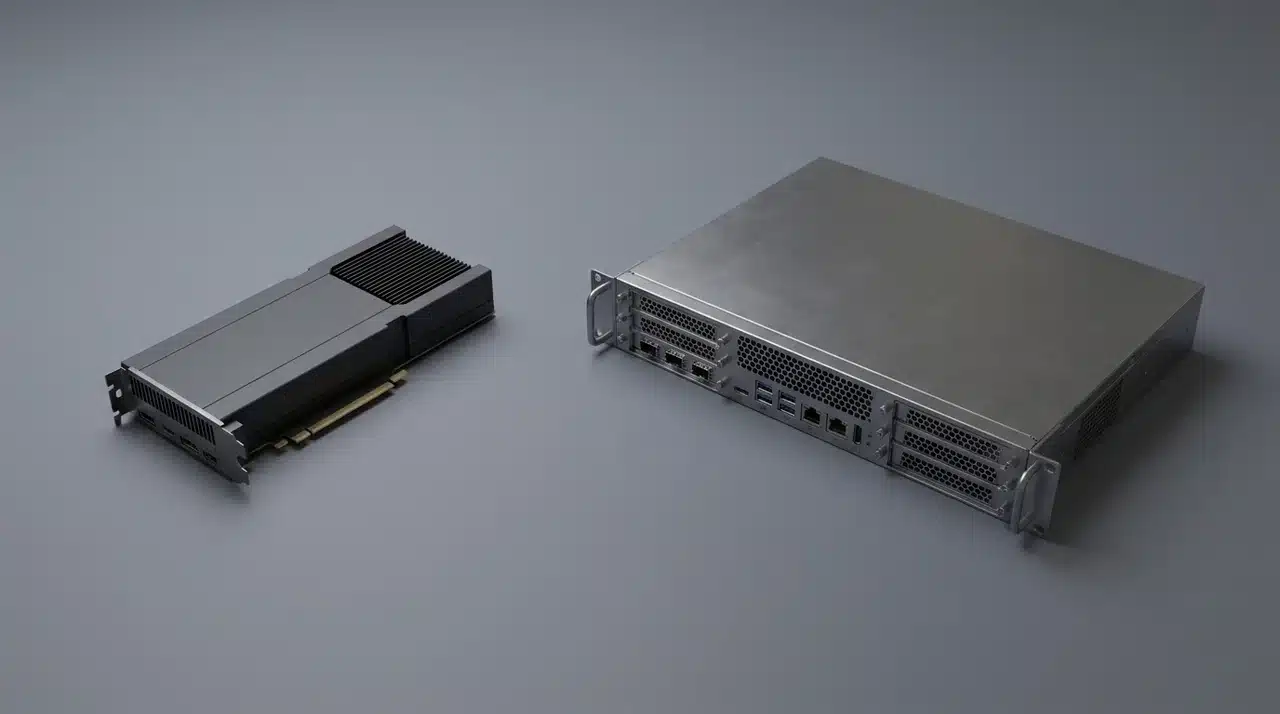
The platform landscape splits into two categories, and confusing them is where most selection mistakes happen.
Some platforms are built for raw inference performance on the device. The question they answer is: how fast can this device process a frame?
Others are built to manage AI deployment across large, distributed fleets. The question they answer is: how do I keep 10,000 devices running the same model version reliably?
These are different problems. A team that buys an orchestration platform when they need compute throughput or vice versa ends up solving the wrong constraint.
High-Performance Inference Hardware (NVIDIA Jetson, Intel Edge AI)
These platforms are built for workloads where on-device compute is the constraint.
NVIDIA Jetson is the most widely deployed option for physical AI, robotics, multi-camera vision, and industrial inspection.
The Jetson Orin line handles up to 275 TOPS (tera-operations per second) at the high end; enough to run multiple concurrent vision models on a single device. Lower-end Nano and NX modules bring that capability to cost-constrained deployments where full Orin performance isn’t needed.
The consistent thread across the lineup is GPU-accelerated inference, which is why it’s the default choice for any workload where a camera feed has to be analyzed in real time.
Intel Edge AI takes an open-architecture approach. Built around Core Ultra processors and dedicated VPUs, it’s positioned for computer vision, retail analytics, and factory automation, particularly where avoiding vendor lock-in matters.
Orchestration and Fleet Management Platforms (Wind River, Azure IoT Edge, AWS IoT Greengrass)
These platforms solve a different problem, not how fast a single device can infer, but how you deploy and manage models across thousands of devices reliably.
Wind River is built for enterprise and telecom environments. It handles automated deployment, orchestration, and real-time GPU metrics across distributed edge nodes at scale.
Azure IoT Edge lets you deploy AI modules, custom models, or pre-built cognitive services directly to edge devices from the Microsoft cloud. Training and management stay in Azure. Inference runs locally.
AWS IoT Greengrass follows the same model. Local compute and ML inference run on the device. AWS handles fleet management, updates, and connectivity from the cloud side.
The hardware platforms and the orchestration platforms aren’t competing options. Most production deployments use one from each category.
Where Edge AI Breaks Down
The deployments that fail aren’t usually the ones that chose the wrong platform. They’re the ones that hit a constraint they didn’t plan for. Three of them show up consistently — and all three are invisible at small scale.
1. Device compute has a ceiling.
Large models don’t run on edge hardware as trained; they have to be compressed or quantized first.
Quantization reduces the numerical precision of model weights, typically from 32-bit floating point down to 8-bit integers. That shrinks memory footprint and speeds up inference, at the cost of some predictive accuracy.
For simple classification tasks, the accuracy loss is often negligible, but for complex detection workloads, it can matter.
The point is that the model you deploy at the edge is not the model you trained, and planning for that is part of the architecture work, not an afterthought.
2. Fleet heterogeneity adds complexity.
Devices run different firmware, specs, and OS versions. Keeping inference consistent across thousands of nodes is harder than it looks.
3. Models drift without a retraining loop.
Stale models on shifting data degrade quietly, with no obvious error, just gradually worse decisions. If the cloud feedback loop isn’t built in early, you won’t catch it until the damage shows.
Each is solvable, but only if you plan for it. None of these surface during small-scale testing. They show up when you scale.
Wrapping Up
Using edge AI for real-time analytics isn’t a single technology decision; it’s an architectural one. The speed gains are real, but they follow from a structural choice: keeping inference at the source.
That choice also determines your privacy exposure, your offline reliability, and how gracefully your system degrades when models age on shifting data.
The platforms covered here, from NVIDIA Jetson to AWS IoT Greengrass, solve different parts of that problem. None of them work well without a clear picture of what stays on the device and what travels to the cloud.
If you’re evaluating edge AI for your environment, start with that division.
Get the architecture right first, and the platform selection becomes straightforward. Everything else follows from where the decision lives.
Frequently Asked Questions
What is the difference between edge AI and edge computing?
Edge computing moves processing to local devices. Edge AI specifically runs machine learning inference on those devices. All edge AI involves edge computing, but not all edge computing involves AI.
How fast is edge AI compared to cloud-based analytics?
Edge AI processes data in 1–10 milliseconds. Cloud analytics adds a network round-trip of 50–200ms. For decisions that must fire in single-digit milliseconds, that gap is a structural barrier, not a performance trade-off.
Can edge AI work without an internet connection?
Yes. Inference runs locally, so the system operates without network connectivity. This is why edge AI is common in factories, remote infrastructure, and environments where consistent connectivity can’t be guaranteed.
What industries use edge AI for real-time analytics?
Manufacturing, healthcare, retail, autonomous vehicles, and smart city infrastructure are the primary verticals. Manufacturing uses it for inline quality control and predictive maintenance. Healthcare uses it for continuous patient monitoring and on-device diagnostic support. Retail uses it for computer vision at checkout and in-store flow analytics. Autonomous vehicles run all safety-critical inference on-board. Smart city infrastructure – traffic management, utility monitoring, public safety systems uses edge AI where consistent connectivity can’t be guaranteed, and response speed matters more than centralized aggregation.