


The last time you visited a bank branch, how long ago was it? For millions of Americans, the answer is “I honestly can’t remember.”
The reason is simple. Banking has moved into your pocket, and it happened faster than almost anyone expected.
Behind that shift is a full reinvention of how banks work, run on AI, cloud computing, and mobile apps instead of paperwork and waiting rooms.
Below, I’ll break down what’s driving the change, the technology making it happen, real examples from major banks, what it means for you, and where it all heads next.
What is Digital Transformation in Banking?
Digital transformation in banking means rebuilding how a bank operates from the inside out, using technology as the foundation instead of an add-on layer.
The key word is transformation, not addition. Most people think of a better banking app, but that is digitization. Digitization changes format, like paper statements becoming PDFs, while the underlying process stays the same.
The difference matters because many large banks still rely on core systems built in the 1970s and 1980s. Those systems still control loan approvals, fraud detection, and service speed, even when the front-end experience looks modern.
Real transformation replaces or rebuilds those back-end processes, not just the customer-facing layer. That is what turns a multi-day loan approval into a three-minute decision, and a next-day fraud alert into a real-time one.
That gap between surface and engine is what the shift is actually trying to close.
Why Banks Are Going Digital Right Now
Banks aren’t changing simply because digitalization is a trend. Three pressures are pushing them, and all three trace back to you, the customer.
Customers Expect Amazon-Level Speed
- People bank the way they shop and stream. If Amazon delivers overnight and Netflix loads instantly, a three-day transfer feels broken.
- Customers now expect 24/7 mobile banking, instant transfers, and quick answers. More than 2 billion people use online banking, and they reward whoever moves fastest.
Fintechs and Neobanks Are Winning Customers
- Traditional banks no longer compete only with each other. App-only players like Chime and Cash App built clean, fast tools and pulled in millions of users.
- Those startups carry no costly branches or old systems, so they ship new features in weeks. Older banks either match that pace or watch younger customers walk.
Going Digital Saves Banks Money
Automation handles routine tasks like data entry and basic support, which trims costs for banks.
That frees staff to focus on complex work a chatbot can’t touch. Lower overhead and faster service is a rare win for both sides.
All three forces point one direction: forward. Now, let’s look at the technology making the shift possible.
The Technology Powering Modern Banking
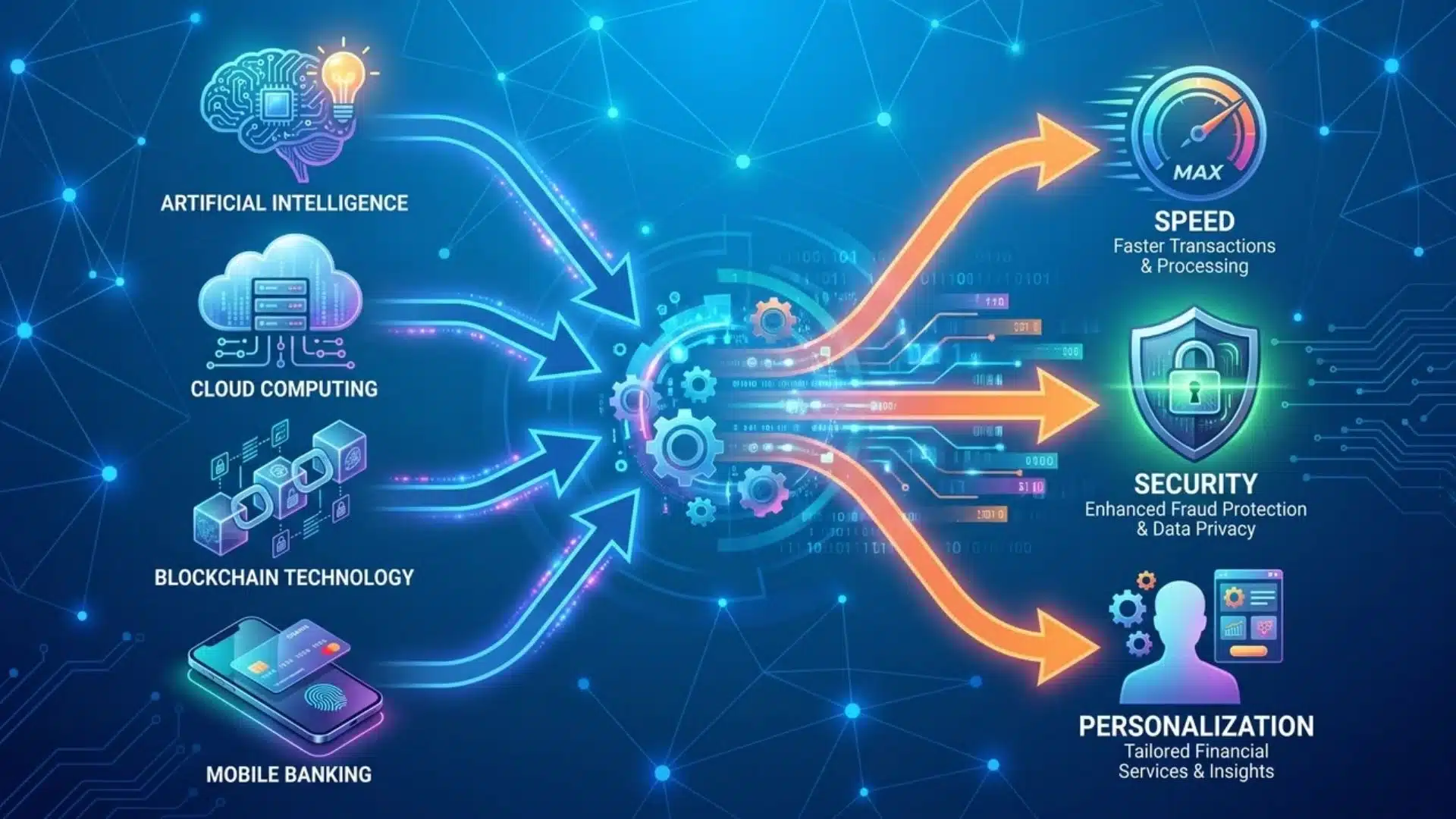
Behind every quick transfer and fraud alert sits a stack of tech doing the heavy lifting. Four tools drive most of the change.
AI in Banking
Artificial intelligence is the workhorse of modern banking. It shows up in three main places:
- Customer service: Chatbots and virtual assistants answer questions at any hour.
- Fraud detection: Systems flag a suspicious charge in seconds, not days.
- Personalization: Your spending patterns shape the products a bank suggests.
Banks are betting big here. The World Economic Forum projects global financial AI spending to reach $97 billion by 2027, up from around $35 billion in 2023.
Cloud Computing
The cloud is where banks now store data and run software, instead of on in-house servers. The payoff comes down to two things:
- Speed: New features roll out in weeks rather than months.
- Scale: Banks handle demand spikes without buying costly hardware.
A bank on the cloud simply moves faster than one stuck on old equipment.
Blockchain
Blockchain is a secure, tamper-resistant way to record transactions. Banks lean on it mostly for payments:
- Cross-border transfers: Money moves in minutes instead of days.
- Lower fees: Cutting out middlemen trims the cost of each transaction.
The result is cheaper, faster transfers that used to crawl.
Biometrics and Mobile Banking
Your face or fingerprint is now a password. Paired with full-featured apps, the benefits are clear:
- Stronger security: Biometric login makes accounts harder to break into.
- Easy access: The whole bank fits in your pocket, available 24/7.
Tech alone is just potential, though. Next, let’s see how real banks put it to work.
Real Examples of Digital Banking in Action
Theory is fine, but the proof is in what big banks already do every day. A few real cases show how far the shift has come.
JPMorgan Chase Runs AI at Scale
The largest U.S. bank has gone all in. JPMorgan invests about $2 billion a year in AI and, according to CEO Jamie Dimon, has seen roughly $2 billion in benefits in return.
The reach is wide. Around 150,000 employees use the bank’s in-house AI model every week to summarize reports, run research, and scan contracts, and Dimon has called the savings only “the tip of the iceberg.”
Fraud Detection That Works in Real Time
Catching fraud is where AI helps everyday customers most. Banks now scan transactions as they happen and flag odd activity before a charge clears.
The adoption is nearly universal. Feedzai’s 2025 report, based on a survey of 562 fraud professionals, found that about 9 in 10 financial institutions already use AI to fight fraud.
Everyday Tools You Already Use
The change shows up in small ways too. Robo-advisors build investment portfolios, AI-driven onboarding lets you open an account in minutes, and a tap of your smartwatch pays for coffee.
Most of that arrived only in the last decade for regular customers. So what does all of it actually change for you?
How Digital Banking Affects Your Money and Privacy
All the bank-side tech eventually lands in one place: your phone, your account, your money. Here’s the real tradeoff, good and bad.
The wins are easy to feel. You get faster service, sharper fraud alerts, and offers shaped around how you actually spend.
- Speed: Deposit a check, move money, or open an account in minutes, any hour.
- Protection: AI flags a sketchy charge and texts you before it clears.
- Personalization: Your bank suggests products that fit your habits, not random ones.
The flip side deserves honesty too. Fewer branches mean less face-to-face help, more support happens through chatbots, and your spending data is studied around the clock.
- Fewer branches: Some banks close local spots as customers go mobile.
- Less human contact: A bot handles the first response, not a person.
- Constant data use: Personalization runs on tracking your every transaction.
The takeaway is balance. You gain speed and security, and you trade a bit of privacy and in-person service to get there.
The Future of Digital Transformation in Banking
The shift is far from finished. The next wave centers on AI that does more than answer questions, it takes action on your behalf.
Smarter AI Assistants
Tomorrow’s banking assistant goes beyond a chatbot. Picture an AI that plans your savings, walks you through a mortgage, and flags a bill before it’s due.
So-called agentic AI can handle full tasks start to finish, like reviewing a loan application without a human touching it.
Fairer, More Transparent AI
As banks lean harder on AI, regulators want it fair and explainable. Expect more rules around ethical AI, so a denied loan comes with a clear reason, not a black-box “no.”
Tokenized Money and Faster Payments
Big banks are testing blockchain-based assets and digital tokens. JPMorgan already runs a deposit token on a public blockchain to move money faster between clients.
The throughline is clear. The future of digital transformation in banking points toward service that’s quicker, smarter, and more automated than ever.
Let’s pull the big picture into a few takeaways worth remembering.
Conclusion
Banking has quietly changed more in the last decade than in the fifty years before it. The branch visit gave way to the app, and the teller now shares the desk with AI.
For you, the payoff is real: faster service, smarter fraud protection, and an experience built around how you actually bank. The tradeoffs, fewer branches and constant data use, are worth knowing too.
The smartest move is to lean in with eyes open. Use the digital tools your bank offers, turn on fraud alerts, and keep your logins strong.
Digital transformation in banking will only pick up speed from here. Banks that get it right will earn your trust, and the ones that don’t will lose you to those that do.
Frequently Asked Questions
What are the four pillars of digital transformation in banking?
The four pillars are customer experience, modernized infrastructure, data analytics, and security. Together they cover better apps, updated systems, smarter use of data, and stronger fraud defense.
Which was the first fully digital bank?
Security First Network Bank, launched in the United States in 1995, is widely cited as the first internet-only bank, paving the way for today’s neobanks like Chime.
How does digital banking affect bank employees?
It shifts roles rather than erasing them. Routine tasks get automated, so staff move toward advisory and complex work, though some specific functions do see fewer jobs.
What is the difference between digitization and digital transformation in banking?
Digitization means converting paper processes into digital ones, like online statements. Digital transformation goes deeper, rebuilding how a bank operates, serves customers, and makes decisions around technology.