
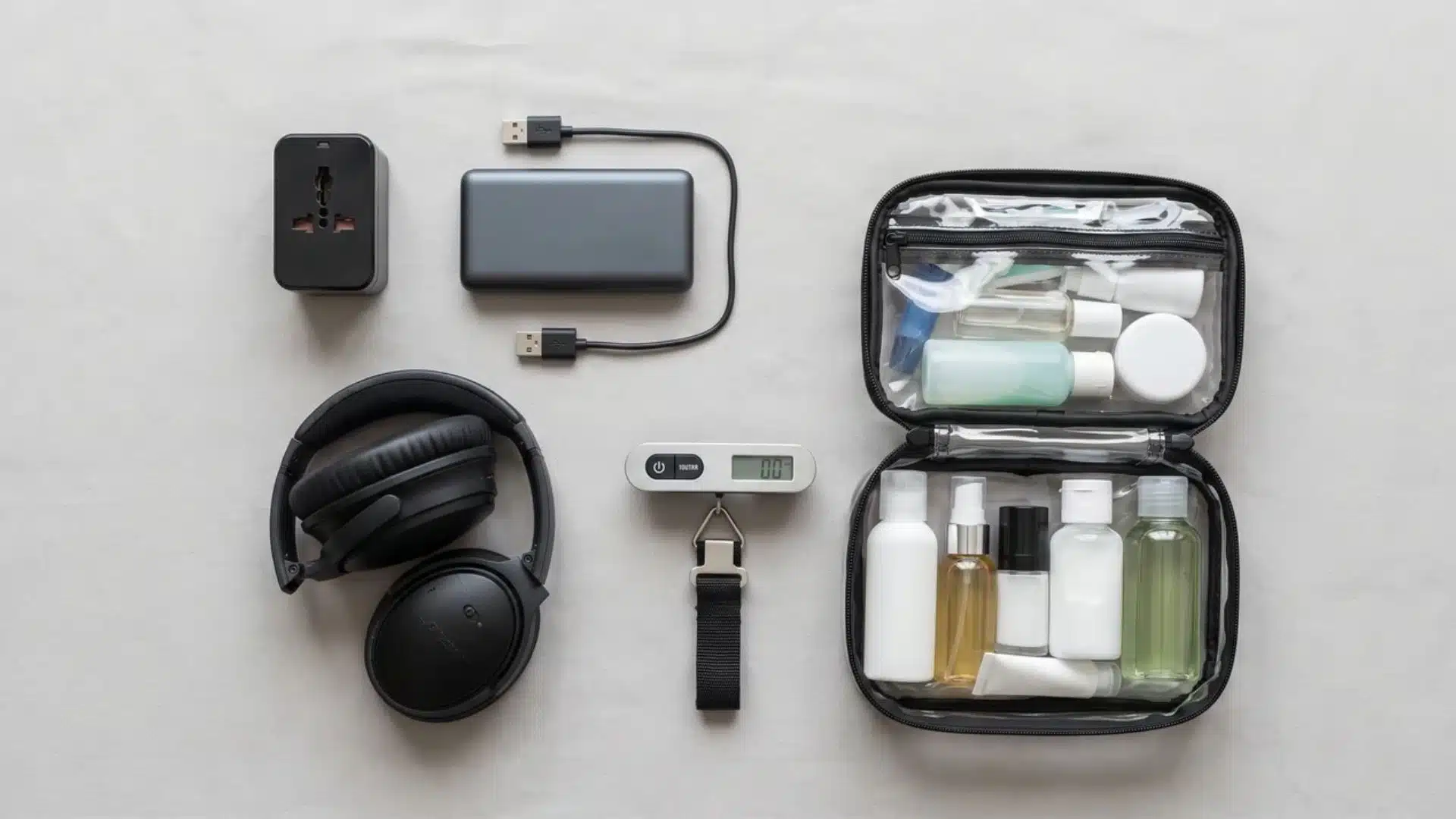
What Makes a Travel Gadget Worth Carrying?
There’s only one real test for a travel gadget: does the problem it solves cost more than the space it takes up?
An 80-gram scale that saves you a $75 overweight fee? It passes. A 400-gram device that does something your phone already does? It doesn’t.
Travel creates the same problems on almost every trip. Dead battery at hour nine. An outlet that won’t accept any of your plugs. A toiletry bag that exploded inside your carry-on. These aren’t surprises — they’re predictable. That means you can prepare for them.
What changes is which problems apply to your trip.
A Bluetooth speaker is essential for a two-week beach trip. It’s dead weight on a one-day work trip where you never leave the conference room.
The most common mistake I see? People pack five charging solutions for a problem one good product would fix. Everything here gets judged the same way: real problem, right trip type, weight that makes sense.
Power and Charging: The Non-Negotiables
One good universal adapter with USB-C output replaces every country plug and charging brick you’d otherwise carry. That’s the headline. But power is worth understanding at a deeper level, because getting it wrong doesn’t just inconvenience you. It stops your trip.
No phone charge means no maps, no boarding pass, no way to call anyone. No laptop charge means no work. I’d argue this is the one category where buying cheap or buying wrong costs you the most.
Here’s what you actually need to know.
Universal Travel Adapter: What the Ports Actually Do
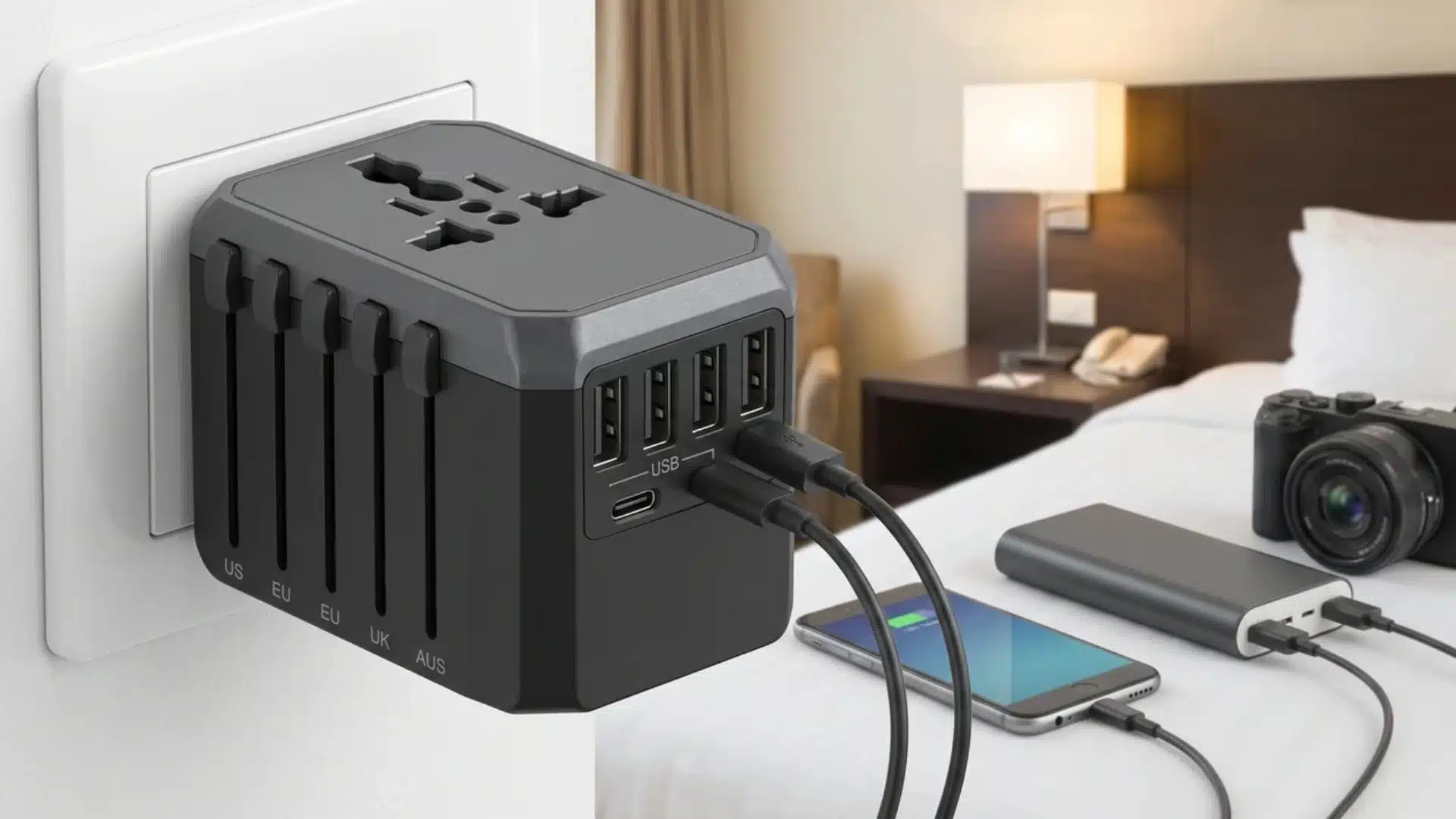
A universal adapter does two separate jobs, and most people only think about one of them.
The first is plug conversion, it carries the prong shapes for over 150 countries. Type A, B, C, G, I, and more. One unit, everywhere.
The second is port consolidation. A 5-in-1 model gives you multiple outputs from one wall socket, usually two USB-A ports plus one or two USB-C ports. That means your phone, earbuds, and laptop all charge at once.
Without USB-C, you still need a separate laptop brick. That’s the detail most product descriptions skip.
Magnetic vs. Wired Power Banks: Which Setup Fits Your Phone
This is where I see people waste money more than anywhere else in the gadgets category.
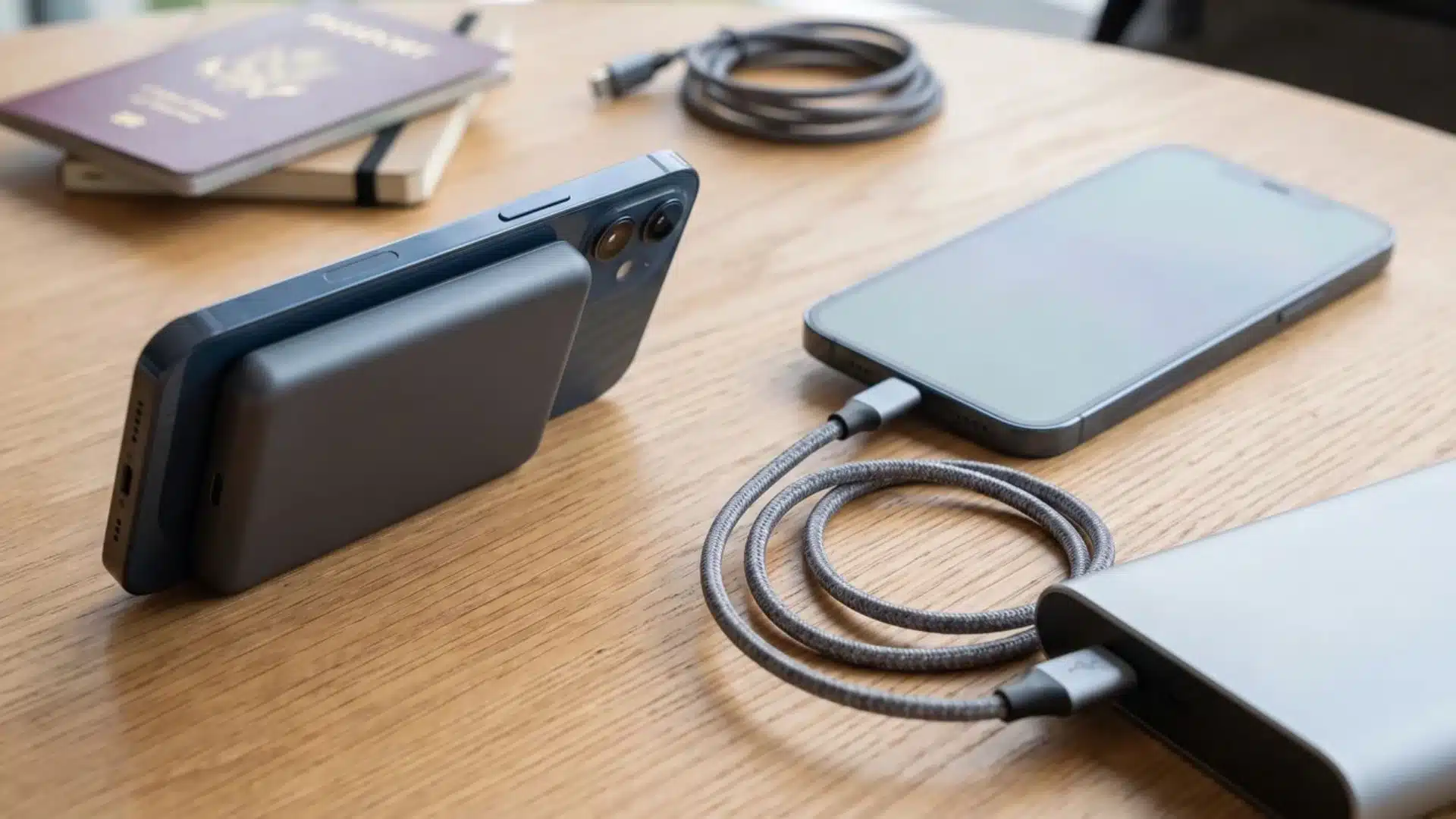
Magnetic wireless power banks are everywhere right now. Every travel list recommends them. Almost none of those lists mention the thing that actually matters: they’re built for iPhones.
Specifically, iPhones from the 12 onward have Apple‘s MagSafe magnet ring built in. That ring lets a magnetic power bank snap onto the back of your phone and charge it with no cable.
Android phones don’t have that ring.
Put a magnetic bank against an Android, and you get standard Qi wireless charging. That means slower speeds and your phone has to lay flat on the bank instead of clicking onto it. The whole “no cables” benefit disappears.
If you’re an Android user, a slim wired bank and a short braided USB-C cable is faster, more reliable, and cheaper. Don’t let the marketing steer you wrong here.
One more item worth mentioning: a digital luggage scale. It’s a conditional essential. If you’re pushing a budget carrier’s 7kg carry-on limit, it earns its place instantly. If you’re checking a 20kg bag and packing light, it probably doesn’t.
In-Transit Comfort: Headphones and Audio
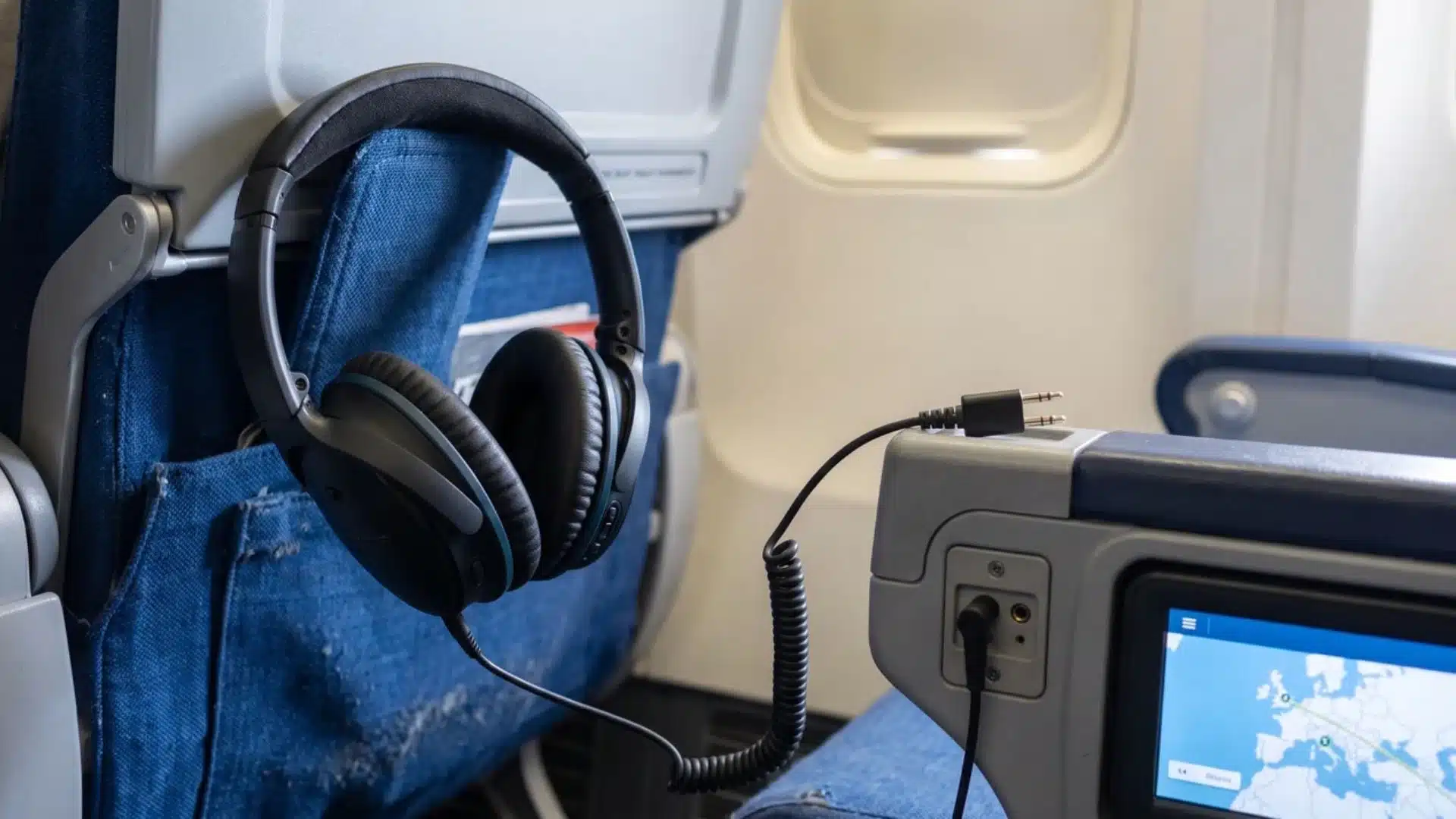
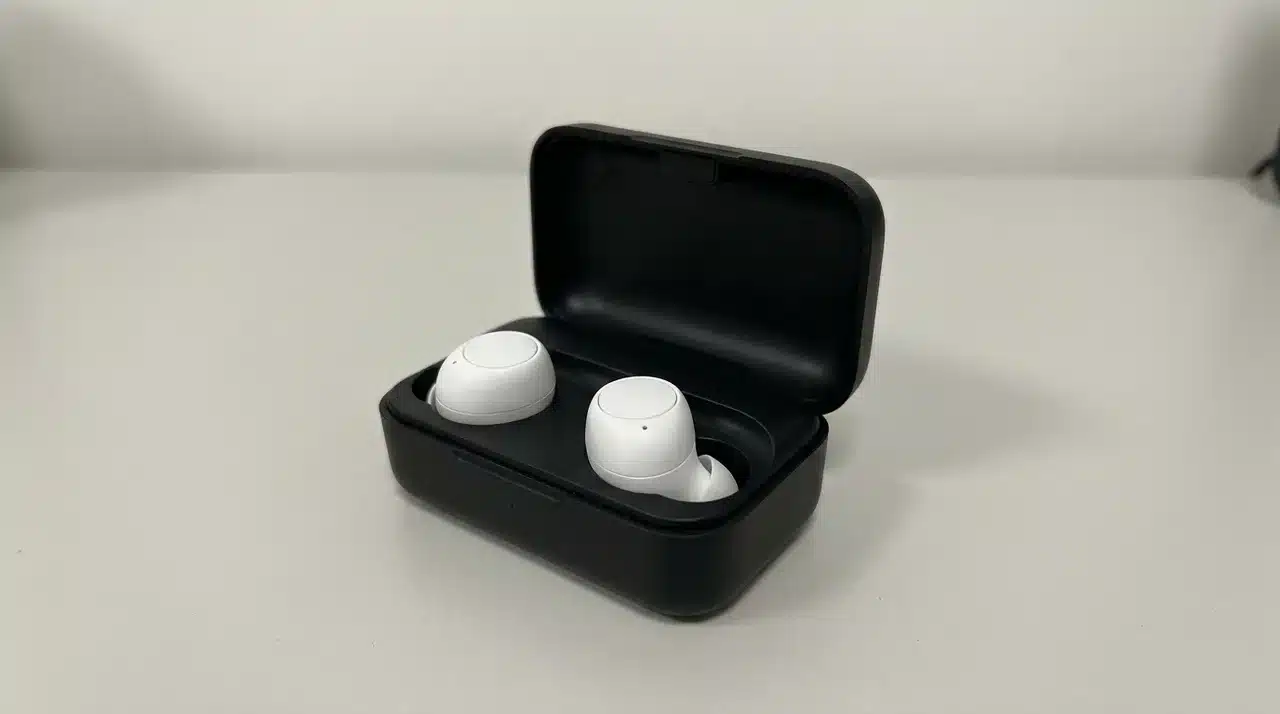
Active noise cancellation works by generating an opposing sound wave to cancel out engine hum. That’s what makes long flights and train rides far less tiring. But understanding how it works also shows you exactly where it lets you down.
Most travel lists just say: get noise-canceling headphones. That’s not wrong, it’s just incomplete.
ANC targets constant, low-frequency sound. Jet engine rumble, train wheel noise, highway drone. It’s genuinely excellent at those.
It is not excellent at irregular or high-pitched sound. A child crying two rows back. A flight attendant making an announcement. Someone having a loud conversation at normal speaking volume. Those get through.
If you’re expecting near-silence on a full flight, you’ll be disappointed. If you’re expecting to knock the edge off a six-hour red-eye so you can sleep, you’ll find them genuinely life-changing. I’ve never regretted packing mine. I’ve heard plenty of people say they expected more.
Here’s something most ANC headphone recommendations miss entirely: the wired headphone jack in your armrest.
Most long-haul economy seats have one. It’s wired only. Your wireless ANC headphones won’t connect to it. If you want to use the in-flight entertainment, you either use the airline’s plastic earbuds, or you pack an AirFly Pro.
The AirFly Pro plugs into the 3.5mm seat jack and transmits audio to your Bluetooth headphones wirelessly. It’s a small thing that solves an otherwise unavoidable problem. If you never use seat-back screens, skip it. If you do, it’s essential.
For outdoor audio, the JBL Clip 5 earns its spot for two reasons: it clips onto almost anything with its built-in carabiner, and it’s genuinely waterproof at IP67. The audio quality is fine. The portability is the point.
Organization and Toiletries: The Space-Saving Layer
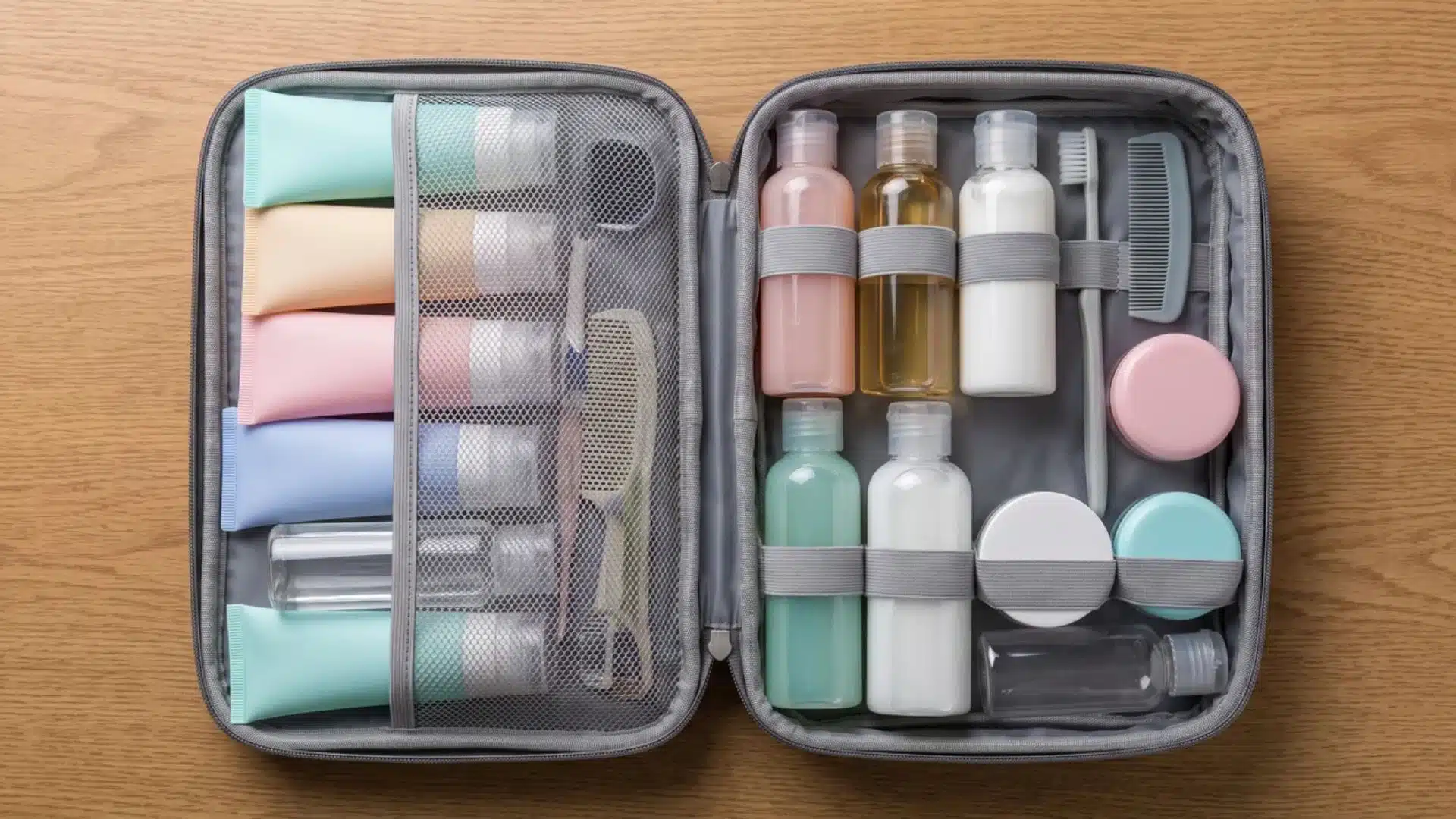
A Refillable Silicone Bottle
Silicone refillable travel bottles don’t leak in carry-on bags because their flexible walls absorb pressure changes instead of fighting them. And it explains something I’ve had to point out to a lot of people: rigid plastic travel bottles from the pharmacy still leak mid-flight, even when they’re not full.
Here’s why.
As the plane climbs, cabin pressure drops. The air inside any sealed bottle expands. In a rigid bottle, that expanding air has nowhere to go, so it pushes against the cap seal until something gives. Usually the cap gives.
In a silicone bottle, the walls flex outward slightly and absorb the pressure difference. Nothing forces liquid out. Add a locking flip-cap or a screw-top with a silicone gasket, and you’ve closed the last gap.
The result: your shampoo arrives in the same volume it left. That doesn’t happen with a rigid bottle as reliably.
Packing Cubes
Packing cubes are frequently oversold, and I want to be straight with you about what they actually do.
They don’t compress your clothes. There’s no mechanism that reduces the volume of a folded shirt. If you’re buying them to squeeze more into a bag, they won’t do that.
What they do is keep your bag organized across a multi-day trip.
Without cubes, a bag that gets opened and repacked five times becomes a loose mess by day three. With cubes, the same items go back to the same zones every time. The bag stays readable. You stop digging.
For a single-destination trip where you unpack into a hotel wardrobe on arrival, cubes don’t add much to be honest, but for a two-week trip with four stops, they’re worth every gram.
One more option worth knowing: if you pack only dry toiletries, you can skip this entire category.
Solid shampoo bars, conditioner bars, solid sunscreen, and powdered toothpaste are all easy to find now. No 100ml rule, no zip-lock bag, no pressure-related leaks. Minimalist packers who go this route cut their toiletries footprint nearly to zero.
Safety and Tracking: Low-Weight, High-Value Additions

Luggage Tracker
A Bluetooth luggage tracker earns its place in checked bags on multi-leg trips where the airline handles connections on your behalf.
The value isn’t theft prevention. A tracker doesn’t lock a bag or stop anyone from taking it. What it does is give you a specific data point during a lost-bag dispute.
When a bag doesn’t show up and the airline’s system says it was delivered, “it was last seen at the connecting hub in Frankfurt, not at this airport” is a very different conversation than “I don’t know where it went.”
That specificity changes the speed and outcome of the claim. I’ve heard from enough frequent travelers to know it makes a real difference.
AirTag integrates natively with Apple’s Find My network. Chipolo works across both Apple and Android and uses a replaceable battery. For most people, the choice comes down to which phone you carry, not which tracker performs better.
Personal Safety Alarm
A personal safety alarm is a different tool entirely. It doesn’t contact emergency services. It doesn’t transmit your location.
What it does is make a lot of noise, typically 120 to 130 decibels to draw attention to a situation.
That’s useful in a narrow set of circumstances: solo travel in unfamiliar urban environments where attracting attention is the point. It’s not worth packing for a group trip or a destination you know well. It’s worth considering if you’re traveling alone somewhere new.
Neither of these items needs to be in your bag for a 48-hour domestic work trip with a carry-on on a single direct flight. Trip length, number of connections, and whether you’re on your own; those are the three things that tell you whether either item earns its place.
Which Gadgets Do You Actually Need? A Trip-Type Audit
Most travelers only need two to four items from this entire list. The problem is that most gadget guides make you feel like you need all of them.
Before you pack anything, answer three questions.
How long is the trip? Am I checking a bag or going carry-on only? Am I traveling solo or with someone else?
Those three answers cut the list down fast.
One-week international trip, checked bag:
Your essentials are a universal adapter, a power bank for long travel days, noise-canceling headphones for any flight over three hours, and a Bluetooth tracker in your checked bag. Toiletry organization matters here because the bag will be opened repeatedly.
Pack a luggage scale too, not for departure, but for the return leg, when purchases and souvenirs have added weight you haven’t accounted for.
Three-day carry-on-only domestic trip:
Your list is shorter: a power bank for airports and transit, and possibly noise-canceling headphones if the flight runs past 90 minutes. You don’t need a universal adapter on a domestic trip. You don’t need a tracker because the bag never leaves you. Everything else is conditional on your plans.
Here’s what the two lists have in common: a universal adapter (for international travel) and a power bank (for any trip with airports or trains).
Those are the only two items that apply to nearly every trip. Everything else is situational. Buying the full kit every time is how you end up carrying 200 grams of gear you never touch.
Wrapping Up
Every good travel gadget solves one specific problem better than the alternative, at a weight you can justify.
The universal adapter and the power bank are the only items on this list that belong in almost every bag. Everything else, the ANC headphones, the tracker, the luggage scale, the silicone bottles, earns its place based on how you travel.
Check the bag type. Check the trip length. Check whether you’re going solo. The list writes itself from there.
The goal was never to carry more. It was to travel with exactly what you need and nothing you don’t.
Frequently Asked Questions
What is the single most useful travel gadget for international trips?
A universal travel adapter with USB-C ports. It solves a problem that every international traveler hits, on every trip, regardless of destination. A model that covers 150-plus countries and charges multiple devices at once, like the Anker Nano, means one wall socket handles everything overnight. No other single item comes close to that level of universal usefulness.
Do noise-canceling headphones work on trains and buses, not just flights?
Yes. ANC works on any vehicle that produces constant low-frequency noise; trains, buses, subways, and long-haul coaches all qualify. The same principle applies: sustained engine or wheel rumble gets cancelled; unpredictable high-pitched sounds like announcements or conversations get through. The vehicle doesn’t change how the technology works.
Are magnetic wireless power banks compatible with Android phones?
They’ll charge an Android phone, but not the way the marketing suggests. Magnetic snap-on charging requires Apple’s MagSafe magnet ring, which Android phones don’t have. Without it, you get standard Qi wireless charging, which is slower, and the phone has to lie flat on the bank. The click-on convenience that makes these banks appealing simply doesn’t work on Android hardware. A slim wired bank does a better job for less money.
Is a digital luggage scale worth buying for carry-on-only travel?
It depends on how close to the limit you pack. Budget carriers and many international routes enforce carry-on weight limits strictly. A small handheld scale, most weigh under 50 grams, can stop a gate-check fee that typically costs more than the scale itself. If you pack well under the limit every time, skip it. If you consistently push the ceiling, it pays for itself on the first trip it catches an overweight bag.