


Enterprise AI chatbots are more than upgraded versions of typical online tools. They can directly impact how your organization manages information, workflows, and customer interactions.
Many companies assume a chatbot will automatically solve every support or internal process issue, only to see adoption fail when it can’t access the correct data or perform real actions.
The difference comes down to how these systems are designed, integrated, and connected to your organization’s information.
Here, I’ll explain what makes a chatbot genuinely enterprise-ready, why some deployments succeed while others fail, and how to pick a platform that delivers results.
What Is an Enterprise AI Chatbot?
An enterprise AI chatbot is a system built to serve an organization’s internal processes and data securely, rather than just chat with users.
Its core design focuses on data governance, system integration, and auditability, ensuring the chatbot can operate safely and reliably at scale within an enterprise environment.
Unlike consumer or small-business chatbots, enterprise-grade bots are defined by architecture and compliance, not by the number of features or chat volume.
Enterprise Chatbot vs. Consumer Chatbot
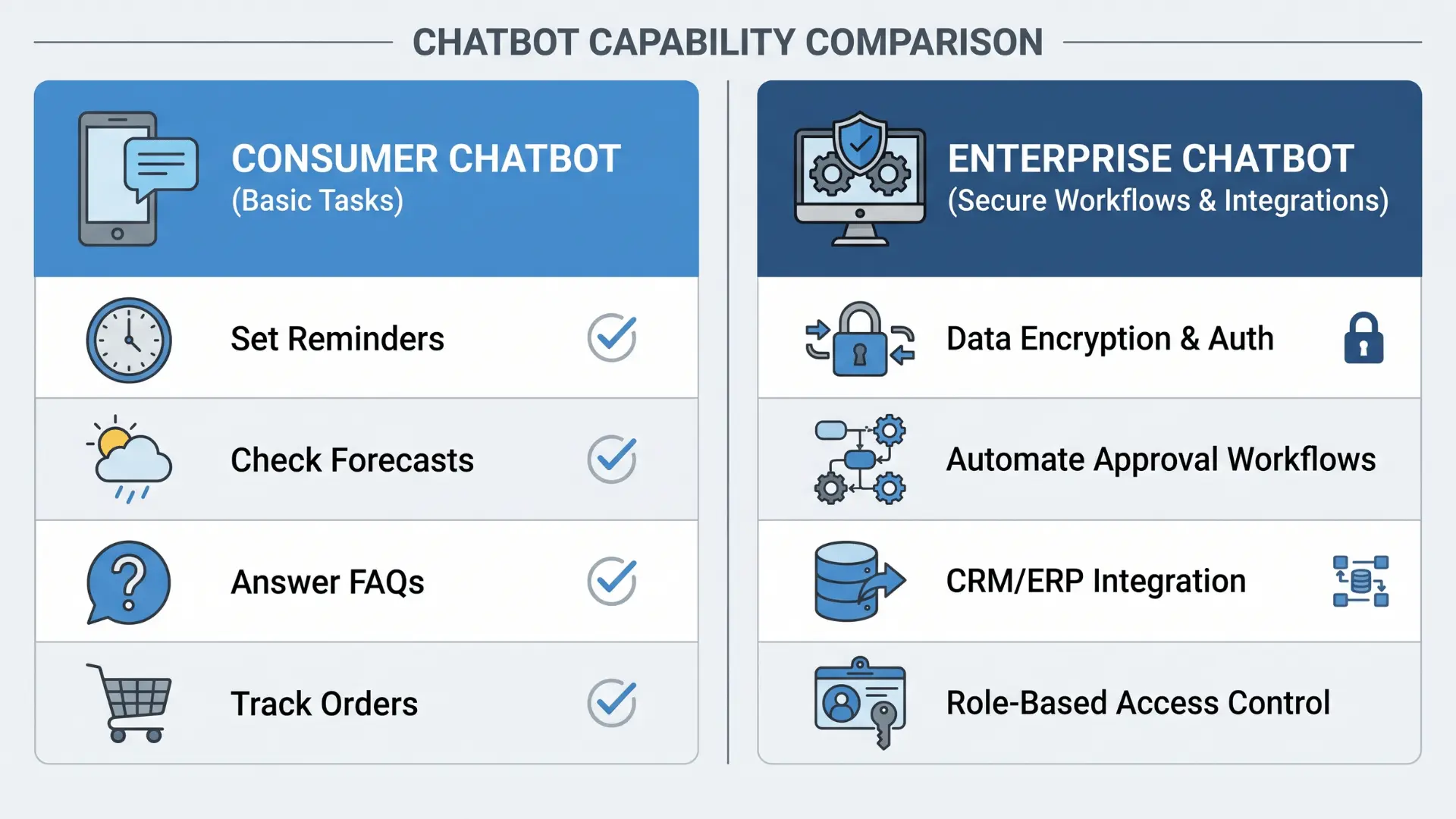
Enterprise and consumer chatbots serve very different needs, from basic interactions to secure, organizational workflows.
| Feature / Aspect | Consumer Chatbot | Enterprise Chatbot |
|---|---|---|
| Purpose | Handles general questions and basic tasks | Supports organizational processes with secure, auditable workflows |
| Data Access | Uses publicly available data | Accesses internal databases, CRMs, ERPs |
| Security & Controls | Minimal or no access restrictions | Strict access controls and permissions |
| Compliance | Not built for regulatory standards | Designed to meet industry regulations and data residency rules |
| Integration | Basic, limited connections | Deep integration with enterprise systems for complex operations |
The key differences reveal why enterprise chatbots are designed for compliance, deep integration, and controlled access to sensitive data.
Enterprise Chatbot vs. SMB Chatbot
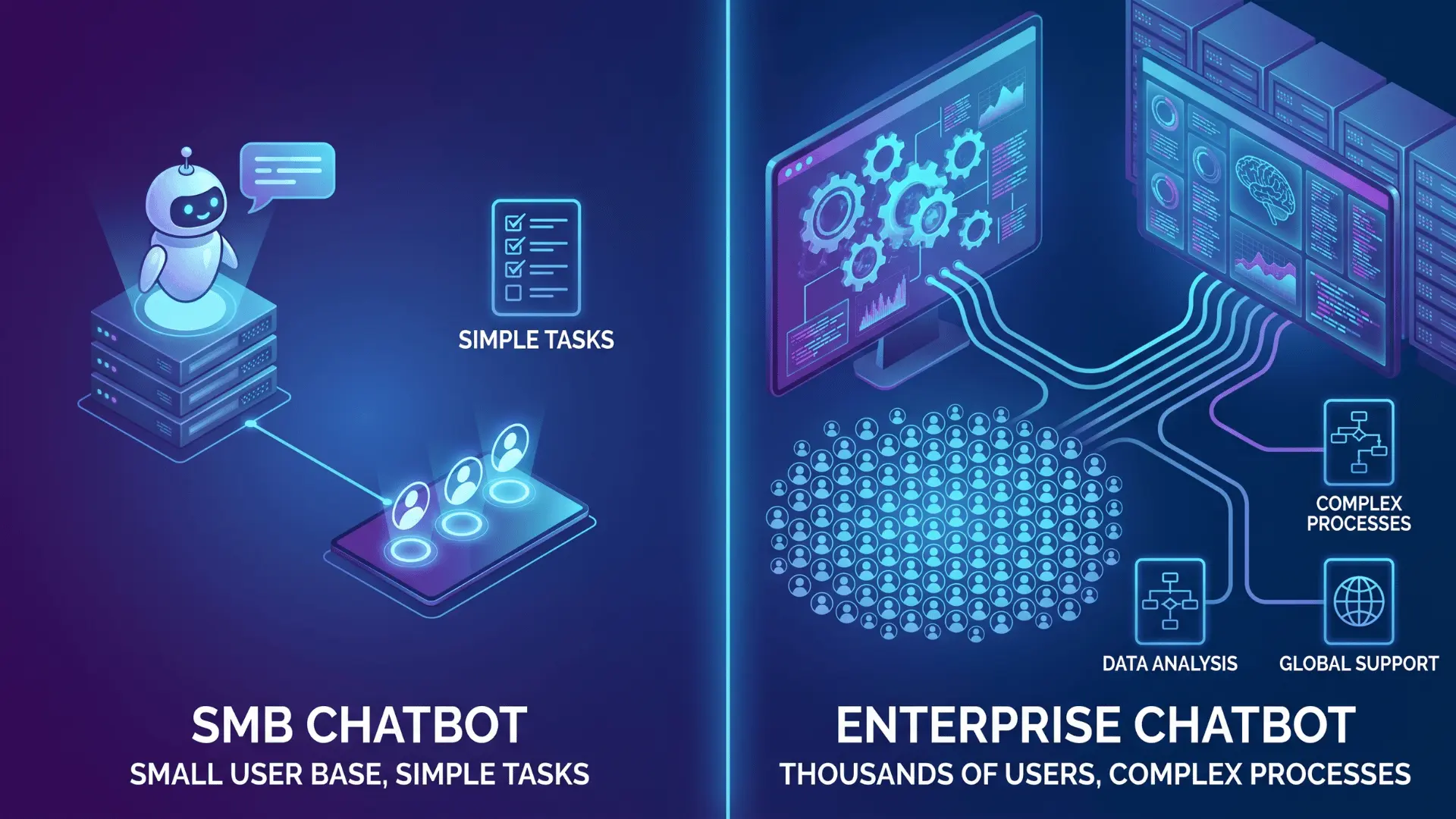
Chatbots for small businesses and enterprises differ in scale, complexity, and the level of control required for secure operations.
| Feature / Aspect | SMB Chatbot | Enterprise Chatbot |
|---|---|---|
| User Scale | Handles a few hundred to a thousand users | Supports thousands of concurrent users |
| Task Complexity | Simple customer service or HR tasks | Complex operations across multiple systems and departments |
| Compliance | Limited or basic compliance | Built to meet industry regulations like HIPAA or PCI DSS |
| Integration | Minimal or basic system connections | Deep integration with CRMs, ERPs, and internal databases |
| Reliability & Governance | Short-term or basic reliability | Long-term reliability with strong data governance, audit trails, and controlled access |
Enterprise chatbots are designed to handle high-volume use, ensure compliance, and integrate deeply across complex organizational systems.
Core Use Cases Across the Enterprise
Enterprise chatbots streamline workflows, connect systems, and deliver accurate, auditable information across teams and customers.
Customer Support & Service Automation
Chatbots handle customer inquiries, route complex issues, and reduce ticket load. They match questions to a knowledge base, escalate unresolved cases, and log interactions.
This leads to faster responses, fewer tickets, and consistent service.
Bots can operate 24/7, integrate with CRM platforms your team already relies on, and handle high volumes without fatigue.
Employee Self-Service (HR, IT, Onboarding)
Internal bots answer employee questions, troubleshoot IT issues, and guide onboarding.
They pull data from structured systems like Workday or ServiceNow and can create tickets automatically.
This speeds up HR and IT support, reduces backlogs, and improves onboarding, often providing quicker ROI due to controlled data and clear escalation paths.
Knowledge Retrieval Across Siloed Systems
Bots using RAG pull, summarize, and cite information from multiple databases. Employees get precise, traceable answers quickly, solving knowledge silos and improving decision-making.
Well-scoped bots with maintained data sources deliver more accurate, reliable results than bots trying to cover everything at once.
What Separates an Enterprise-Ready Platform from One That Isn’t?
An enterprise-ready chatbot succeeds through security, integration, and knowledge grounding not by features or chat volume.
- Security & Compliance Architecture: Must meet SOC 2, ISO 27001, GDPR, and HIPAA standards with proper logs, access controls, and data residency. Verify what each certification covers.
- Integration Depth: Requires deep links to CRMs, ERPs, HR systems, and middleware to fetch real-time data and trigger workflows. Weak integration reduces reliability.
- RAG and Knowledge Grounding: RAG uses curated internal data to provide accurate, auditable answers. Success depends on structured, maintained data and strong system connections.
Weak integrations limit data access, and without proper grounding, bots may rely on general training data, which is risky for enterprise policies, procedures, and products.
Integration, Deployment, and Where Implementations Break Down
Integrating an enterprise chatbot goes beyond connecting an API. It needs ongoing engineering to ensure secure access to systems like Salesforce, ServiceNow, Workday, and internal ERPs, allowing the bot to trigger actions, maintain context, and deliver reliable responses.
A common cause of failed deployments is the integration cascade: incomplete or poorly maintained connections create partial context, confident but useless answers, and lost trust. Failures are often blamed on AI rather than integration issues.
What Integration Actually Requires
Integration includes authentication, permission scoping, data mapping, and ongoing updates. Changes in connected systems require adjustments in the bot’s logic.
Open APIs provide access but still need engineering work to align systems and maintain data flow. Deployment approaches differ across cloud-native, on-premise, and hybrid environments, with regulated industries adding extra restrictions.
Common Integration Failure
Failures usually come from brittle middleware, underestimated scope, or permission gaps.
Middleware that worked at launch can break with updates, producing incomplete or misleading responses and eroding trust.
Deployment Phasing
Starting with a small pilot before full rollout allows verification of connections, testing workflows, and adjusting middleware. Proper sequencing reduces risk, ensures actionable responses, and improves adoption.
Careful integration, phased deployment, and ongoing maintenance are essential for reliable chatbot performance and user trust.
How to Evaluate and Compare Enterprise AI Chatbot Platforms?
Choosing the right enterprise chatbot is about fit, not features. Platform suitability depends on your tech stack, data quality, primary use case, and regulatory environment, which shape integration, RAG, and compliance needs.
Evaluation Criteria by Condition
Platform suitability depends on organizational context, including tech stack, regulatory needs, and primary use cases.
- Tech Stack: ServiceNow-heavy organizations need native workflow integration; Salesforce-centric companies prioritize CRM connectors.
- Regulatory Requirements: Financial or healthcare firms emphasize audit trails and compliance, while internal-use bots focus on controlled access and curated knowledge.
- Use Case: Customer-facing bots require scalable ticket routing and escalation, whereas internal bots benefit from structured knowledge bases.
Matching these factors to platform capabilities ensures reliable deployment and measurable ROI.
Questions to Ask Vendors
To evaluate effectively, ask vendors about:
- Integration depth: Which APIs, connectors, or middleware are supported, and how is ongoing maintenance handled?
- RAG corpus requirements: How is knowledge curated, updated, and verified to prevent hallucinations?
- Compliance scope: What certifications cover which controls, and how do they apply to your jurisdiction or industry?
- Escalation design: How does the bot handle exceptions, approvals, or transfers to human agents?
These questions reveal whether a platform is production-ready for your specific environment, beyond what a polished demo shows.
Build vs. Buy vs. Hybrid
Choosing between building, buying, or using a hybrid chatbot approach depends on how much control, customization, and engineering support your organization can provide.
| Approach | Description | Pros | Cons |
|---|---|---|---|
| Build (Open-Source, e.g., Rasa) | Fully in-house chatbot built using open-source frameworks | Full control, high customization, flexible design | High effort, slow setup, heavy maintenance |
| Buy (Commercial Platforms, e.g., IBM watsonx, Moveworks, Workativ, Crescendo, Oracle Digital Assistant) | Ready-made platforms with vendor support | Fast deployment, low engineering effort, built-in integrations | Limited customization, vendor lock-in, recurring cost |
| Hybrid | Mix of commercial tools with custom RAG or workflows | Balanced flexibility, faster than build, more control than buy | Integration complexity, ongoing maintenance |
Select the approach that aligns with your team’s capacity, integration needs, and ability to maintain the system over time.
Chatbots vs. Agentic AI: What Enterprise Buyers Need to Understand Now?
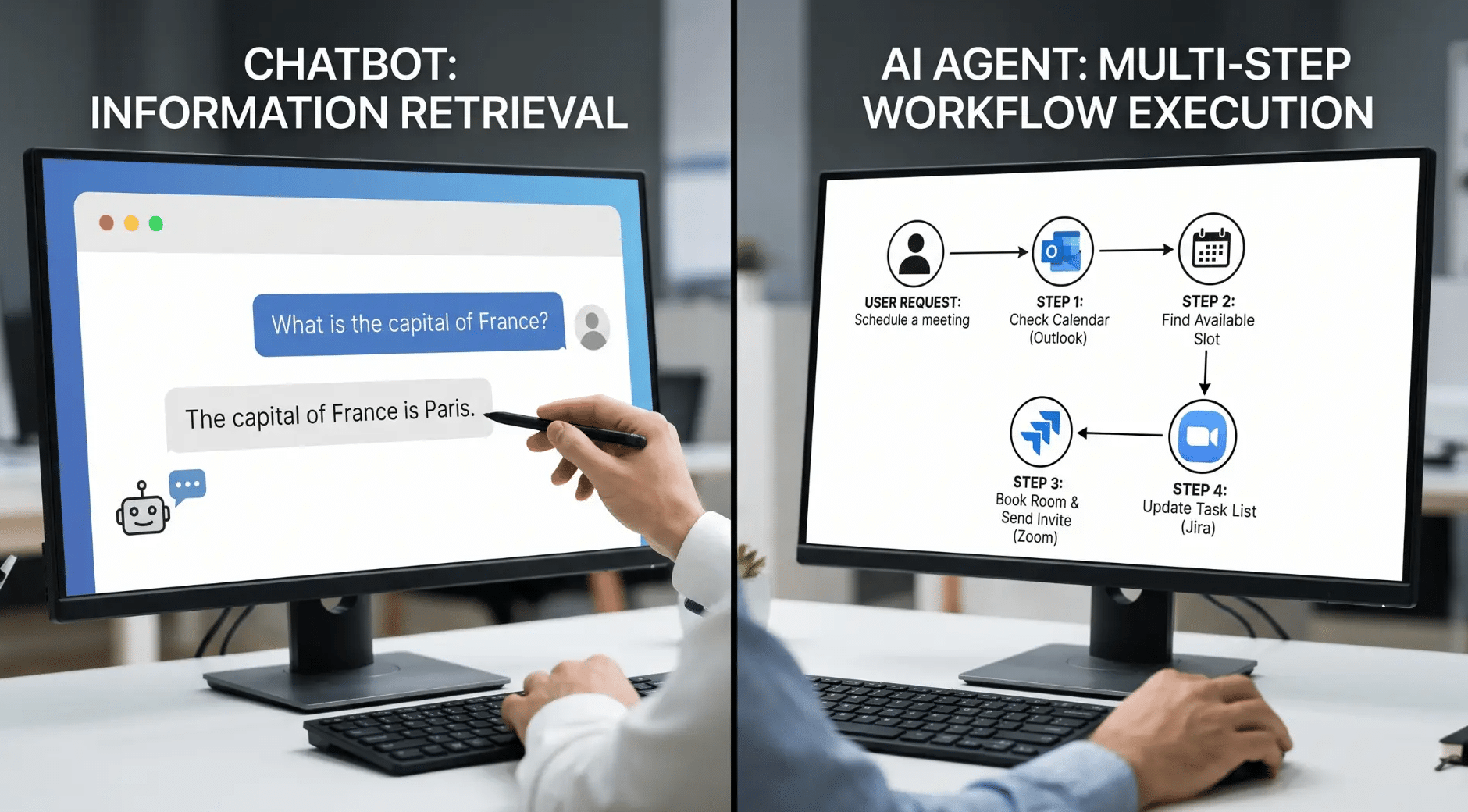
Enterprise chatbots provide information, while AI agents can act autonomously across systems, handling multi-step workflows and tool interactions.
| Aspect | Enterprise Chatbot | AI Agent |
|---|---|---|
| Function | Answers questions and provides information | Executes tasks autonomously across connected systems |
| Workflow Capability | Limited to user prompts and retrieved data | Performs multi-step workflows and interacts with multiple systems in sequence |
| Permissions & Decision-Making | Minimal; relies on human intervention for actions | Holds permissions and makes decisions based on context and rules |
| Use Case Suitability | High-volume, narrow-scope tasks like FAQ deflection, ticket routing, HR/IT requests | Complex, multi-step tasks requiring autonomous action across systems |
| Future Flexibility | Simple architecture, easier to deploy, cost-effective | Requires strong integration, modular workflows, and RAG-based grounding to scale safely |
| Strategic Consideration | Best for immediate, well-scoped tasks | Select platforms that allow future adoption of agentic capabilities without rearchitecting |
Recognizing the distinction allows organizations to pick the right solution now while enabling future agentic capabilities.
Wrapping Up
Enterprise AI chatbots can transform how your organization manages information and workflows when chosen and deployed thoughtfully.
By focusing on integration, data quality, and reliable knowledge grounding, you can avoid costly mistakes and ensure real-world impact. Remember, a well-scoped bot often outperforms one trying to do everything.
Keep testing, refining, and planning for future needs to get the most from your system.
For more insights and practical guidance, explore other blogs on the website to strengthen your AI strategy.
Frequently Asked Questions
How does data residency impact enterprise chatbots?
Data residency determines where your chatbot’s data is stored and processed, affecting compliance with local regulations such as GDPR and regional financial and healthcare laws.
Can enterprise chatbots handle multiple languages?
Yes, but multilingual support depends on both the LLM’s capabilities and whether your RAG corpus is maintained in those languages to ensure accurate responses.
How do chatbots maintain accuracy over time?
Accuracy relies on continuous updates to knowledge bases, monitored RAG sources, and auditing logs to catch outdated or incorrect information.
Do enterprise chatbots require dedicated IT teams?
Typically, yes; ongoing integration maintenance, permission management, and RAG updates require engineering support to ensure reliability and compliance.


One Response