

Not every production problem is a people problem. Some of it comes down to systems, how work is sequenced, how errors get caught, and how consistently output holds up at volume.
That’s where automation in manufacturing earns its place. Done right, it removes the variability that quietly drives up costs; inconsistent timing, fatigue-driven errors, and process drift that’s hard to catch until it’s already expensive.
But it’s not a universal fix. The type of system, the production environment, and the integration quality all determine whether automation pays off or creates new problems.
Here’s a clear breakdown of how it works and where it actually delivers.
What is Automation in Manufacturing?
Automation in manufacturing is the use of machines, control systems, and software to handle production tasks with little to no human involvement.
Instead of workers assembling or moving materials by hand, machines do it. They follow programmed instructions built into software and control systems, no guesswork, no variation.
Here’s how it works in simple terms. Sensors collect real-time data like temperature, speed, or position. That data goes to a control system, which processes it and tells the machines what to do next. The whole thing runs continuously and adjusts on the fly.
The goal is to take humans out of tasks that are repetitive, precise, time-sensitive, or physically hazardous. Machines don’t fatigue. They don’t drift. They execute the same operation the same way, every time.
The end result is a production environment that’s faster, more consistent, and easier to scale.
Why Automation Exists in Manufacturing
Automation exists because manual production has real limits, and at scale, those limits become costly.
People get tired. Repetitive tasks slow workers down over time, and fatigue leads to mistakes. In high-volume production, even small errors stack up fast. You end up with defects, wasted material, and rising costs.
Machines don’t have that problem. They run the same motion, at the same speed, with the same force every single time. Sensors track conditions like temperature, speed, and position. If something shifts, the control system corrects it automatically.
The result is steadier output, less scrap, and fewer rework cycles.
That said, automation isn’t the right fit for every operation. When demand is unpredictable or products change often, the setup costs can outweigh the gains.
It works best where production is high-volume, repeatable, and consistent. That’s where the payoff is clearest.
Key Benefits of Automation in Manufacturing
Automation delivers measurable operational gains when applied to the right production environment. Here are the benefits manufacturers consistently see.
- Higher throughput: Machines operate continuously without breaks, fatigue, or shift limits. Output per hour increases without proportional cost increases.
- Consistent quality: Programmed logic applies the same force, speed, and timing on every cycle. Defect rates drop as process variation decreases.
- Lower labor costs: Automation handles repetitive tasks, freeing workers for higher-value roles like programming, maintenance, and quality oversight.
- Improved worker safety: Machines take on hazardous tasks such as welding, heavy lifting, or chemical handling, reducing injury risk on the floor.
- Faster production cycles: Automated systems eliminate delays caused by manual handling, shift changes, and performance inconsistency.
- Scalability: Once a system is programmed and validated, output can scale without a proportional increase in headcount or error rate.
These benefits are most pronounced in high-volume, stable-demand environments. Lower-volume or highly variable production may see fewer gains from full automation.
How Automation in Manufacturing Actually Works?
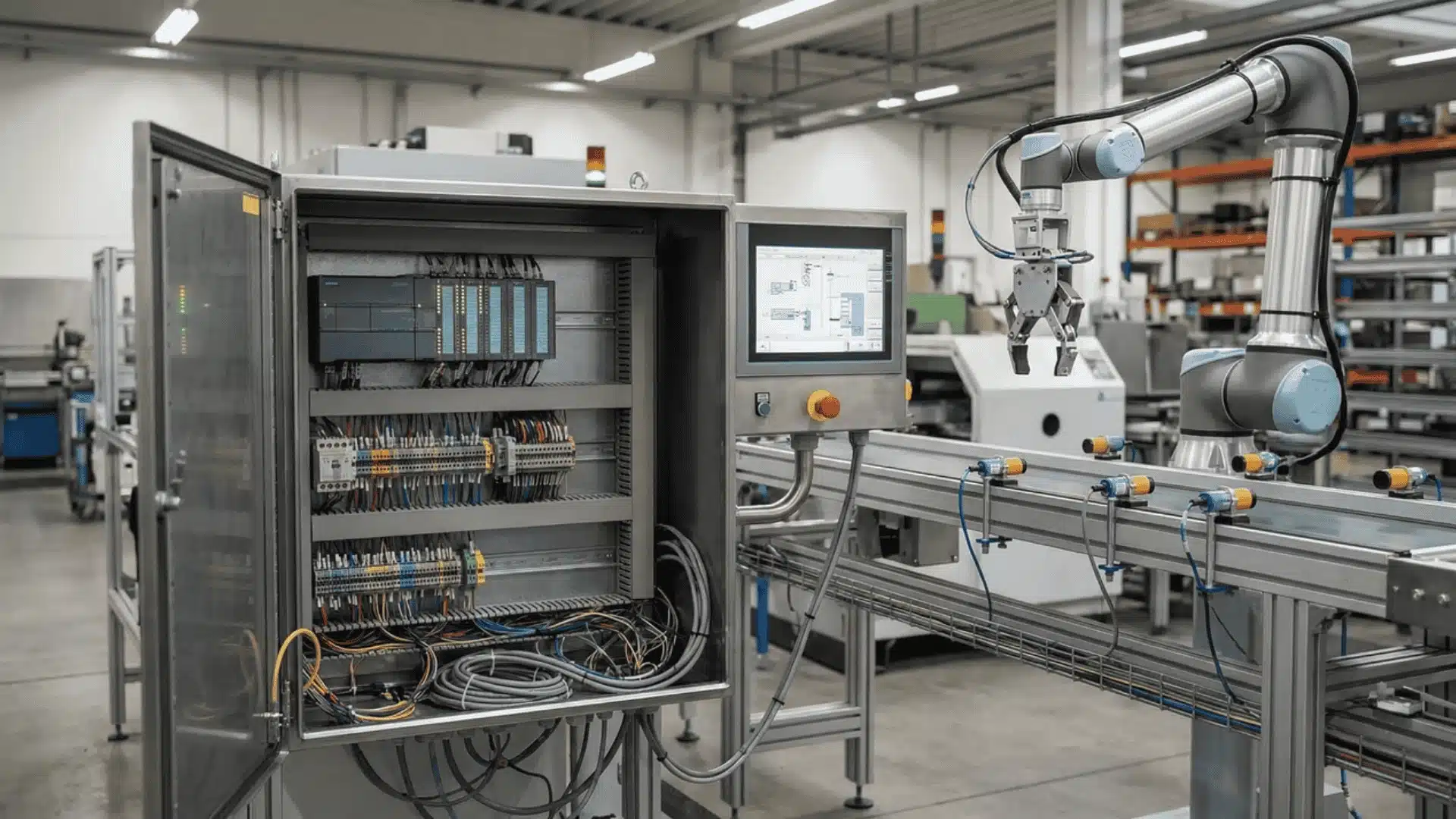
Automation in manufacturing operates through a structured control loop that connects materials, machines, sensors, and software. Each stage follows a defined sequence to ensure consistent and repeatable production.
Input → Processing → Output Loop
Every automated system begins with inputs. These include raw materials entering the production line and sensor data measuring variables such as temperature, speed, or position.
The processing stage is managed by control systems such as PLCs or industrial software. These systems interpret programmed instructions and evaluate incoming sensor data.
Once conditions match the programmed logic, the system triggers outputs. Machines then perform physical actions such as cutting, welding, assembling, packaging, or moving materials.
How PLCs Direct Machine Actions
The PLC functions as the central decision-making unit within the system. It follows pre-programmed logic that defines when actions occur and how equipment responds to specific conditions.
If a sensor detects a change, it sends the information to the PLC. The PLC processes the signal and sends commands back to machines for immediate adjustment.
This creates a real-time feedback loop: sensors → PLC → machine response. The loop runs continuously during operation.
Continuous Feedback and Optimization
Sensors constantly monitor process variables such as temperature, pressure, alignment, or speed. When deviations occur, the system automatically corrects them within predefined limits.
This ongoing correction maintains stable operating conditions. The result is repeatable production with minimal variation.
Failures typically occur when programming logic is incorrect, sensors provide inaccurate data, or systems are poorly integrated. In these cases, the control loop produces flawed decisions, leading to defects or instability.
Core Components of Manufacturing Automation Systems
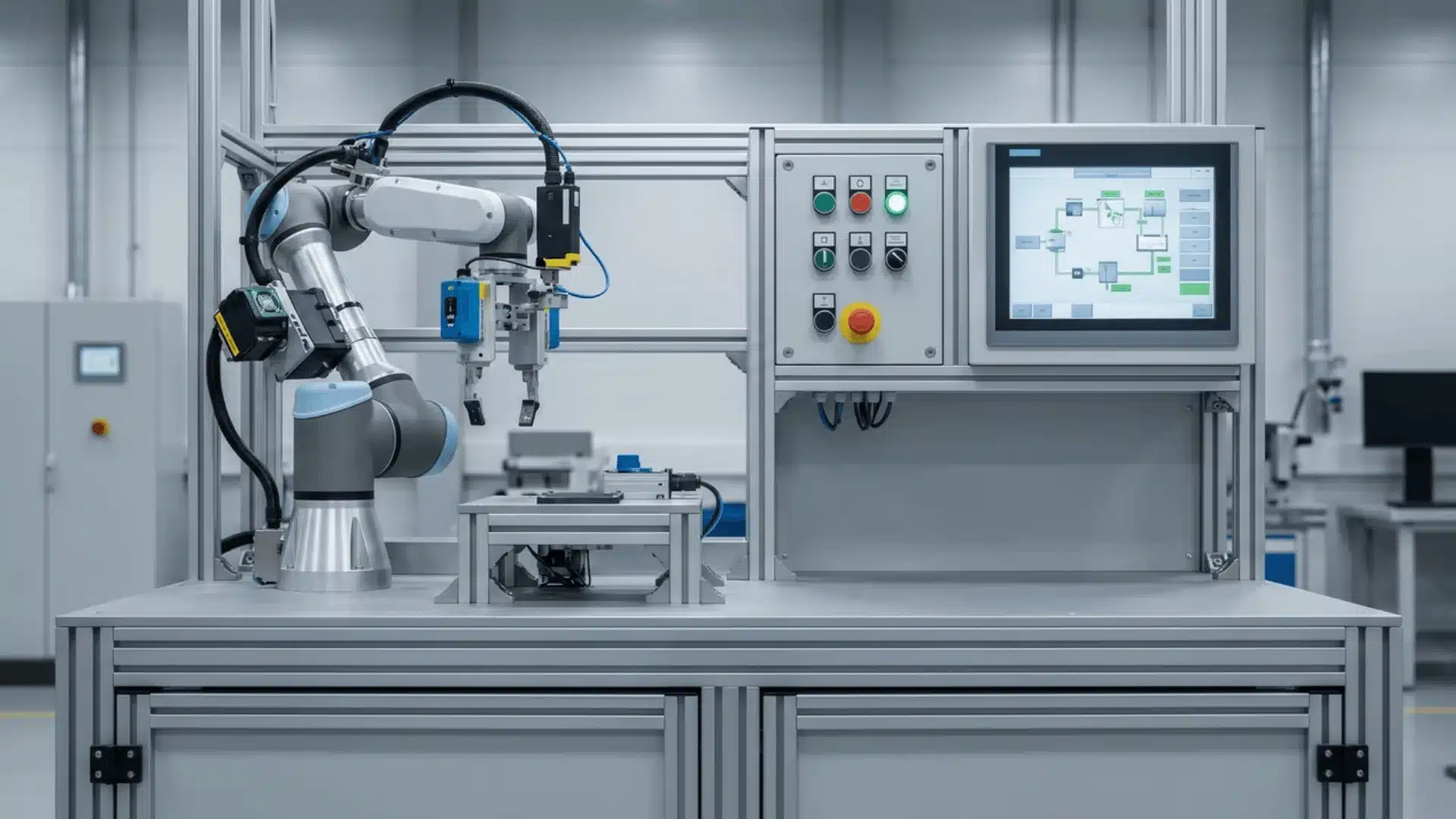
Manufacturing automation functions as an integrated system comprising coordinated hardware and software layers. Each component performs a distinct role within the overall control structure.
1. Machines and Robotics
- Perform physical production tasks, including assembly, welding, cutting, packaging, and material handling.
- Execute pre-defined motion sequences programmed into the control system.
- Deliver high-speed, repeatable precision without performance variation.
- Convert digital instructions into measurable physical output.
2. Sensors and Actuators
- Sensors collect real-time data, including temperature, pressure, position, speed, and alignment.
- Provide continuous input that reflects current operating conditions.
- Actuators convert control signals into physical movement or mechanical action.
- Enable the feedback loop that allows systems to adjust and stabilize processes.
3. Control Systems (PLCs and Software)
- Interpret sensor inputs and compare them to programmed instructions.
- Function as the central decision-making unit of the system.
- Trigger machine actions based on logical conditions.
- Coordinate multiple machines to ensure synchronized operations.
4. Human-Machine Interfaces (HMIs)
- Allow operators to monitor system performance in real time.
- Display production data, alarms, and process variables.
- Enable manual overrides, parameter adjustments, and diagnostics.
- Serve as the connection point between human supervision and automated execution.
Automation is not limited to robots alone. It is a coordinated integration of machines, sensors, control logic, and human oversight working as a unified system.
Types of Automation in Manufacturing
Manufacturing automation systems vary in terms of flexibility, production volume, and integration level. The table below summarizes how each type operates and where it fits best.
| Automation Type | Mechanism | Outcome | Best For | Limitations |
|---|---|---|---|---|
| Fixed (Hard) Automation | Pre-set equipment for one product. Sequence and tooling are permanent. | Very high speed and consistent output. Low flexibility. | High-volume, stable demand. | Hard to modify for design changes. |
| Programmable Automation | Program changes between batches. Equipment is reconfigured via software. | Moderate flexibility with changeover downtime. | Batch production and medium volumes. | Reprogramming reduces uptime. |
| Flexible (Soft) Automation | Computer-controlled system adjusts automatically. Minimal manual changeover. | High adaptability with low downtime. | Variable or mixed-product production. | Higher cost and system complexity. |
| Integrated / Process Automation | All systems are connected through shared data. Centralized control across operations. | End-to-end coordination and visibility. | Large-scale, multi-process operations. | Complex setup and integration effort. |
Selecting the appropriate type depends on production volume, product variability, and the required balance between efficiency and flexibility.
Cost of Automation in Manufacturing
Automation costs vary depending on system size, production volume, and integration complexity. Below is a structured breakdown of typical industry cost ranges.
Capital Equipment
- A single industrial robot cell typically costs $50,000 – $150,000.
- Pick-and-place automation systems range from $100,000 – $300,000.
- CNC machines generally cost $75,000 – $500,000, depending on size and precision.
- Fully automated production lines can range from $1 million to $10+ million.
Integration And Engineering
- System design and programming usually cost $10,000 – $100,000.
- Full plant integration may range from $250,000 – $2+ million.
- Legacy system upgrades often add 15–30% to base equipment costs.
Software And Control Systems
- PLC hardware and configuration cost $5,000 – $50,000 per line.
- MES implementation ranges from $100,000 – $500,000.
- ERP integration costs typically fall between $50,000 – $250,000.
- Cloud automation software subscriptions range from $1,000 – $10,000 per month.
Training And Workforce Development
- Operator and technician training costs $2,000 – $10,000 per employee.
- Advanced PLC or robotics certification programs range from $5,000 – $15,000 per person.
Maintenance And Operational Costs
- Annual maintenance typically equals 3–7% of total equipment cost.
- Spare parts and system updates may cost $10,000 – $100,000 annually.
- Energy consumption can increase facility costs by 5–15%.
Return on investment commonly occurs within 2–5 years in high-volume environments, while lower-volume operations may require a longer recovery period.
Real-World Examples of Automation in Manufacturing
Automation becomes clearer when examined through practical factory applications. The examples below show how system logic translates into real production tasks.
Robotics: Used for welding, painting, assembly, and material handling through repetitive programmed motion that ensures consistent speed and precision.
CNC Machines: Perform precision machining using computer-controlled instructions to cut, drill, or shape materials with high accuracy.
Artificial Intelligence (AI): Analyzes production data in real time to detect defects, predict equipment failures, and optimize process parameters. AI adds a decision layer that improves system performance without requiring manual reprogramming.
3D Printing: Produces components layer by layer based on digital design files, enabling automated prototyping and low-volume part production.
Inventory Automation: Uses software systems to track stock levels, manage replenishment, and forecast demand through real-time data processing.
Production Outcomes: These systems shorten production cycles, reduce human error, and maintain consistent output quality across runs.
These examples show how automation combines machines and software to deliver faster cycles and stable output. Each system applies programmed control to reduce variation and improve efficiency.
Where Automation Works Best and Where it Struggles
Automation performance depends on how well the system matches the production environment. Its value increases when conditions favor stability and repeatability.
Where Automation Works Best
Automation performs best when tasks are repetitive and follow a fixed sequence. Programmed logic can then execute actions consistently without deviation.
It is highly effective when high precision is required across large production volumes. Continuous operation and controlled parameters reduce defects and stabilize output.
High-volume environments also justify the initial setup and integration costs. Over time, consistent throughput offsets capital investment and improves efficiency.
Where Automation Struggles
Automation struggles when demand is unpredictable or shifts frequently. Reconfiguration reduces efficiency and increases downtime.
It is less effective when products change often or require customization. Standardized machine logic cannot easily adapt to constant variation.
Integration complexity can also limit performance if systems are poorly coordinated. Automation is not automatically cheaper, and not every process benefits when flexibility is more valuable than repetition.
Key Takeaways: How Manufacturing Automation Functions as a System
Manufacturing automation operates as a coordinated system rather than isolated equipment. Its performance depends on how well machines, control logic, and data flow work together.
- Automation operates through the interaction of machines, control systems, sensors, and real-time data within a single connected system.
- Every automated process follows a loop of input → control logic → output → feedback to maintain stable operation.
- Continuous monitoring enables automatic correction of deviations, reducing variation and maintaining consistency.
- Different automation types balance flexibility and efficiency depending on production design.
- System effectiveness depends on matching the automation structure to production volume, variability, and precision needs.
When these elements align, automation delivers predictable, repeatable, and scalable manufacturing performance.
Conclusion
Automation in manufacturing operates as an integrated system of machines, control logic, and continuous feedback. Its strength lies in matching the right structure to the right production environment.
Understanding how automation works, where it excels, and where it struggles allows for smarter operational planning.
You now have a clear view of its control logic, system types, and practical applications.
Use this knowledge to evaluate how automation fits within your production goals and long-term growth strategy. When aligned correctly, it becomes a driver of stable, scalable performance.
Frequently Asked Questions
Does automation in manufacturing eliminate jobs completely?
Automation shifts roles rather than eliminating them entirely. Workers move from manual execution to programming, monitoring, maintenance, and system optimization responsibilities within automated environments.
How long does it take to implement manufacturing automation?
Implementation timelines depend on system complexity and integration requirements. Simple automation may take weeks, while large-scale integrated systems can require months of planning and deployment.
Can small manufacturers benefit from automation?
Yes, but selectively. Targeted automation of repetitive or error-prone tasks can deliver efficiency gains without requiring full-scale system integration or excessive capital investment.