


The conversation around AI arbitrage usually starts with income claims; thumbnails promising six figures, crypto platforms with suspiciously smooth return charts, and courses sold by people who made their money selling courses.
That noise makes it easy to miss the part that’s actually worth understanding. AI arbitrage is a real pricing dynamic: a gap between what it now costs to produce certain outcomes and what buyers still expect to pay for them.
That gap opened quietly, it’s closing gradually, and not every version of it is the same thing.
Before you decide whether this is an opportunity worth your time or money, it’s worth being clear about exactly what AI arbitrage is, how its three main models differ, and where the real risks sit.
What is AI Arbitrage?
AI arbitrage is the practice of profiting from the gap between what something costs to produce with AI and what a client or market will pay for it.
The AI is not the point. The gap is.
That gap shows up in three different contexts: service businesses, physical or digital goods, and financial markets. The activities look different on the surface, but they all run on the same logic; asymmetric pricing between production cost and perceived value.
Clients don’t pay based on how long something took or what tools you used. They pay based on what the outcome is worth to them. That expectation was built around human labor costs.
AI has quietly lowered the cost of production, but it hasn’t changed what buyers expect to pay. That’s the gap. And right now, it’s wide open.
What Are the Three Models of AI Arbitrage?
The term gets applied to three structurally different business models. They share the same underlying logic: produce cheaply and deliver at perceived value, but the market, the risk, and the execution look nothing alike.
1. The Agency Model (Service Arbitrage)
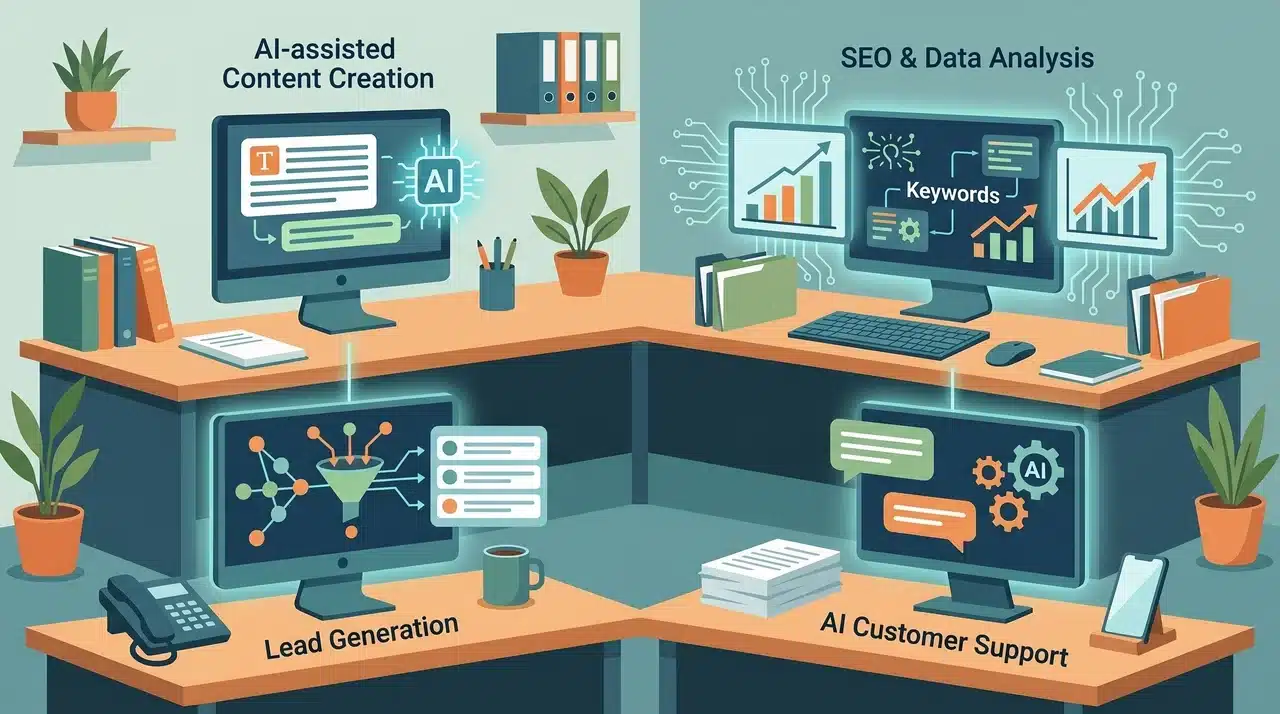
This is the most common version, and the one most people mean when they talk about AI arbitrage as a business opportunity. The steps are straightforward; the margin is in the execution.
- Choose a service with stable market pricing. Copywriting, SEO, lead generation, or customer support all work. The key is that buyers already have an expectation of what it costs.
- Price against that expectation, not your costs. The client’s reference point is what agencies or freelancers historically charged. Start there.
- Use AI for production. Handle most of the deliverable work with AI tools. Your time goes into quality control, client management, and iteration.
- Deliver the outcome. The client receives what they paid for. They don’t need to know your production stack, and in most cases, they don’t care.
- Pocket the margin. The difference between what the client pays and what your tools cost is the business. That gap is wider than most people expect, at least for now.
The barrier here isn’t capital; it’s execution quality and client trust.
In practice, the tools doing the production work are accessible and low-cost. A copywriting or SEO agency might use a combination of an LLM (ChatGPT, Claude, or Gemini) for drafts and ideation, a tool like Surfer SEO or Clearscope for optimization, and a workflow automator like Zapier or Make to handle handoffs between steps.
A lead generation service might run Apollo or Clay for list building, with AI handling initial outreach copy.
The specific stack varies by service type, but the model is the same: a small number of subscriptions, often $50–$300 a month, replace work that previously required hours of human labor per deliverable.
2. Retail and E-Commerce Arbitrage

This isn’t a new concept. Resellers have always profited by buying low and selling high. AI doesn’t change that; it just changes how fast and how broadly you can spot the opportunities.
- Manual scanning replaced: AI monitors thousands of products across platforms at once, where a human might check dozens in the same time.
- Instant alerts: Tools flag pricing gaps the moment they appear, before the opportunity closes.
- Same business model: Identical to traditional retail arbitrage; buy cheap, sell where demand is higher.
- AI role: A speed and coverage multiplier, not a new model.
Where a human reseller might scan 50–100 product listings in an hour, an AI-assisted tool like Tactical Arbitrage or Seller Assistant can cross-reference tens of thousands of products across Amazon, Walmart, and liquidation platforms in the same time, flagging units where the price gap, after fees, is wide enough to flip profitably. The model is traditional reselling. The edge is scale.
3. Quantitative and Crypto Trading
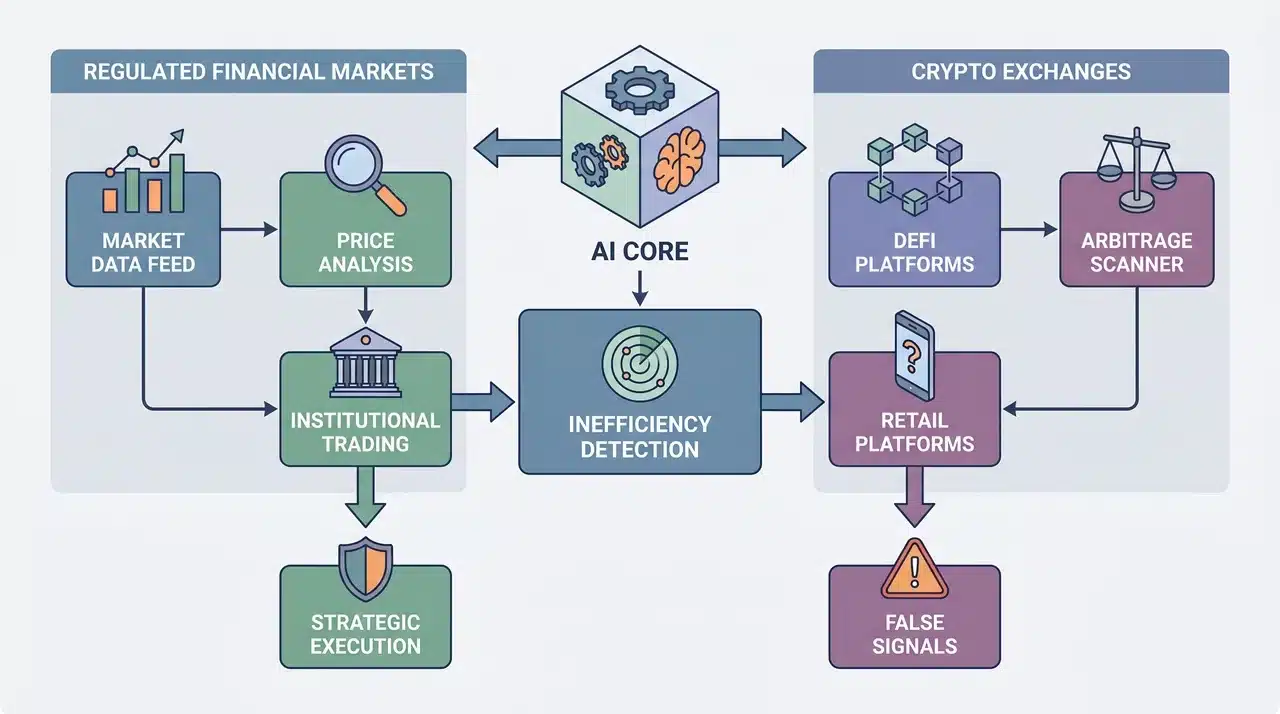
Of the three models, this is the one where the label is most frequently borrowed to sell something fraudulent. Understand the difference before you engage with anything in this category.
- Legitimate use: Institutional trading desks use AI to spot tiny price inefficiencies across global markets, fractions of a cent, milliseconds of timing.
- High barriers: It requires infrastructure, capital, and strict regulatory compliance that sits well beyond individual access.
- Scam risk: Many crypto platforms promising automated AI trading returns are fraudulent. The returns are fabricated, and the exit is designed.
- Red flag: Legitimate trading operations don’t recruit retail investors. If it’s being marketed to you online as a passive income opportunity, treat that as a warning.
Most retail AI trading offers are scams. The institutions that run real AI arbitrage trading don’t need your money or your attention; they already have the infrastructure and the capital to operate without you.
Why Does the Pricing Gap Exist and How Long Does It Last?
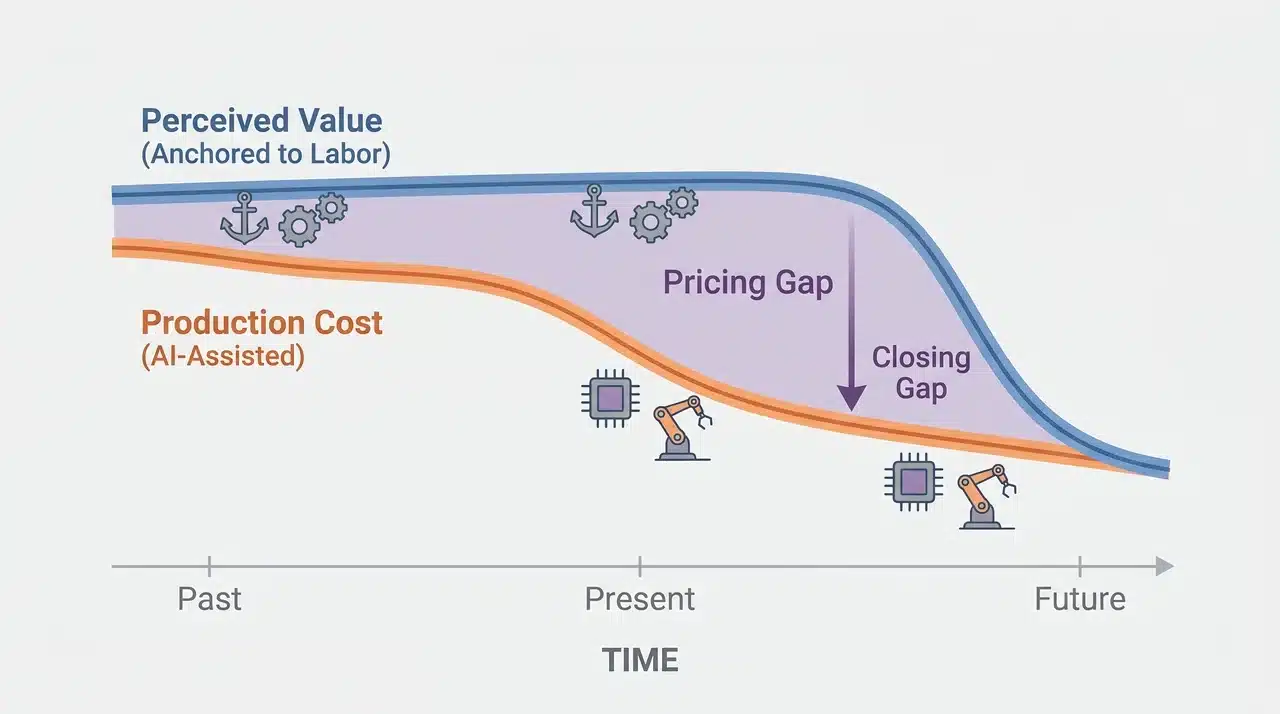
The pricing gap isn’t caused by AI. It comes from how buyers value services and how slowly that valuation adjusts to new realities.
When a client agrees to pay $2,000 for a content package or lead generation setup, that price reflects what they’ve previously seen the work cost. Agencies, freelancers, and in-house teams built that number around human hours. It’s anchored to labor, not to output quality.
AI changes what it costs you to produce the outcome, not what the outcome is worth to the client. That’s the lag. Buyer expectations are still rooted in a world where quality took time and headcount. The market hasn’t repriced yet.
This window won’t stay open forever.
Several forces close it: clients become more AI-literate and start questioning legacy rates, competitors lower prices and compress margins, and AI tools become widely accessible and commoditized.
What feels like an edge today becomes table stakes as soon as enough people are running the same playbook.
The operators who maintain strong margins aren’t necessarily the first to spot the gap. They’re the ones who build something harder to replace: specialization, reliable processes, and client relationships that don’t commoditize as easily as the tools do. The arbitrage opportunity is real. So is its expiry date.
How to Get Started With the Agency Model
The agency model has the lowest barrier to entry of the three. No upfront capital, no trading infrastructure, no inventory. What it requires is a service you can already deliver and the discipline to systematize it.
A workable starting path looks like this:
- Pick one service in a defined niche. The more specific, the better. “Content for SaaS companies” outperforms “content writing” every time. A tighter niche makes your pitch clearer and your AI output easier to quality-control.
- Identify the two or three AI tools that handle 80% of the production. For most service types, one LLM plus one specialized tool covers the core workflow. Start with the minimum viable stack; you can layer in more once the model is proven.
- Price to the market, not your cost. Research what agencies or freelancers currently charge for the service. Start at that rate. The margin comes from the gap between your delivery cost and theirs; not from undercutting and racing to the bottom.
- Land one client before scaling. The first engagement shows you where AI output needs human judgment, what the client actually values, and which parts of the workflow are genuinely repeatable. That knowledge is what you build on.
The goal at this stage isn’t efficiency, but understanding. Scale comes after you know which parts of the process can actually be handed to a tool without the quality falling apart.
Is AI Arbitrage Legal and Legitimate?
For the service and retail models, yes, they’re legal.
AI-assisted agencies operate the same way traditional agencies always have, marking up the cost of production and delivering client outcomes. The model isn’t new. The tools are.
The real concern is reputational, not legal.
Using AI to meet a client brief is fine. Misrepresenting AI-produced work as entirely human, especially in a contract that specifies otherwise, is a different matter. Be clear about what you’re delivering and how.
AI trading is a different category entirely.
Institutional AI trading is legitimate, but it’s complex, capital-intensive, and not accessible to individuals operating outside a regulated financial environment. Most platforms marketing passive AI trading returns, especially in crypto, are fraudulent.
The red flag is the marketing itself: legitimate operations don’t need to recruit retail investors to function.
Conclusion
AI arbitrage works because markets are slow to reprice. Buyers still anchor to what skilled work cost before AI changed the economics of producing it. That lag is the opportunity.
But the window isn’t permanent, and the label covers very different things: a legitimate service model, a speed-multiplied reselling approach, and a trading category where fraud is the norm rather than the exception.
Knowing the difference matters before you commit time or money to any of it.
If you want to explore the service model, start with one skill you can already deliver well. AI handles the scale. You handle the relationship. That’s where the real margin lives, and where it holds longest as the gap closes.
Frequently Asked Questions
How is an arbitrage different from freelancing?
Freelancing trades time for money; your output is limited by your hours. AI arbitrage removes that ceiling. AI tools produce the work faster and at lower cost, while clients pay standard market rates. The margin comes from that gap, not from billing more hours.
Is AI arbitrage the same as trading bots?
No. The service and retail models have nothing to do with financial trading. AI arbitrage trading exists as a separate category, but it’s dominated by institutional players and is largely inaccessible to individuals. Most retail versions of it are scams.
Why is the agency model the easiest entry point?
It requires no upfront capital — just access to AI tools and the ability to earn client trust. You don’t need inventory, trading accounts, or technical infrastructure. Success depends on execution and relationships, not a financial runway.
Will the pricing gap closes over time in AI Arbitrage?
Yes. As clients become more AI-literate and competitors lower their rates, margins compress. Specialists who build strong processes and client relationships hold onto their margins longest — but no version of this gap stays open indefinitely.