
Put a conventional bike helmet next to a smart one and the basic shape may look almost identical. Inside, however, the newer helmet can contain several layers of technology doing very different jobs.
Some features are mechanical.
Others rely on sensors, batteries, Bluetooth and software. Integrated lights can make a rider more visible, while accelerometers can help recognize the movement associated with a hard impact. A companion app can then turn sensor data into an alert that reaches someone away from the crash.
Well, welcome the smart bike helmet; a connected safety ecosystem worn on your head.
Understanding those individual parts is more useful than treating “smart helmet” as a single feature. It also reflects a wider shift in consumer technology toward practical utility, where the value of added electronics depends less on having more specifications and more on whether they solve an everyday problem.
Here is a look at the architecture, sensors, and safety engineering transforming the humble helmet into an essential, high-tech command center for modern riders.
The Protective Shell Still Does the Most Important Job
Before getting to Bluetooth or LEDs, it helps to separate a smart helmet’s protective structure from its electronic features.
Most bicycle helmets still rely on an outer shell and an energy-absorbing liner, commonly made from expanded polystyrene foam. In an impact, the liner is designed to deform and absorb energy rather than allowing all of it to reach the rider’s head.
The electronics do not replace this structure.
In the United States, bicycle helmets are subject to Consumer Product Safety Commission requirements covering factors including impact attenuation, retention strength, positional stability and peripheral vision. A helmet also needs to carry the appropriate certification labeling.
This is why the word “smart” should never be treated as a safety certification on its own. A rear light, app or sensor may add useful functions, but the helmet underneath still needs to meet the relevant standards for where and how it is being used.
What Mips Actually Does
MIPS is one of the most frequently misunderstood parts of a modern helmet because it is often grouped together with electronic features.
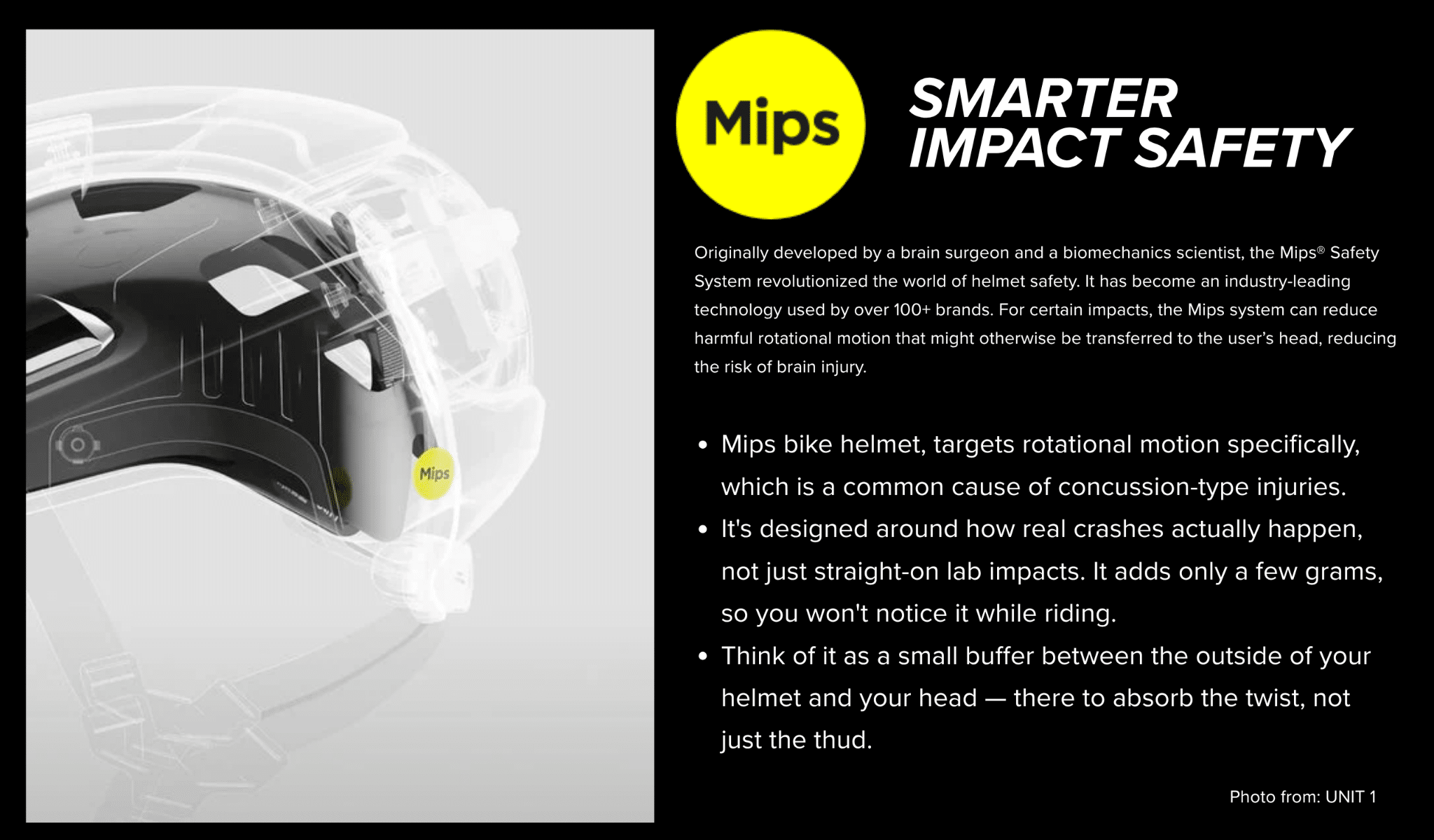
It is not a sensor. MIPS, short for Multi-directional Impact Protection System, is designed to address rotational motion associated with certain angled impacts. Its low-friction system allows a small amount of movement between the helmet and the head during an impact, helping redirect some rotational motion that might otherwise be transferred to the head.
Mips says its system can allow approximately 10 to 15 millimeters of relative movement during the first few milliseconds of certain impacts.
Independent helmet testing increasingly considers rotational movement alongside linear acceleration. Virginia Tech’s bicycle helmet STAR methodology, for example, measures both linear acceleration and rotational velocity across a series of laboratory impacts when producing its helmet ratings.
A smart helmet with MIPS therefore combines two separate ideas. UNIT 1’s AURA, FARO and NEON helmets are examples of this layered approach, combining MIPS with integrated electronic systems. The MIPS layer works mechanically during an impact, while the “smart” portion can include electronics for visibility, signaling, customization or post-crash communication.
Sensors are the helmet’s way of understanding movement
The sensor layer is where a helmet begins behaving more like a connected wearable.
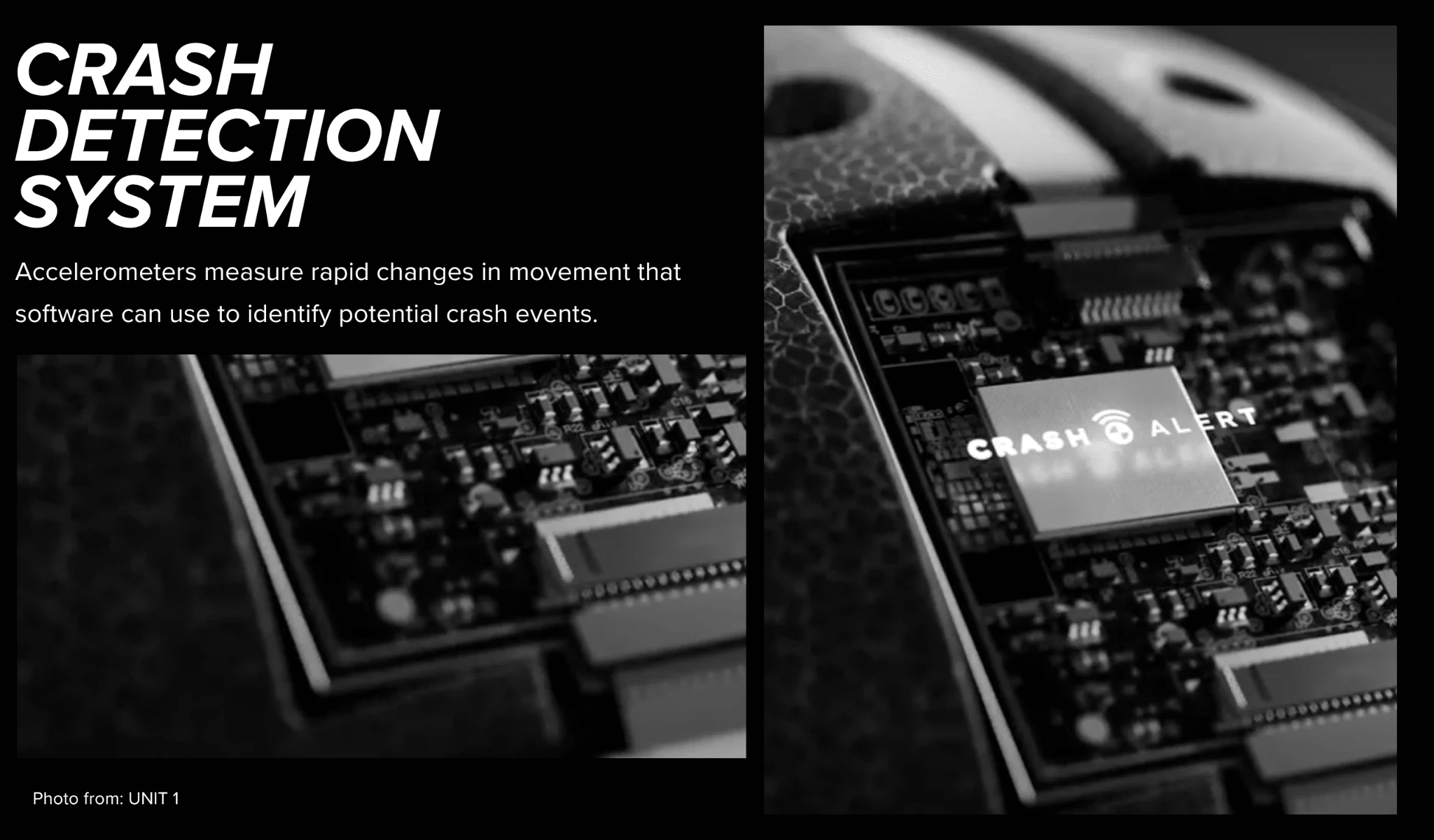
An accelerometer measures changes in motion. In normal use, the sensor encounters constant movement from turning your head, riding over uneven pavement or taking the helmet on and off. A crash-detection system therefore needs software rules designed to distinguish ordinary movement from a sufficiently hard event.
UNIT 1 describes its Crash Alert system as using onboard sensors to detect certain hard impacts. Detection alone does not immediately contact someone. It starts a safety-check process instead.
That extra step is useful because a motion sensor does not know whether a rider is injured. It recognizes a pattern in movement.
Crash Alerts Add a Communication Layer
Once a helmet detects a possible crash, software becomes more important than the sensor itself.
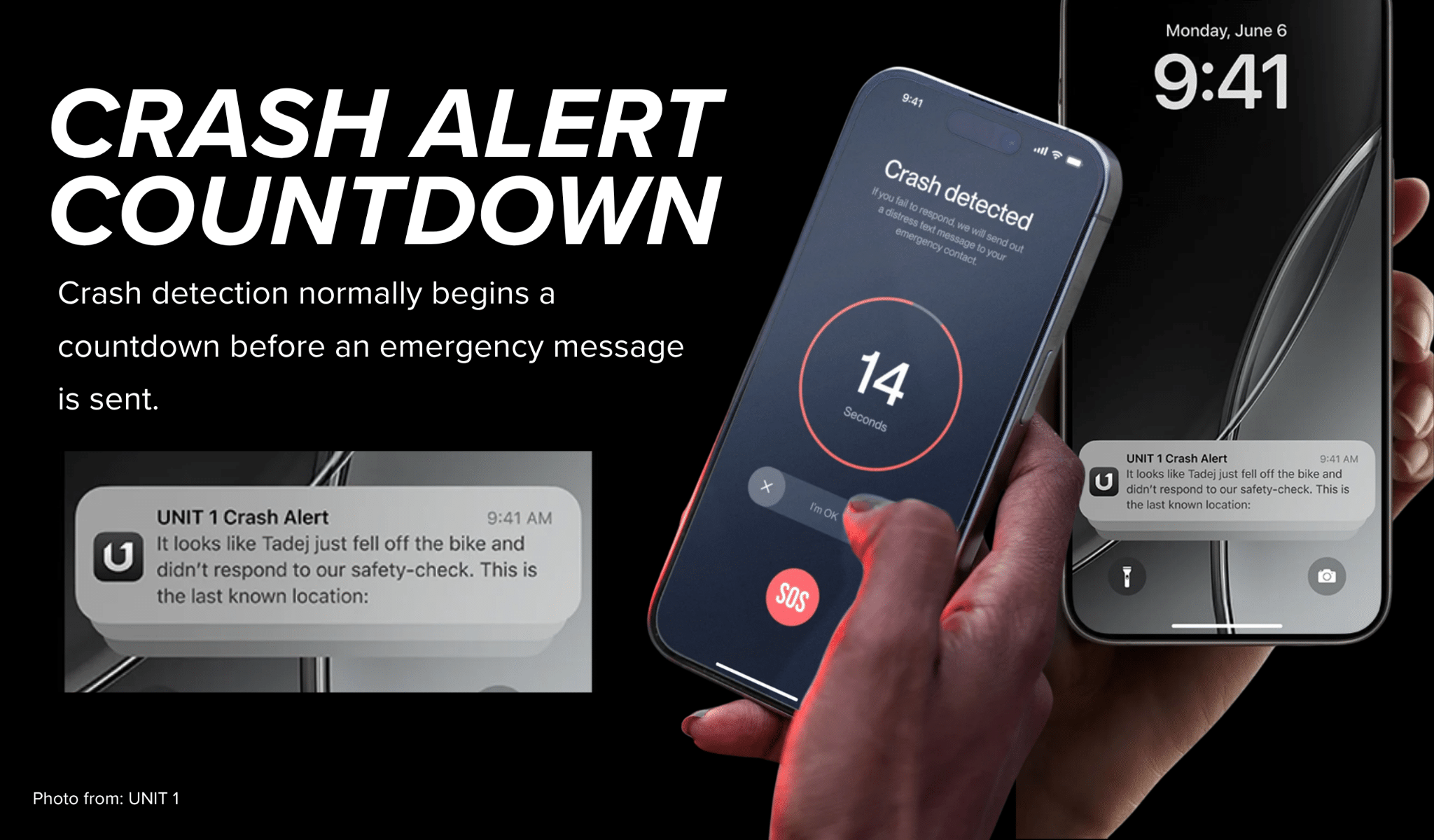
In UNIT 1’s system, a detected hard impact triggers a countdown through the companion app. The rider has an opportunity to cancel the alert if no help is needed. If there is no response, the system can send an SMS containing the rider’s location to a previously selected emergency contact.
There are several dependencies worth understanding.
The helmet needs sufficient battery power, and the rider needs the smartphone used with the system. UNIT 1 states that Crash Alert also requires an active Bluetooth connection between the helmet and phone, while the phone needs cellular service for the SOS message to be sent.
This makes crash alerts an additional communication tool, not a guarantee that emergency assistance will always be contacted. Battery state, connectivity and phone permissions all affect what a connected feature can do.
Integrated Lights do More than Illuminate the Helmet
Lighting is the most immediately visible smart-helmet feature.
A basic implementation may simply place a rechargeable rear LED high on the rider’s head. More advanced systems can connect several lighting functions.
UNIT 1, for example, integrates a rear light across its smart-helmet range, while AURA and FARO also incorporate front lighting. On compatible models, a separately available handlebar remote can control turn signals without requiring the rider to remove a hand from the bars.
Automatic brake lights work differently. Rather than waiting for the rider to press a button, the system detects deceleration and increases rear illumination to communicate slowing to people behind.
This is a good example of smart hardware being useful when the technology recedes into the background. The rider does not need to open an app every time the bike slows.
Helmet lighting should still be viewed as supplemental visibility. Riders need to follow local laws governing bicycle-mounted lights and reflectors rather than assuming an illuminated helmet replaces required equipment.
The App Ties the Hardware Together
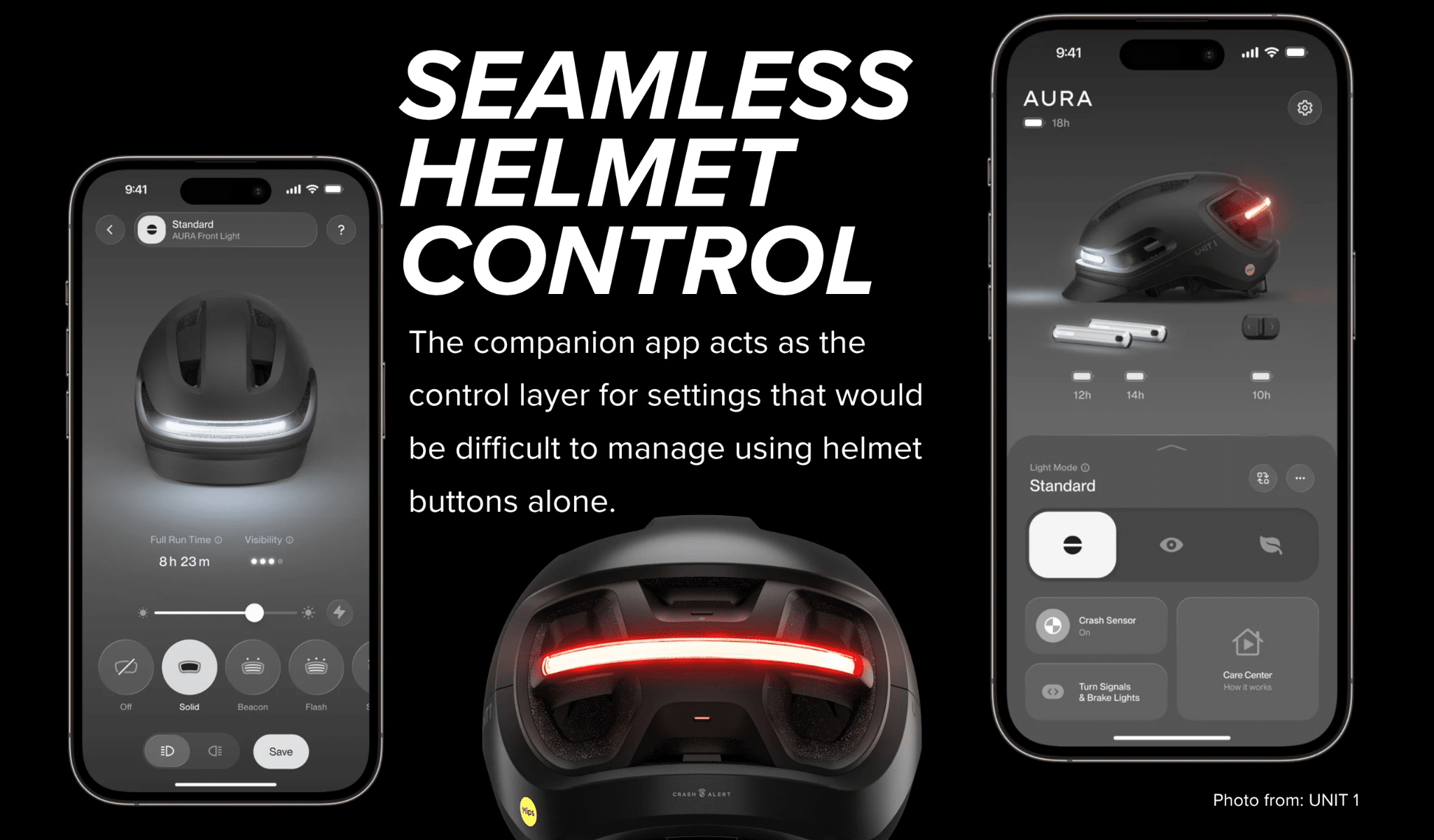
Once a helmet includes sensors, customizable lights and connected accessories, physical buttons alone become limiting.
A companion app can handle battery information, light modes, crash-alert settings and connected accessories from one interface. It also provides the link between a helmet-mounted sensor and services on a smartphone, such as location and SMS communication.
Bluetooth normally provides the short-range connection between the helmet and phone. The phone then handles functions requiring a wider network.
There is a trade-off. Connected features introduce batteries to charge, firmware to maintain and permissions to configure. Anyone buying a smart helmet should therefore ask a simple question for each feature: does it still provide value when I use the helmet every day?
What to Check Before Buying a Smart Helmet
A long feature list can make comparison difficult, so start with the helmet rather than the electronics.
Check the certification for your riding environment first. In the US, look for CPSC compliance. Riders using faster e-bikes may also encounter NTA 8776, a helmet standard developed for S-EPAC riders and higher-speed e-bike use. UNIT 1’s AURA and NEON currently carry NTA 8776 alongside CPSC and EN 1078 certifications.
Fit comes next. Even a highly rated helmet needs to sit correctly and remain securely positioned.
Only then consider the electronic layer: where the lights are positioned, which functions require a separate remote, how long the battery lasts under your preferred settings, what happens if your phone disconnects, and whether crash alerts require the app to remain active.
A smart helmet is best understood as several systems sharing one shell. The impact liner and MIPS layer address forces during a crash. Sensors recognize movement. LEDs improve visibility and communicate riding behavior. Bluetooth connects the helmet to a phone, and software can turn a detected event into an alert.
Once those functions are separated, the technology becomes much easier to evaluate. The useful question is no longer whether a helmet is “smart.” It is which parts of the system will actually improve the way you ride.