

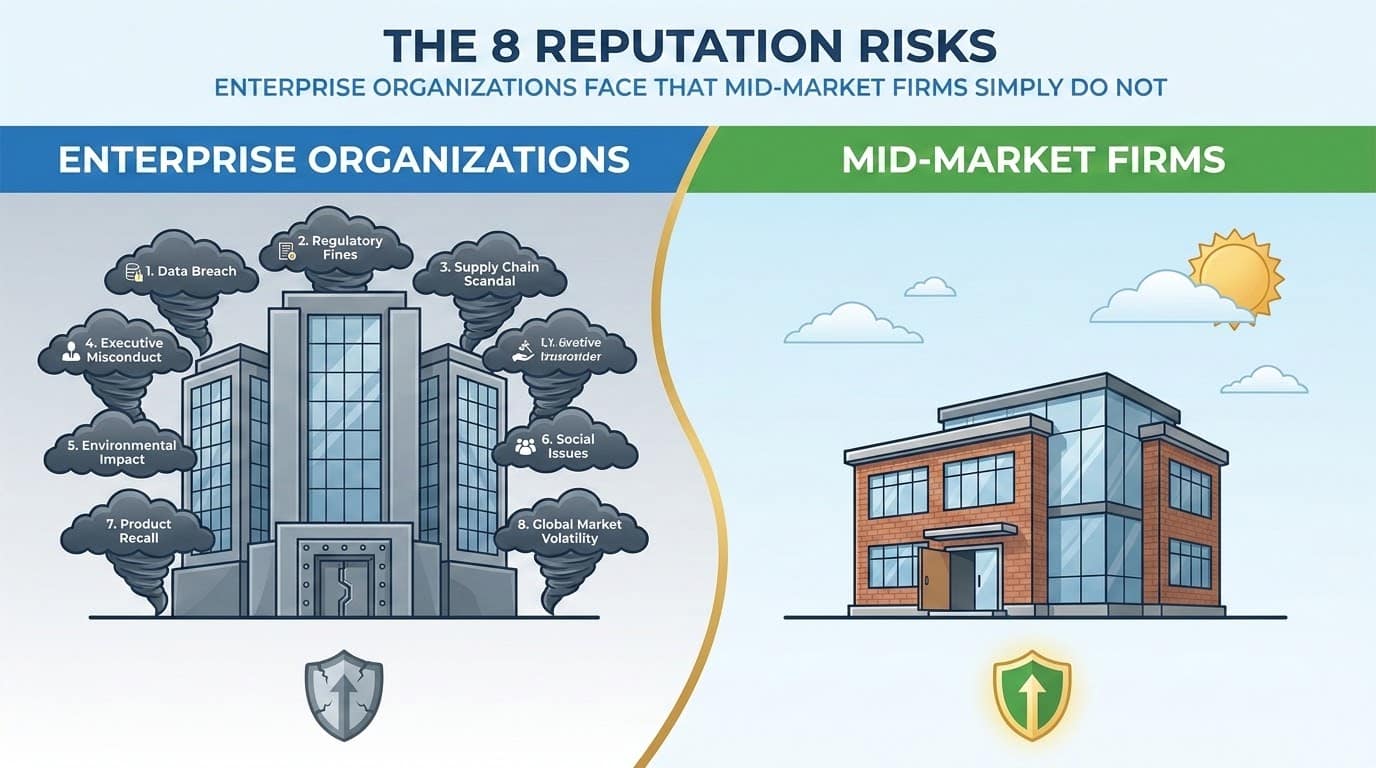
A single misstep can trigger global reputational fallout for enterprise giants, while a mid-market firm in the same situation barely registers a blip. The disparity is not a coincidence. Enterprise reputation management operates at a scale where local issues become international crises, and the tools, strategies, and stakes involved are categorically different from anything a smaller organization faces.
These are the eight reputation risks unique to enterprise organizations, and why mid-market firms simply do not face them at the same level.
Risk 1: Global Media Scrutiny Amplification
Multinational enterprises receive around-the-clock coverage from more than 500 global outlets. A minor issue becomes an international story within hours. Mid-market firms typically deal with local or regional press, which limits both reach and lasting damage.
Outlets like Reuters, Bloomberg, and the BBC constantly track businesses. A single executive comment can spark worldwide headlines by the end of the day. The United Airlines passenger incident in 2017 generated 1.8 billion Twitter impressions in 48 hours and wiped out $1.4 billion in market cap. A regional bakery with a complaint might generate 100 local mentions and move on.
How Coverage Speed Creates Disproportionate Risk
The gap in media exposure is structural, not situational.
| Enterprises | Mid-Market Firms | |
|---|---|---|
| Coverage Speed | Instant via CNN, WSJ | 24-48 hours via local TV |
| Audience Reach | 1B+ global, 24-hour cycle | 10K local, weekly cycle |
| Impact Duration | Months of scrutiny | Days at most |
Boeing’s 737 MAX issues drew five years of coverage and cost the company roughly $20 billion. Mid-market firms rarely face prolonged brand damage of that magnitude. Monitoring tools range from Google Alerts for basic tracking to Meltwater ($10K+ per year) and Talkwalker ($5K+ per year) for enterprise-level sentiment analysis.
Risk 2: High-Profile Executive Misconduct
C-level scandals cause an average 22% stock drop within 24 hours, according to a 2022 University of Chicago Booth study. In enterprise organizations, executive behavior is inseparable from corporate brand identity. A local executive’s poor decision might fade in a week. An enterprise CEO’s misstep becomes a shareholder event.
The reason the exposure is so much greater is that enterprise executives function as brand proxies. Their statements, social media activity, and personal conduct are treated as organizational positions. Elizabeth Holmes and the Theranos collapse generated billions in lost valuation and millions of media impressions. The reputational harm outlasted the company itself.
| Case Study | Key Impact |
|---|---|
| Enron | Stock value fell to near zero amid executive fraud |
| VW Dieselgate | The CEO faced legal consequences and billions in fines |
| Uber under Kalanick | CEO was removed after a toxic culture was exposed, and the valuation hit |
Prevention requires executive social media training, background vetting through services such as LexisNexis, and personal reputation insurance policies from providers such as Chubb. Regular audits of C-suite digital footprints prevent small errors from escalating into regulatory investigations or shareholder lawsuits.
Risk 3: Supply Chain Partner Failures
Enterprise supply chains span more than 1,000 vendors across 50+ countries. That creates roughly 10 times the reputational vulnerability compared to a mid-market firm running a single-supplier model. When a partner fails, the enterprise owns the headline.
The four cases that define this risk are well documented:
- Boeing and Spirit AeroSystems: Production flaws at the supplier triggered massive delays and quality failures that damaged Boeing’s reputation for years
- Apple and Foxconn: Reports of poor working conditions led to boycotts and eroded consumer trust in Apple’s ethical positioning
- SolarWinds: A compromised vendor update affected thousands of enterprises, exposing the cascading risk of partner-based cybersecurity threats
- Nike sweatshop exposures: Revelations of exploitative labor practices sparked activist pressure and long-term reputational harm
Vendor Risk Assessment Framework
A structured vendor scorecard helps quantify risk before incidents occur. Weight factors: ESG score at 40%, financial stability at 30%, and cybersecurity posture at 30%. Tools like RiskMethods and Prevalent automate this analysis for complex global supply chains.
The 15-point vendor due diligence checklist should cover financial statements, ESG performance, cybersecurity protocols, regulatory compliance records, labor practices, governance issues, anti-corruption measures, sanctions compliance, data privacy plans, intellectual property protections, contract dispute history, environmental impact, DEI initiatives, litigation exposure, and media reputation.
Risk 4: Regulatory Non-Compliance Fines
Enterprises paid $14 billion in global regulatory fines in 2023, averaging $23 million per incident. SMEs average $50,000. Large enterprises operate under more than 100 jurisdictions simultaneously, and the rules across those jurisdictions frequently conflict.
HSBC’s $1.9 billion money laundering fine in 2012 and Google’s $5 billion antitrust penalty in 2018 are not outliers. They reflect the structural reality of operating at a global scale. The reputational damage from those headlines often outlasts the financial hit.
How Jurisdictional Complexity Creates Unique Exposure
| Regulation | Jurisdiction | Key Fine Details |
|---|---|---|
| GDPR | EU, extraterritorial | 4% revenue cap, avg $20M |
| CCPA | California only | $7,500 per violation |
| FCPA | US, global reach | Unlimited, avg $50M |
| PIPL | China | Up to 50M RMB |
| SEC | US | $2M per day possible |
The EU issued more than 1,200 GDPR fines totaling $2.1 billion in 2023 alone. Meta’s $1.3 billion fine that year came despite its US base. Mid-market firms face mostly regional oversight with far simpler compliance obligations.
Mitigation requires cross-border Data Protection Officers, compliance clauses in third-party contracts, annual training with documented completion rates, and automated scanning tools for ongoing audits. Platforms like NAVEX Global and MetricStream handle compliance tracking at enterprise scale.
Risk 5: Activist Shareholder Campaigns
Activist campaigns against S&P 500 firms rose 25% in 2023, forcing governance changes at roughly 15% of targeted companies. Mid-market firms rarely attract this kind of investor pressure. Enterprise organizations do so because the stakes are high enough to justify a campaign.
Enterprise reputation management in this context means tracking shareholder sentiment before a campaign materializes, not after. Engine No. 1 forced major board changes at Exxon and redirected $40 billion toward cleaner energy. BlackRock applies ESG pressure across its portfolio. Norges Bank uses divestment as a reputational signal.
The Disney vs. Nelson Peltz proxy fight cost $1 billion and exposed Disney to months of public scrutiny over leadership and strategy. That kind of fight tests every layer of a company’s crisis communication infrastructure.
Preparation starts with quarterly tracking of shareholder sentiment using tools like Dataminr, a documented IR crisis playbook with a 7-day response protocol, and board-level engagement on ESG and DEI initiatives before activists frame the narrative.
Risk 6: Data Breach Catastrophe Scale
Enterprise breaches cost an average of $4.88 million, compared to roughly $25,000 for small and medium businesses, according to IBM’s 2024 report. Recovery typically takes 60 days. The reputational damage, particularly the loss of stakeholder trust, often extends far longer.
Equifax exposed 147 million records and saw its stock drop 35%. Marriott’s breach affected 500 million guests and resulted in a $118 million fine. Target’s compromise of 110 million cards led to a $300 million settlement. The scale of exposure at the enterprise level has no mid-market equivalent.
Scale vulnerabilities specific to enterprises include legacy systems prone to known exploits, multi-cloud complexity that expands the attack surface, and nation-state threat actors that target high-value enterprise data.
Breach Response Timeline
| Timeframe | Key Actions | Reputation Impact |
|---|---|---|
| 0-24 Hours | Detect, isolate breach, notify internal teams | Contain damage, prevent escalation |
| 24-48 Hours | Assess scope, engage forensics experts | Maintain stakeholder trust |
| 48-72 Hours | Notify regulators and customers, issue a public statement | Avoid media amplification |
| 72+ Hours | Remediate, communicate recovery plan | Begin reputation recovery |
The first 72 hours determine how the story gets told. Tools like Darktrace for anomaly detection and CrowdStrike Falcon for endpoint protection support faster response times.
Risk 7: ESG Backlash from Stakeholders
Enterprise organizations face ESG backlash at a scale mid-market firms rarely encounter. The reason is visibility. Large enterprises operate publicly, report to institutional investors, and simultaneously attract scrutiny from activist groups, regulators, and the media.
ESG backlash refers to reputational and financial harm that results when an organization’s environmental, social, or governance practices fail to meet stakeholder expectations. Each of the three pillars carries distinct risks.
On the environmental side, the BP oil spill demonstrated that a single incident can trigger long-term stakeholder outrage and regulatory penalties across multiple jurisdictions.
On the social side, the Facebook Cambridge Analytica scandal showed how data mishandling erodes public trust on a global scale. On the governance side, Wells Fargo’s fake-account scandal damaged stakeholder trust due to direct executive misconduct and failures in internal controls.
Firms like NetReputation, which work across corporate reputation cases, consistently flag ESG issues as among the most difficult to remediate because they involve systemic perceptions rather than single incidents. Tools like Sustainalytics and RepRisk provide ongoing ESG risk monitoring. Remediation involves net-zero roadmaps, DEI audits, and whistleblower response protocols backed by genuine transparency.
Risk 8: Brand Sabotage by Competitors
Competitor-sponsored review campaigns damage enterprise brand scores in measurable, documented ways. Large enterprises face this threat more than mid-market firms because the competitive stakes are higher and the target is more visible.
Brand sabotage is the deliberate use of disinformation, fake reviews, or coordinated campaigns to damage a competitor’s online reputation. Common tactics include:
- Review bombing: Flooding review platforms with fake negative feedback (Uber faced 15,000 fake reviews in one coordinated campaign)
- Astroturfing: Creating fake grassroots movements using bots, as seen in Volkswagen’s Dieselgate denial campaign
- Executive doxxing: Releasing personal information on C-suite leaders to incite public backlash
- Fake ESG reports: Publishing fabricated sustainability data to undermine social responsibility credibility
Detection Tools and Legal Countermeasures
Three platforms support early detection of coordinated sabotage: Fakespot for free review authenticity analysis, ReviewMeta for detailed breakdowns by subscription, and BrandThreat for enterprise-level monitoring with advanced anomaly alerts.
On the legal side, the Lanham Act addresses unfair competition and provides for significant awards. DMCA takedowns remove fabricated content efficiently. The Peloton vs. Bowflex case illustrates the pattern: Bowflex released a video that sabotaged Peloton treadmills, gained massive views, and forced Peloton into a reactive crisis-communication response that drew sustained media scrutiny.
The brands that recover fastest from sabotage are the ones that had detection systems running before the attack started, not after. Building legal teams, integrating detection tools into existing enterprise risk management frameworks, and maintaining transparent stakeholder engagement are what separate brands that absorb the hit from those that get defined by it.